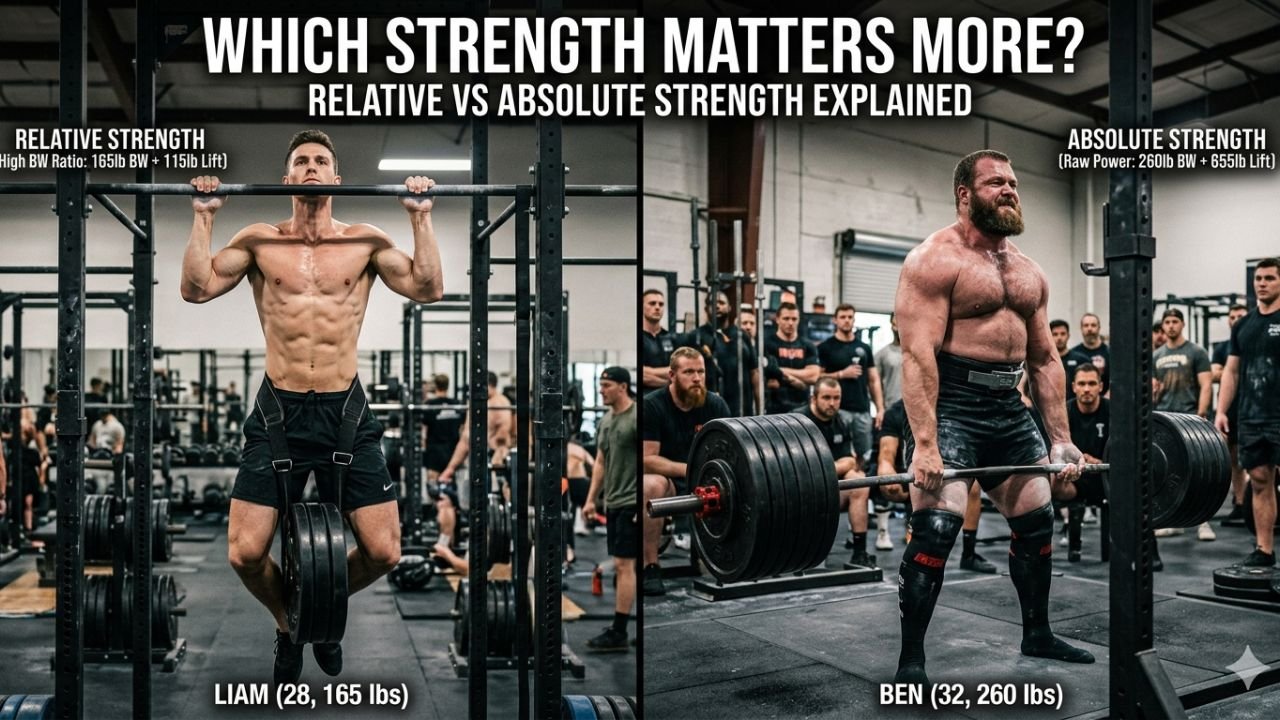
Let me ask you something. Have you ever seen a 150-pound guy at the gym lifting more than someone twice his size and walked away genuinely impressed?
Or maybe you’ve wondered why a powerlifter who squats 500 pounds struggles to do a simple pull-up?
That’s not a weird coincidence. That’s the difference between relative strength and absolute strength, and understanding this concept might be the missing piece in your fitness journey.
Whether you’re a beginner trying to figure out where to start, an athlete chasing peak performance, or just someone who wants to look and feel strong, this article is going to break it all down for you. No complicated science. No confusing jargon. Just real talk about what these two types of strength actually mean and which one you should be training for.
Let’s get into it.
What Is Absolute Strength?
Absolute strength is exactly what it sounds like: the total amount of force your muscles can produce, regardless of your body weight.
Think of it this way. If a guy who weighs 300 pounds deadlifts 600 pounds, his absolute strength is 600 pounds. That’s it. That’s the number. No math needed.
Absolute strength is the raw power output of your body.
This is the kind of strength that gets celebrated at powerlifting competitions, World’s Strongest Man events, and Olympic weightlifting stages. It’s impressive. It’s visible. And it’s real.
Examples of Absolute Strength in Action
- A powerlifter squatting 700 pounds
- A strongman competitor flipping a 400-pound tire
- A football lineman pushing opponents off the line of scrimmage
- A construction worker lifting heavy beams all day long
In sports or activities where the actual weight you can move matters, not your body weight, absolute strength is king.
What Is Relative Strength?
Relative strength is where things get really interesting.
Relative strength is how strong you are compared to your own body weight. It’s the ratio of your strength to your size. And honestly, for most people living everyday life, this is the more meaningful number.
Here’s a simple way to think about it. If a 150-pound person deadlifts 300 pounds and a 250-pound person deadlifts 350 pounds, who is relatively stronger? The lighter person because they’re lifting twice their body weight, while the heavier person is lifting only 1.4 times theirs.
Relative strength = your strength divided by your body weight.
Examples of Relative Strength in Action
- A gymnast holding an iron cross on the rings
- A rock climber pulling their body up a sheer cliff face
- A martial artist generating explosive power despite being lightweight
- You being able to do 15 clean pull-ups
Relative strength matters enormously in sports where you have to move your own body, such as gymnastics, climbing, wrestling, MMA, sprinting, and even everyday activities like carrying groceries up the stairs or lifting your kid over your head.
The Key Differences Between Relative and Absolute Strength
Let’s put them side by side so you can really see the contrast.
|
Feature |
Absolute Strength |
Relative Strength |
|
Definition |
Total force output |
Strength per unit of body weight |
|
Measurement |
Max weight lifted |
Weight lifted ÷ body weight |
|
Who benefits most |
Powerlifters, strongmen, football players |
Gymnasts, fighters, climbers, and general fitness |
|
Body weight impact |
Doesn’t factor in |
Directly factors in |
|
Key exercises |
Heavy barbell lifts |
Bodyweight movements, scaled lifts |
Both are real. Both are valuable. But they serve different purposes, and your goal determines which one deserves more of your attention.
Why Most People Confuse the Two
Here’s a scenario that plays out in gyms every single day.
A big guy walks in, loads up the bench press, and pumps out 225 pounds. Everyone nods in respect. Then a smaller, leaner guy sits down and puts up 185 pounds. People barely notice.
But here’s the thing: if the big guy weighs 240 pounds and the lean guy weighs 155 pounds? The lean guy is actually the stronger one, relatively speaking. He’s benching 1.19 times his body weight. The big guy is only benching 0.94 times his body weight.
We’re wired to be impressed by big numbers. And that’s okay, absolute strength is genuinely impressive. But don’t confuse being big with being strong in every meaningful sense of the word.
Which Type of Strength Should YOU Train For?
This is the real question, right? And the honest answer is: it depends on your goals. But let me help you figure out which one fits your life.
Train for Absolute Strength If…
You should focus on building absolute strength if:
- You compete in powerlifting, Olympic weightlifting, or strongman
- You play sports where raw force matters (football, rugby, shot put)
- Your job requires physically moving heavy loads
- Your main goal is to get as strong as humanly possible, period
- You don’t mind gaining body weight in the process
How to train for it:
- Focus on compound lifts: squat, deadlift, bench press, overhead press
- Train in lower rep ranges (1–5 reps) with heavy weight
- Prioritize progressive overload, always aim to add more weight over time
- Eat enough to support muscle growth (usually a caloric surplus)
- Rest longer between sets (2–5 minutes) so you can lift heavy again
Train for Relative Strength If…
You should prioritize relative strength if:
- You’re an endurance athlete or play sports where you carry your own body
- You do martial arts, gymnastics, rock climbing, or CrossFit
- You want to lose fat while maintaining or building strength
- You care about how your body functions, not just how much you can lift
- You want that lean, athletic look, strong but not bulky
How to train for it:
- Master bodyweight movements: pull-ups, push-ups, dips, pistol squats
- Use moderate rep ranges (5–12 reps) with controlled technique
- Keep your body weight in check; extra fat hurts relative strength
- Focus on strength-to-weight ratio improvements, not just raw numbers
- Add skill-based movements that challenge control and coordination
Can You Train for Both? (Spoiler: Yes, You Can)
Great news, these two types of strength aren’t enemies. You don’t have to choose one and completely ignore the other. In fact, the best training programs balance both.
Think about elite sprinters. They need explosive absolute power to drive off the blocks, but they also need exceptional relative strength to accelerate their own body weight at insane speed. Or consider MMA fighters, they need to be absolutely strong enough to move an opponent and relatively strong enough to control their own body in complex positions.
A balanced approach looks something like this:
- 2–3 days of heavy compound lifting (building absolute strength)
- 1–2 days of bodyweight or skill work (building relative strength)
- Smart nutrition that supports performance without unnecessary fat gain
- Regular assessment of both your max lifts AND your bodyweight movement quality
Real-Life Examples That Put This Into Perspective
The Gymnast vs. The Powerlifter
A male gymnast might weigh 155 pounds and be able to hold a planche, a movement that requires extraordinary relative strength and body control. Put that same gymnast under a 500-pound barbell, and he’ll struggle. Put the powerlifter on the rings and… well, let’s just say it won’t be pretty.
Neither is “more fit.” They’ve simply trained for different demands.
The Everyday Dad
Here’s one that hits closer to home. A regular guy who weighs 185 pounds and can do 15 pull-ups, carry his 60-pound kid on his shoulders, move furniture without throwing out his back, and run around the backyard without getting winded?
That’s excellent relative strength. And for most people’s actual lives, that’s exactly what matters.
Practical Tips to Improve Both Types of Strength
No matter which direction you’re leaning, here are some practical tips that will serve you well:
For building absolute strength:
- Never skip the big three: squat, deadlift, bench press
- Sleep 7–9 hours, your muscles grow while you rest
- Track your lifts, so you know when you’re progressing
- Don’t ego-lift. Proper form always beats a heavier weight done wrong
- Work with a coach or experienced training partner at least occasionally
For building relative strength:
- Master the basics before trying advanced moves (nail pull-ups before muscle-ups)
- Train your core; everything in relative strength ties back to core stability
- Don’t bulk mindlessly. Extra body fat is dead weight
- Add isometric holds to your training; they build incredible tension and control
- Be patient. Relative strength takes time, but the results are remarkable.
For both:
- Eat enough protein (aim for 0.7–1g per pound of body weight)
- Be consistent above all else; a good plan followed consistently beats a perfect plan followed occasionally.
- Deload every 4–6 weeks to let your body recover and come back stronger
How to Measure Your Progress
You can’t improve what you don’t track. Here’s how to keep tabs on both types of strength:
Measuring absolute strength:
- Track your 1-rep max (1RM) on key lifts every 8–12 weeks
- Note the total weight lifted in a session (volume)
Measuring relative strength:
- Calculate your lift ÷ body weight ratio (e.g., squat 225 lbs ÷ 180 lbs bodyweight = 1.25x)
- Track max reps of bodyweight movements (pull-ups, push-ups, dips)
- Use benchmark workouts and retest them every month or two
Seeing both numbers improve over time is one of the most satisfying things in fitness. Trust me.
Frequently Asked Questions
Is relative strength more important than absolute strength for weight loss?
When it comes to weight loss, relative strength is generally more relevant. As you lose body fat, your strength-to-weight ratio often improves even if your absolute numbers don’t shoot up dramatically. The goal is to maintain or build muscle while reducing unnecessary body fat, which naturally boosts your relative strength over time.
Which type of strength is better for athletic performance?
It truly depends on the sport. Sports where you move external objects (powerlifting, football, shot put) reward absolute strength. Sports where you move your own body (gymnastics, climbing, sprinting, martial arts) reward relative strength. Most team sports and combat sports benefit from a smart balance of both.
Can a beginner improve both relative and absolute strength at the same time?
Absolutely, and beginners actually have a huge advantage here. In the early stages of training (often called the “newbie gains” phase), your body responds rapidly to almost any consistent training stimulus. You’ll likely see improvements in both your raw lifts and your bodyweight movement ability simultaneously. Enjoy it while it lasts!
Does body weight always matter for relative strength?
Yes, body weight is the core variable in relative strength. This is why two athletes with the same bench press number can have very different levels of relative strength depending on their body weight. Carrying unnecessary fat is essentially carrying extra weight that gives you zero strength benefit, which is why staying lean matters for relative strength athletes.
How do I know if I have good relative strength?
A decent benchmark for men: being able to do 10+ clean pull-ups, squat 1.5x your body weight, and deadlift 2x your body weight. For women, the standards shift slightly, but the principle is the same. If you can move your body efficiently and lift a respectable weight relative to your size, you’re in solid shape.
Conclusion
Here’s the bottom line: both relative strength and absolute strength are real, valuable, and worth developing. Neither is “better” in an absolute sense. What matters is what you need from your body.
If you want to compete in strength sports or work a physically demanding job, chase that absolute strength. If you want to move better, look leaner, perform athletically, or just feel great in your own skin, relative strength deserves your attention.
And honestly? Most of us should be training for a healthy dose of both.
Don’t get too caught up in the numbers game. What matters most is that you show up consistently, train smart, eat well, and keep improving. The strength, in whatever form you need, will follow.
Now go lift something. You’ve got this.