Let me guess, you just started squatting, and you’re already wondering, “How fast should I be getting stronger?”
Or maybe you’ve been training for a year, and you’re frustrated because your numbers aren’t going up the way you expected. You see someone on YouTube squatting 300 pounds and think, “Am I doing something wrong?”
You’re not alone. Squat progression is one of the most searched and most misunderstood topics in fitness. Everyone wants to know what’s realistic, not the crazy numbers from elite powerlifters, but what a normal person can actually expect, month by month, based on where they’re starting.
This guide is going to break that down honestly. No hype. No “gain 100 pounds in 30 days” nonsense. Just real, practical expectations that will keep you motivated and on the right track, whether you picked up a barbell for the first time last week or you’ve been training for a few years.
Let’s get into it.
First, Let’s Talk About What “Squat Progression” Actually Means
Squat progression simply means getting better at squatting over time. That could mean:
- Lifting more weight
- Doing more reps with the same weight
- Moving with better form and less effort
- Recovering faster between sessions
Most beginners only think about the weight on the bar. But real progress is a combination of all of the above. A beginner who goes from squatting with shaky form to squatting smoothly with 20 more pounds? That’s massive progress, even if it doesn’t look flashy on paper.
The Factors That Affect Your Squat Progression
Before we get into numbers, you need to understand that not everyone progresses at the same speed. Your squat gains depend on:
- Your Training Age: Are you brand new to lifting, or have you been at it for years? Beginners gain strength much faster than advanced lifters. This is called “newbie gains,” and it’s very real.
- Your Body Weight and Structure. Heavier people often move more weight early on. Taller lifters with longer femurs may find squatting more challenging mechanically. Your anatomy plays a role.
- Your Program: Following a structured program makes a huge difference. Random workouts without progressive overload will get you nowhere.
- Nutrition and Sleep: You don’t build strength in the gym, you build it while you sleep and eat. Skimping on protein or sleeping five hours a night will absolutely kill your progress.
- Consistency. Someone who squats three times a week for six months will destroy the progress of someone who squats once a week, takes two weeks off, trains again, etc.
Realistic Squat Progression: Month-by-Month Breakdown
Now here’s what you actually came for. Let’s break this down by experience level.
Beginner Squat Progression (0–6 Months)
If you’ve never squatted before, or you’re in your first few months of serious training, congratulations. This is the golden era. Your body responds to almost everything, and your strength will go up fast.
What to Expect:
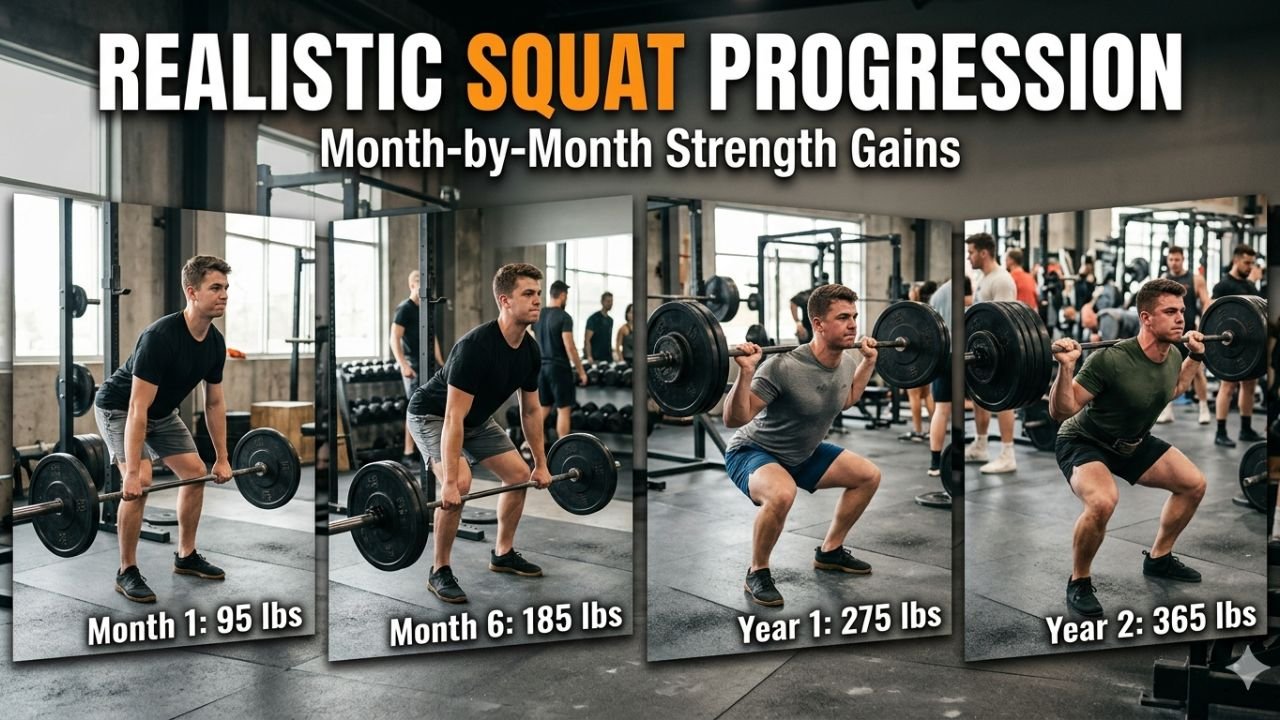
- Month 1: You’re learning the movement. Your first goal is form, not weight. Most beginners start with bodyweight squats or a very light bar (45 lbs). Don’t ego-lift here; a solid squat with 65 lbs beats a dangerous squat with 135 lbs every time.
- Month 2: Once your form is solid, you can start adding weight. Many beginners can add 5–10 lbs per session on squats during this phase. On a program like StrongLifts 5×5, it’s totally normal to go from 45 lbs to 95–115 lbs in just a few weeks.
- Month 3: Progress starts to slow slightly, but you’re still in fast-gain territory. You might be squatting 120–155 lbs for sets of 5, depending on your bodyweight and how consistent you’ve been.
- Months 4–6: By the end of month six, a beginner male might be squatting around 135–185 lbs for multiple sets. A beginner female might be at 85–125 lbs. These are general ranges, don’t stress if you’re slightly above or below.
Real-Life Example: Marcus, 28 years old, 175 lbs, started squatting in January with just the bar. By June, he was hitting 185 lbs for 3 sets of 5. He followed StrongLifts 5×5, ate around 180g of protein per day, and slept 7–8 hours. Nothing magical, just consistency.
Beginner Tips:
- Focus on form over everything
- Add weight in small increments (5 lbs at a time)
- Squat at least 2–3 times per week
- Film yourself to check your depth and back position
Intermediate Squat Progression (6 Months – 2 Years)
Welcome to the stage where things get real. You can’t just add weight every session anymore. Progress slows down, and that’s completely normal. This phase requires smarter programming.
What to Expect:
- Months 6–9: You’re transitioning out of beginner gains. Weekly progression becomes your new goal. Aim to add 5–10 lbs per week if your program allows it.
- Months 9–12: By your first anniversary of training, a consistent male lifter might be squatting 225–265 lbs. A female lifter might be at 135–165 lbs. Again, this assumes solid consistency and nutrition.
- Year 1 to Year 2: Progress slows further. Monthly gains of 5–15 lbs are realistic. Some months you might not gain anything, and that’s okay. Plateaus are part of the journey.
Common Intermediate Mistake: Jumping into an advanced program too early. A lot of people at this stage start doing 5-day splits or overly complicated programs. You’ll often do better sticking to proven intermediate programs like GZCLP, Texas Method, or PHUL.
Intermediate Tips:
- Switch to weekly progression instead of session-based
- Start paying attention to volume (total sets and reps)
- Add accessory work like Romanian deadlifts, leg press, and Bulgarian split squats
- Deload every 4–6 weeks to let your body recover
Advanced Squat Progression (2+ Years)
At this stage, you’ve put in the work. You know what you’re doing, and your body is much harder to stimulate. Progress is slower, but every pound you add is earned.
What to Expect:
- Year 2–3: Monthly gains of 5–10 lbs. Some months, zero. You’re playing the long game now.
- Year 3–5: Progress might come in the form of 5–10 lb improvements over several months. Advanced lifters sometimes run full periodization cycles (8–16 weeks) to hit a new personal record.
- Long-Term Standards (for males):
- Intermediate: 1.5x bodyweight squat
- Advanced: 2x bodyweight squat
- Elite: 2.5x+ bodyweight squat
- Long-Term Standards (for females):
- Intermediate: 1x bodyweight squat
- Advanced: 1.5x bodyweight squat
- Elite: 2x+ bodyweight squat
Advanced Tips:
- Use periodization, alternating between hypertrophy, strength, and peaking phases
- Track everything: sleep, food, stress, training volume
- Consider working with a coach if you’re competing or serious about hitting big numbers
- Don’t ignore mobility, it becomes more important the heavier you go
How to Keep Your Squat Moving Forward (Practical Tips That Actually Work)
1. Use Progressive Overload Seriously
This is the number one rule of strength training. You have to give your body a reason to get stronger. That means consistently doing slightly more than last time, whether it’s more weight, more reps, less rest, or better form.
2. Don’t Skip Leg Day (Obviously)
Sounds like a joke, but it’s not. You need to squat frequently. Three times per week is ideal for beginners and intermediates. Even twice a week beats once a week.
3. Eat Enough to Grow
You cannot out-train a bad diet. If you’re eating at a large caloric deficit, your strength will suffer. A slight surplus or maintenance with high protein (0.7–1g per pound of bodyweight) is the sweet spot for most people.
4. Sleep Is a Weapon
Growth hormone is released during deep sleep. If you’re getting six hours or less consistently, you’re leaving gains on the table. Simple as that.
5. Address Weak Points
Is your squat failing at the bottom? Your quads might be weak. Failing as you stand up? Your glutes and hips need work. Targeted accessory exercises fix weak points faster than just squatting more.
6. Video Your Sets
You might think you’re hitting parallel. You’re probably not. Film yourself from the side at least once a week. It’s humbling but incredibly useful.
Signs Your Squat Progression Is on Track
Not sure if you’re doing well? Here are green flags:
- You’re adding weight or reps every 1–2 weeks (beginner) or every 2–4 weeks (intermediate)
- You finish your sessions feeling challenged but not destroyed
- Your form is improving alongside your numbers
- You’re not constantly injured or in pain
Signs Something Is Off With Your Progression
Watch out for these red flags:
- Zero progress for 6+ weeks despite consistent training
- Constant joint pain (especially knees and lower back)
- You’re always exhausted after squatting (could be overtraining)
- Your form is getting worse as the weight increases
If any of these sound familiar, take a step back. Deload, check your form, review your nutrition, and sleep more. Most plateaus have simple causes.
Frequently Asked Questions
How long does it take to squat 225 lbs (two plates)?
For a male beginner following a solid program with good nutrition, squatting two plates (225 lbs) typically takes 6–12 months. Some gifted individuals get there in 4–5 months. Some take 18 months. All of that is normal. Focus on your own timeline.
Is it normal for squat progress to stop?
Absolutely. Plateaus are a natural part of the process, especially after the beginner phase ends. The key is to identify why you’ve stalled (program, sleep, nutrition, stress) and make adjustments. Most plateaus break within 2–4 weeks of targeted changes.
Should I squat every day to progress faster?
Not necessarily. Daily squatting works for some advanced athletes using specific programs (like the Bulgarian Method), but for most beginners and intermediates, 2–3 times per week with proper recovery gives better results. More is not always more.
How much can a natural lifter realistically squat?
With years of dedicated training, a natural male lifter can realistically hit a 1.75–2.5x bodyweight squat. For females, 1.5–2x bodyweight is an impressive and realistic long-term goal. These numbers take years to achieve, and that’s totally fine.
Does squat form really matter that much?
More than almost anything else. Poor form doesn’t just slow your progress; it gets you injured. A knee injury from bad squat mechanics can set you back months or even years. Learn it right from the start. Watch videos, get feedback, and be patient with the technique.
Conclusion
Here’s the truth: squat progression looks different for everyone.
Some people hit 225 lbs in six months. Others take two years. Some people plateau for weeks and then suddenly bust through. Your genetics, lifestyle, consistency, and commitment all shape your journey in unique ways.
What matters most isn’t how fast you’re progressing compared to someone else; it’s whether you are moving forward. A 5-pound personal record on a hard week is still a personal record. Showing up and squatting when you don’t feel like it still counts.
The gym rewards consistency more than anything. Keep showing up. Keep eating well. Keep sleeping. Keep adding weight, even if it’s slow. Look back at where you started three or six months ago and let that be your measuring stick.
Your squat will grow. Give it time, give it effort, and give it the respect it deserves.
Now go load that bar.