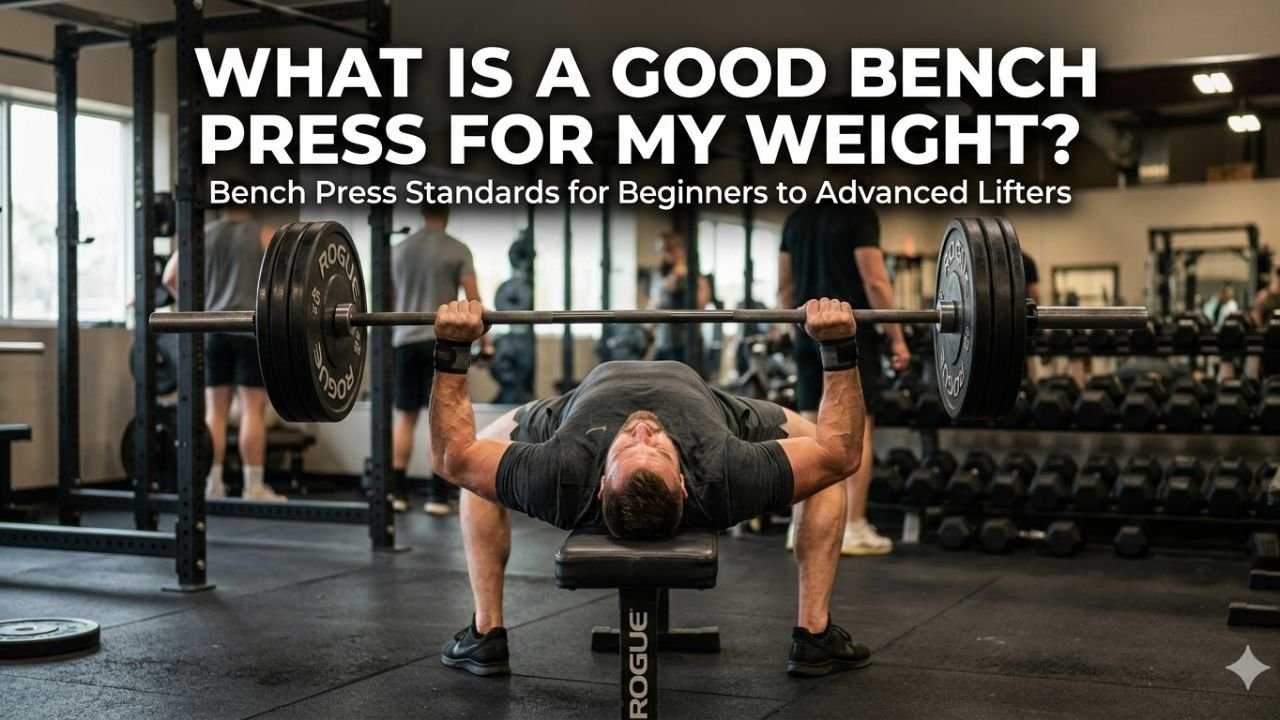
Let’s be real, walking into the gym and seeing someone load up three plates on each side is a little humbling. You start wondering: “Am I lifting enough? What should I actually be benching?”
The truth is, there’s no single magic number. A “good” bench press depends on your body weight, your training experience, and what your personal goals are. Whether you’ve been lifting for three weeks or three years, this guide breaks it all down for you, no fluff, no judgment.
Why Body Weight Matters for the Bench Press
Before we throw numbers at you, let’s quickly talk about why your body weight is the right measuring stick for the bench press.
Heavier people naturally have more muscle mass and a larger frame to support pressing movements. So comparing your raw bench press number with your friend who outweighs you by 50 pounds isn’t fair or useful.
Instead, strength coaches and sports scientists typically measure bench press performance as a multiplier of your body weight. For example, if you weigh 180 lbs and bench 180 lbs, you’re pressing 1.0× your body weight,t which is a solid intermediate milestone.
This is the same system used in powerlifting, strength research, and athletic programs around the world. It’s simple, fair, and surprisingly motivating.
Bench Press Standards by Experience Level
Here’s a general framework that most strength coaches agree on. These numbers are for men performing a single-rep max (1RM) with a full range of motion:
Beginner (Trained for less than 6 months)
- Bench press: 0.5× body weight
- Example: If you weigh 175 lbs → aim for 85–90 lbs
- At this stage, your nervous system is still learning the movement. Don’t rush it.
Novice (Trained 6 months to 1 year)
- Bench press: 0.75× body weight
- Example: 175 lbs body weight → around 130 lbs on the bar
- Gains come fast here. Enjoy it, it won’t always be this easy!
Intermediate (1–3 years of consistent training)
- Bench press: 1.0× body weight
- Example: 175 lbs → pressing your full body weight
- Pressing your own body weight is a classic milestone and a sign of solid general fitness.
Advanced (3–5+ years of serious training)
- Bench press: 1.25–1.5× body weight
- Example: 175 lbs → 215–260 lbs
- At this level, you’re in the top tier of recreational lifters. Progress is slower but deeply satisfying.
Elite (Competitive-level athletes)
- Bench press: 1.75–2.0× or more body weight
- Example: 175 lbs → 305–350+ lbs
- This is competitive powerlifting territory. Most people will never reach here — and that’s completely fine.
Bench Press Standards for Women
Women have different hormonal profiles and, on average, carry less upper body muscle mass. That doesn’t mean the bar is lower; the standards are simply adjusted to reflect physiology. Here’s a general guide for women:
|
Level |
Bench Press (× Body Weight) |
|
Beginner |
0.25–0.35× |
|
Novice |
0.45–0.55× |
|
Intermediate |
0.65–0.75× |
|
Advanced |
0.90–1.0× |
|
Elite |
1.2–1.5× |
A woman who bench presses her own body weight is genuinely strong, no asterisk needed.
Real-Life Examples to Put Things in Perspective
Sometimes the numbers alone don’t click until you see them applied to real people.
Example 1 — The Casual Gym-Goer: Jake weighs 185 lbs and has been lifting on and off for about 8 months. He can bench press 135 lbs (the standard “bar + a plate on each side”). That’s 0.73× his body weight — solidly in the novice range, and perfectly normal.
Example 2 — The Dedicated Intermediate: Priya weighs 140 lbs and has been consistently training for two years. She benches 100 lbs for a 1RM that’s 0.71× her body weight, putting her in the intermediate range for women. She should be proud of that.
Example 3 — The Powerlifter: Marcus weighs 220 lbs and has competed in powerlifting for four years. His competition bench press is 385 lbs, which is 1.75× his body weight. Elite territory.
The point? Progress looks different for everyone. The only number that truly matters is yours and whether it’s going up over time.
Practical Tips to Improve Your Bench Press
If you’re looking to push past your current level, here’s what actually moves the needle:
- Train the bench press consistently. You can’t get better at something you rarely do. Aim to bench press at least twice per week with intention.
- Nail your form before adding weight. A raw, ugly bench press limits both your progress and your safety. Learn the arch, foot drive, bar path, and scapular retraction properly.
- Train your supporting muscles. Your triceps, shoulders, and upper back all contribute to how much you can press. Include dips, overhead press, rows, and face pulls in your program.
- Eat enough to support muscle growth. You can’t build a bigger engine without fuel. A slight calorie surplus and adequate protein (0.7–1g per pound of body weight) make a huge difference.
- Sleep and recover. Muscles grow while you rest, not while you lift. Aim for 7–9 hours of sleep consistently.
- Track your progress. Keep a simple log. Seeing your numbers go up over weeks and months is the most motivating thing you can do.
Common Bench Press Mistakes to Avoid
Even experienced lifters fall into these traps:
- Bouncing the bar off your chest is cheating your reps and risking injury
- Flaring your elbows out at 90 degrees puts unnecessary strain on your shoulder joints
- Holding your breath incorrectly, learn the Valsalva maneuver for safe bracing
- Going too heavy too soon, ego lifting causes plateaus and injuries; build the foundation first
- Skipping accessory work, weak triceps, and a weak upper back are often the hidden reasons people stall
How Often Should You Test Your 1RM?
Here’s something most beginners don’t know: you don’t need to max out every week to know if you’re getting stronger.
Most coaches recommend testing your true 1RM every 8–12 weeks,s once at the end of a training cycle. In the meantime, you can estimate your max using a simple formula:
Estimated 1RM = Weight × (1 + Reps ÷ 30)
So if you bench 155 lbs for 5 reps: 155 × (1 + 5/30) = 155 × 1.167 = ~181 lbs estimated max
This keeps you progressing safely without constantly burning out your nervous system.
Frequently Asked Questions
Is benching your own body weight impressive?
Yes, absolutely, especially for someone who hasn’t been training for years. A 1.0× body weight bench press puts you firmly in the intermediate category and well above the average person who doesn’t lift. It’s a milestone worth celebrating.
How long does it take to bench press your body weight?
For most men, with consistent training and proper nutrition, it takes somewhere between 6 months and 2 years. It varies enormously depending on starting strength, body weight, program quality, and genetics. Women typically take longer to reach a 1× body weight bench since upper body strength develops differently.
Should I use a spotter when testing my max?
Yes always. Testing a true 1RM without a spotter is genuinely dangerous. If you train alone, use a power rack with safety bars set at the right height, or use the “roll of shame” as a last resort. Safety first, always.
My bench press has stalled. What should I do?
Plateaus are completely normal and happen to everyone. The most common fixes are: deload for a week, switch to a slightly different rep range (e.g., 3×5 instead of 3×8), add more volume to your triceps and upper back work, eat slightly more, and ensure you’re sleeping enough. If you’ve been stuck for more than 6 weeks, consider changing your program entirely.
Are bench press standards different for older lifters?
Yes slightly. After age 40–45, strength output tends to decline gradually due to hormonal changes and slower recovery. The same general tiers apply, but the expectations shift slightly lower as age increases. A 55-year-old man pressing 1.0× his body weight is doing exceptionally well. Consistency and injury prevention matter more than chasing numbers as you age.
Conclusion
There’s no single “good” bench press number; it all depends on you. Your body weight, training history, age, and goals. That’s what makes this such a personal journey.
What matters most is this: are you stronger this month than you were last month? Are you moving better, lifting smarter, and staying consistent? If the answer is yes, you’re doing it right.
Use the standards in this guide as a roadmap, not a judgment. Celebrate every milestone: your first 100 lbs, your first bodyweight press, your first “bro, how much do you bench?” moment. They’re all worth it.
Now load the bar. You’ve got work to do.