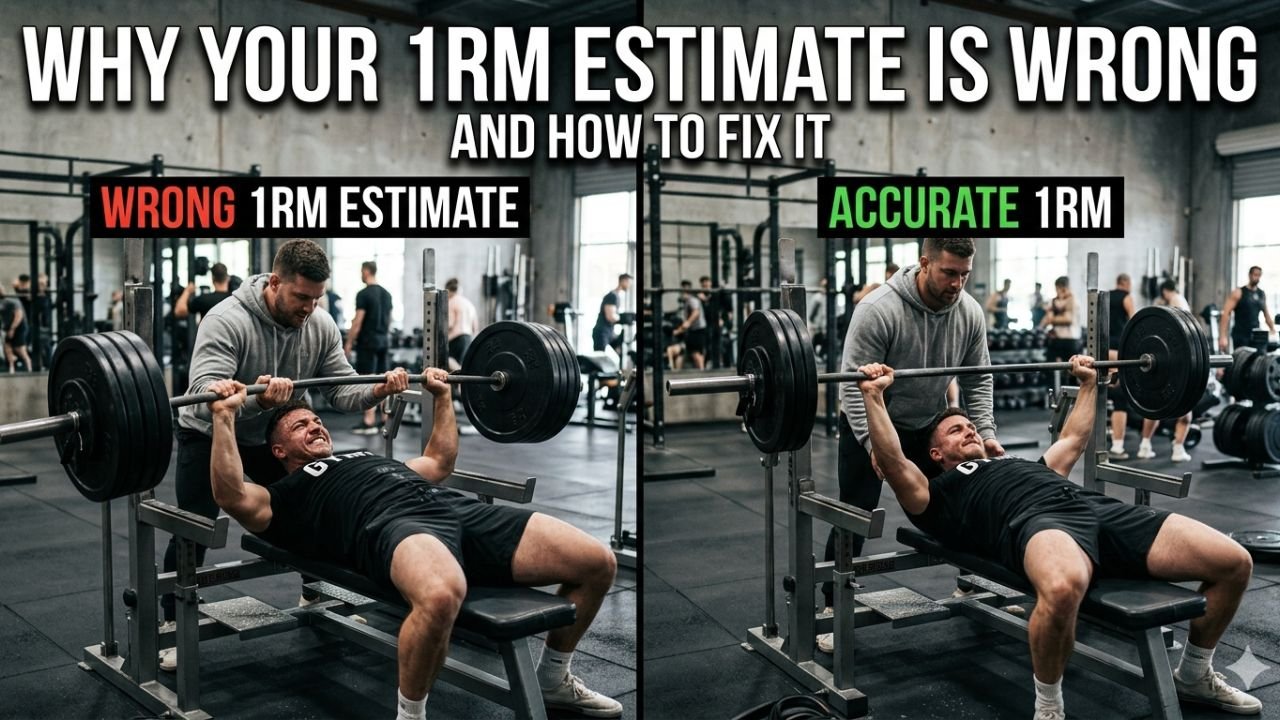
Let me ask you something: Have you ever walked up to the barbell thinking you’re about to crush a personal record, only to find out mid-lift that your estimate was completely off? Maybe you couldn’t even get the bar off the ground, or worse, you discovered you could have lifted way more than you thought.
You’re not alone.
One of the most common issues I see in gyms is lifters who have no idea what their actual one-rep max (1RM) really is. They either drastically overestimate their strength or underestimate it, which throws off their entire training program. And honestly, this happens way more often than people realize, whether you’re a beginner just starting or someone who’s been lifting for years.
Here’s the thing: your 1RM estimate isn’t just a number to brag about. It’s the foundation of your entire strength training program. Everything from your training percentages to your workout intensity depends on it. Get this wrong, and you’re essentially building your house on sand.
In this article, I’m going to break down exactly why your 1RM estimate is probably off, what mistakes you might be making, and most importantly, how to actually fix it and test your true maximum safely and effectively.
Why Your 1RM Estimate Might Be Wrong
1. You’re Relying on Online Calculators (And They’re Not Magic)
I get it. Online 1RM calculators are convenient. You plug in the weight and reps you lifted, and boom, out pops your estimated max. Simple, right?
Wrong.
These calculators use mathematical formulas to predict your 1RM based on submaximal lifts. The problem? These formulas are just estimates. They don’t account for individual differences in your physiology, technique, or how your nervous system responds to heavy loads.
Think of it this way: two people might both deadlift 300 pounds for 5 reps, but their actual maximums could be completely different. One person might be able to pull 400 pounds, while the other might top out at 360. The calculator doesn’t know this.
The most popular formula (Epley) tends to overestimate stronger lifters and underestimate newer lifters. If you’ve been relying solely on these estimates for months or years, your numbers are probably off sometimes by 20 pounds or more.
2. Technique Breakdown at Heavy Weights
Here’s something most people don’t talk about: your form changes when you’re going heavy.
Maybe you can squat 225 pounds for 8 reps with perfect form. But when you load up to a max attempt, your knees might cave inward slightly, your chest might drop forward, or your depth might get shallower. These technique breakdowns mean you’re not moving the same weight the same way, so that calculator estimate becomes even less accurate.
You might think, “Well, I’m still lifting it.” True, but you’re also increasing your risk of injury and not getting the true measure of your strength. A proper max attempt requires maintaining solid technique under maximum load.
3. Fatigue and Recovery Status Aren’t Factored In
When did you last test your 1RM? Was it after a week of heavy training, or after a proper rest day?
This matters way more than most people think.
Your nervous system needs to be fresh to attempt a true maximum. If you’re testing after a grueling workout week, you’re not seeing your true potential; you’re seeing your depleted potential. Fatigue accumulates, and even if you feel okay, your CNS (central nervous system) might not be ready to handle a true max attempt.
I’ve seen lifters add 30+ pounds to their max simply by testing after proper rest and recovery. That’s not a real strength increase; that’s them finally testing when their body was actually ready.
4. You’re Testing the Wrong Lift for Your Training Style
Not all 1RMs are created equal.
If you train primarily with variations (like paused squats, board press, or deficit deadlifts), testing your max on the competition lift might give you a number that doesn’t align with your actual training capacity. Conversely, if you only train heavy singles, your ability to grind out a tough set of 5-7 reps might be better than a calculator would suggest.
This isn’t really “wrong,” but it’s a common source of confusion. Your true max depends somewhat on what you’ve been training.
5. You Haven’t Actually Tested Properly
This is the big one: many people have never actually attempted a true max. They’ve done heavy sets of doubles or triples, but never truly maxed out.
A real max attempt requires:
- Proper warm-up progression
- Adequate rest between attempts
- Mental preparation and focus
- Perfect technique
- Actually failing (or barely making) the lift
If you’ve never gone through this process, you don’t actually know your max. You know your estimate. And estimates are often way off.
The Mistakes People Make When Testing 1RM
Cold Testing Without Proper Warm-Up
I’ve watched people walk into the gym, do a couple of arm circles, and immediately load up to what they think is their max. Then they wonder why they fail at a weight they thought they could hit.
Your muscles and nervous system need preparation. A proper warm-up gradually increases your heart rate, pumps blood to your working muscles, and prepares your CNS for heavy loads. Skip this, and you’re leaving pounds on the bar.
A solid warm-up progression might look like:
- 5-10 reps at 40% of your estimated max
- 3-5 reps at 60%
- 1-2 reps at 75%
- 1 rep at 85%
- Then attempt your max
This isn’t just for safety—it actually improves your performance.
Not Resting Enough Between Attempts
Attempting a max is taxing on your nervous system. If you wait only 2-3 minutes before your next attempt, you’re not fully recovered. You’re trying again while fatigued, which means you’re not getting an accurate reading of your true strength.
Most strength coaches recommend 5-10 minutes of rest between max attempts. This gives your nervous system time to recover and prepare for the next effort.
Testing When You’re Mentally Unprepared
Strength isn’t just physical. A huge part of hitting a max is mental. You need focus, confidence, and the right mindset.
If you’re testing while distracted, unmotivated, or in a bad headspace, you’re sabotaging yourself. This is actually a sneaky reason people’s max estimates are wrong. Their true max is higher, but they never hit it because they didn’t approach the attempt with the right mentality.
Ego Over Reality
Let’s be honest: it’s hard to admit your max isn’t what you thought it was.
Some people keep failing at their target weight, taking that as a sign they need to “just try harder,” rather than realizing maybe that weight is genuinely above their current capacity. Other people won’t even attempt a true max because they’re afraid of failing in front of other people.
This ego-driven approach leads to inaccurate estimates in both directions.
How to Test Your True 1RM (The Right Way)
Step 1: Choose the Right Day
Pick a day when you’re well-rested, fed, and feeling strong. Don’t attempt a max after a brutal training week or on a day when you’re feeling run-down.
Ideally, test on a day when you’re 48+ hours away from your last heavy lower body or upper body session (depending on what you’re testing). Your body needs to be fresh.
Step 2: Execute a Proper Warm-Up
Don’t skip this. Go through the progression I mentioned earlier:
- General warm-up (light cardio, mobility)
- Movement-specific warm-up (lighter versions of the lift)
- Progressive loading
The goal is to feel prepared and confident, not to tire yourself out.
Step 3: Make Attempts at 85%, 90%, and 95%
Before going for an all-out max, try these percentages. This serves two purposes:
First, it gives you more data points to estimate from. If 90% feels relatively easy, your max is probably closer to your higher estimates. If 90% is brutal, you know your max isn’t as high as you thought.
Second, it allows your nervous system to gradually ramp up to the heavy load without shocking it.
Step 4: Attempt Your True Max
Once you’ve done these warm-ups, you’re ready. Pick a weight that feels challenging but achievable. Your goal is to lift it with solid form.
If you’re successful, rest for 5-10 minutes and try 5-10 pounds heavier. If you fail, that’s your max (or very close to it).
Step 5: Be Honest About Form
If you hit a weight but your form completely breaks down, that’s not your real max for that lift. A true max should maintain decent technique. You might grind it out, but the movement should still be recognizable.
If your knees cave, you dump forward, or you bounce the bar excessively, that weight doesn’t count. Reset and try something lighter.
Real-Life Example: How John Fixed His 1RM Estimate
Let me tell you about John. He’d been lifting for about 3 years and thought his bench press max was 285 pounds based on some online calculators. He trained with 80% of this (around 225 pounds), and felt like he was progressing slowly.
When he actually tested his max properly with adequate warm-up, rest, and recovered from a training week, he hit 315 pounds. That’s 30 pounds higher than his estimate.
Suddenly, his entire training program needed adjustment. He’d been undertraining for months. By fixing his 1RM estimate, he actually started making better progress because his training percentages were finally accurate.
This isn’t an uncommon story. The difference this correction made for John’s progress was dramatic.
Practical Tips to Keep Your Estimates Accurate
Test every 8-12 weeks – Your max changes as you get stronger. Don’t test too frequently (you won’t see changes, and you’ll accumulate fatigue), but don’t test so infrequently that your program becomes obsolete.
Use multiple lifts as reference points – Your squat, bench press, and deadlift all give you information about your progress. If one seems out of line with the others, that one might need retesting.
Account for lift variations – If you spend most of your time doing paused squats, your max on a regular squat might be slightly higher. Keep this in mind when planning your training.
Consider a coach for your first test – If you’ve never tested a true max, having someone experienced watch your form and guide you through the process is incredibly valuable. They’ll catch form breakdown you might miss.
Don’t test when sick, injured, or sleep-deprived – You’ll get inaccurate data and increase injury risk. Wait until you’re healthy.
Frequently Asked Questions
Can I test my 1RM on a machine instead of free weights?
You can, but it’s not ideal. Free weights require more stabilization and neuromuscular coordination. A max on a machine doesn’t translate as well to free weight performance. If you must use machines, at least be aware of this limitation.
How many times can I attempt a max in one session?
Generally, 3-5 attempts is the limit before fatigue becomes a major factor. More than this, and your nervous system is just getting depleted, not getting stronger information.
I failed at my last max attempt. Does that count as my 1RM?
No. Your 1RM is the heaviest weight you successfully lifted with proper form. If you failed, you don’t have a new 1RM. But you do know that the next weight down is under your max.
My estimated max from a calculator is way different from what I actually lifted. Why?
Calculators are estimates based on formulas. They don’t account for individual differences in your neuromuscular system, technique, fatigue level, or training history. Your actual max is always more accurate than an estimate.
Can I test different lifts on the same day?
You can, but it’s better to separate them by at least a few days if possible. Testing multiple maxes in one day increases fatigue and the risk of missing out on your true max for some lifts. If you must test multiple lifts, do smaller muscle groups first.
Conclusion
Your 1RM estimate might be wrong, and that’s okay. What matters is that you fix it.
Here’s the takeaway: take a day to test your true one-rep max properly. Warm up adequately, rest between attempts, focus on solid form, and be honest about what you can actually lift. Once you know your real numbers, everything changes. Your training becomes more effective, your progress becomes more measurable, and you actually know where you stand.
Stop relying on calculators and guesses. Get in the gym, properly prepared, and find out what you’re actually capable of. You might be surprised in a good way.
Your training program is only as good as the numbers you’re basing it on. Make sure those numbers are real.