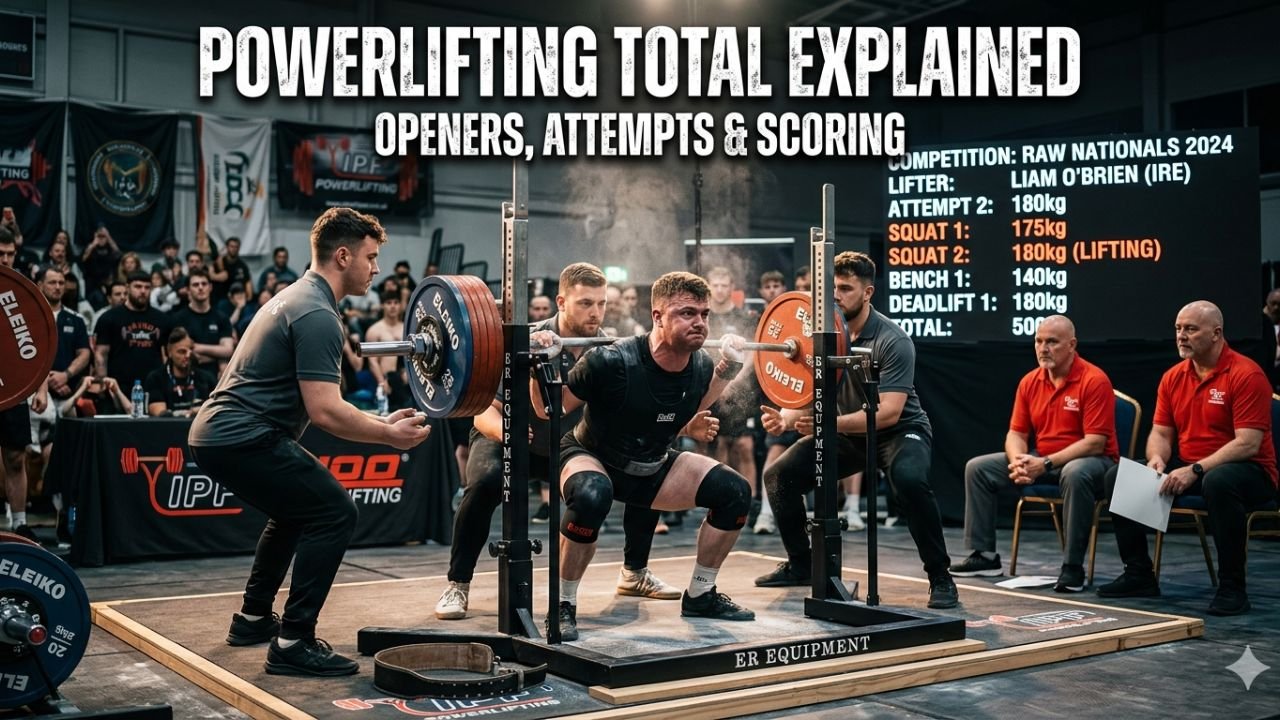
Picture this: it’s your first powerlifting meet. The room smells like chalk and determination. Your hands are shaking slightly. You’ve trained for months, maybe years. And now someone hands you a card and asks: “What’s your opener?”
If you’ve ever stared at that question with a blank face, you’re not alone.
Powerlifting is one of the most raw, honest sports in the world. No fancy equipment. No judges scoring your “style.” Just you, the bar, and gravity. But for newcomers, the system, the attempts, the scoring, and the total can feel like a whole different language.
This post is going to break it all down for you. By the time you finish reading, you’ll understand exactly how a powerlifting meet works, how the total is calculated, and how smart attempt selection can make or break your day on the platform.
Let’s get into it.
What Is the Powerlifting Total?
The powerlifting total is the single most important number in competition. It’s the sum of your best successful lift in each of the three disciplines:
- Squat
- Bench Press
- Deadlift
Simple, right? If you squat 200kg, bench 130kg, and deadlift 240kg, your total is 570kg.
That total is what determines your placement in a competition. The lifter with the highest total in their weight class wins. No extra points for looking good. No deductions for ugly technique (as long as it’s technically legal). Just the total.
But here’s where it gets interesting: getting to that total isn’t as straightforward as it sounds.
How Attempts Work in Powerlifting
Every lifter gets three attempts at each lift. That’s three chances to squat, three for bench, and three for deadlift, nine attempts total throughout the day.
Here’s the key rule: only your best successful attempt counts toward your total.
So if you squat 180kg, miss 190kg, and then hit 185kg, your squat contribution to the total is 185kg.
The Clock Is Always Ticking
At most meets, once it’s your turn, you have 60 seconds to complete the lift after the head judge gives the signal. If you’re lifting back-to-back (because you called the same weight as the person before you, or you’re “taking your own bar”), you usually get 3 minutes.
This matters. Knowing the timing rules helps you warm up properly and stay mentally sharp.
Understanding Openers: Your First Attempt
Your opener, your first attempt on each lift, is arguably the most important decision you’ll make at a meet.
Why Openers Matter So Much
Think of your opener as your foundation. A good opener:
- Builds your confidence
- Gets you on the board with a white-light (successful) lift
- Sets up your second and third attempts strategically
A bad opener, too heavy, too ambitious, can derail your entire day. If you bomb out on your opener (miss three squats, for example), you’re done. You get zero total and no official ranking.
The Golden Rule of Openers
Experienced coaches and lifters will tell you this again and again: Open with something you can hit on your worst day.
That usually means something you’ve done in training multiple times, not just once on a perfect day. Most coaches recommend opening at 85–90% of your expected max for that day.
If you’ve been training a 200kg squat, your opener should probably be somewhere around 175–182kg. Boring? Maybe. Smart? Absolutely.
Real-Life Example
Let’s say Sarah is competing for the first time. In training, her best squat is 120kg. She’s excited and tempted to open at 110kg. But her coach tells her to open at 105kg instead.
She hits 105kg easily. Now she’s relaxed, confident, and ready to push. She takes 112.5kg for her second hits it. Then goes for 117.5kg on her third hit, that too. New PR, happy athlete.
If she’d opened at 112.5kg, been nervous, and missed those whole day changes.
Second and Third Attempts: Building Your Total
Once your opener is locked in, the strategy shifts to maximizing your total without taking unnecessary risks.
Second Attempt Strategy
Your second attempt should be a weight you’re very confident about, in the 90–95% range of your expected max for the day.
After a successful opener, your body is warmed up, your nerves have settled (a bit), and you’re ready to push. This is the time to make a solid, meaningful jump.
Jumps between attempts can vary, but a common range is 5–10kg between first and second attempts for most lifters.
Third Attempt Strategy
Your third attempt is where you chase goals.
This is your shot at:
- A personal record (PR)
- A competition record (if you’re at that level)
- Or simply securing your total if your second was shaky
Here’s a key insight: the right third attempt depends on where you are in the competition and what your goal is. If you’re battling for first place and need a big deadlift, go for it. If you’ve already locked up a podium finish, maybe take a smart, confident lift instead of gambling everything on a max effort.
How Scoring Works: More Than Just the Total
For most local and national meets, the total is the score. Highest total wins in each weight class.
But powerlifting also uses more advanced scoring systems for cross-category comparisons, like comparing lifters of different body weights, ages, or genders.
The Wilks Score
The Wilks Score (and its modern replacement, the Dots Score) is a formula that adjusts your total based on your body weight. It allows organizers to crown an “overall best lifter” title across all weight classes.
For example, a 60kg lifter with a 400kg total and an 110kg lifter with a 650kg total are both impressive. The Wilks/Dots formula helps determine who performed relatively better compared to their body size.
You don’t need to memorize the formula; most met software calculates it automatically. But it’s good to know it exists.
Glossary of Terms You’ll Hear at a Meet
- White light — a judge’s signal that the lift was successful
- Red light — the lift was not successful (failed attempt)
- Good lift — at least 2 out of 3 judges gave white lights
- No lift — 2 or more red lights; attempt doesn’t count
- Bomb out — missing all three attempts on a lift; no total recorded
Common Mistakes Lifters Make With Attempt Selection
Even experienced lifters get this wrong. Here are the biggest mistakes to avoid:
1. Opening Too Heavy
The ego is powerful. But the platform has humbled plenty of strong people. Start conservative. You can always go heavier; you can’t undo a missed opener.
2. Taking Huge Jumps
Jumping from 180kg to 205kg because “you feel great” is a gamble. Big jumps between attempts increase the risk of failure and can throw off your timing and technique. Incremental, strategic jumps are almost always the better play.
3. Chasing PRs Too Early
Don’t attempt your all-time PR on your third squat if you’ve still got bench and deadlift to go. Manage your energy. A PR on squat that leaves you too fatigued to hit your best deadlift isn’t a good trade.
4. Ignoring the Rules of the Federation
Different federations (IPF, USPA, WRPF, etc.) have slightly different rules. Some require specific commands (“squat,” “rack”), some have different judging standards for depth or pause lengths. Know the rules before you step on the platform.
Practical Tips for Your First Meet
If you’re gearing up for your first competition, here are some practical takeaways:
- Practice your openers in training, lift them exactly like you’ll lift at the meet (commands, pauses, everything)
- Write down your attempt plan, know your three attempts for each lift before you walk into the venue
- Have a coach or handler, someone who can submit your attempts on time and talk you through the day
- Warm up intelligently, don’t exhaust yourself in the warm-up room; save something for the platform
- Stay hydrated and fueled; meetings can be long; bring snacks, water, and electrolytes
- Watch other lifters, especially if it’s your first time; observing the flow of the meet reduces anxiety
- Trust the process you’ve put in the work; now let it happen
Frequently Asked Questions
What happens if I miss all three attempts on one lift?
If you miss all three attempts on the squat, bench press, or deadlift, you bomb out of the competition. You receive no total and no official placing. It’s a devastating outcome, which is why conservative openers are so important.
Can I lower my attempt after submitting it?
In most federations, yes, but only up to a certain point (usually before the bar is loaded or within a specific time window). Once the bar is loaded and the clock starts, you’re committed. Always check your federation’s specific rules.
How is the “best lifter” determined if two people have the same total?
If two lifters in the same weight class tie on total, the lighter lifter wins. They achieved the same total at a lower body weight, which is considered a greater athletic achievement.
Do I have to attempt all three lifts?
Yes. To receive an official total, you must complete at least one lift in each of the three disciplines. If you skip a lift or miss all attempts in any one discipline, you don’t receive a total.
How does bodyweight factor into who wins?
Within the same weight class, bodyweight doesn’t affect the result; the highest total wins, period. Bodyweight only becomes a tiebreaker (as mentioned above) or a factor when using formulas like Wilks or Dots to compare lifters across weight classes.
Conclusion
When you understand how the powerlifting total works, how your openers set the tone, how each attempt builds on the last, and how smart strategy can add kilograms to your total without adding a pound of strength, the whole sport clicks into place.
Powerlifting isn’t just about being strong. It’s about being smart with your strength.
Your total tells a story. It’s the story of every early morning training session, every missed rep, every comeback. And on meet day, every single kilogram counts.
Whether you’re a first-time competitor trying to survive your opener or a seasoned veteran chasing a record, the principles are the same: start smart, build confidently, and leave it all on the platform.
Now go lift something heavy and make sure it counts.