Picture this. You’re standing at the barbell, chalk on your hands, heart pounding. You’ve been training for months, maybe years. And someone mentions the “two times bodyweight deadlift” like it’s some golden standard. Suddenly, you wonder: Am I there yet? Is that even a good goal?
If you’ve ever found yourself Googling deadlift standards or comparing your numbers to strangers on Reddit at midnight, you’re not alone. The deadlift is one of those lifts that people obsess over, and for good reason. It’s raw, honest, and brutally revealing about your true strength.
So, is a 2x bodyweight deadlift actually good? The short answer is yes, it’s genuinely impressive for most people. But the longer, more honest answer depends on your gender, training experience, body weight, and what you’re actually training for.
Let’s break it all down, no fluff, no confusion, just real talk about deadlift standards for men and women.
What Does a 2x Bodyweight Deadlift Actually Mean?
Before we dive into the numbers, let’s make sure we’re on the same page.
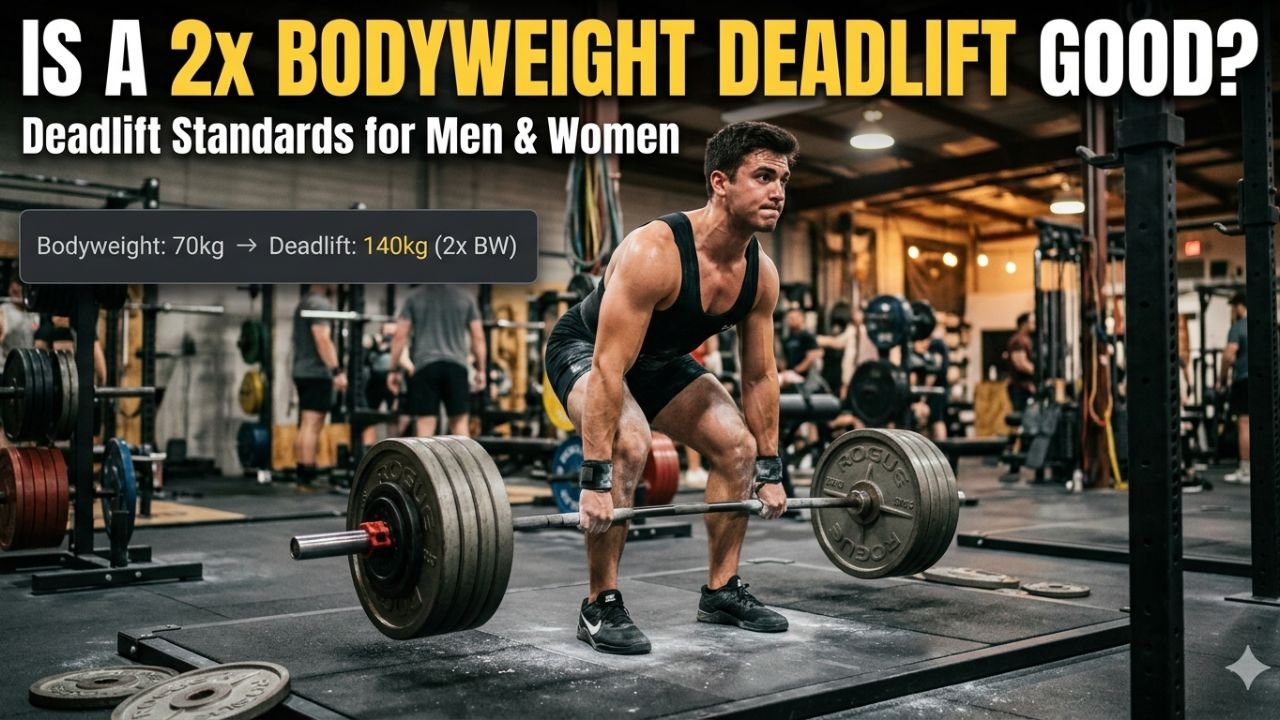
A 2x bodyweight deadlift simply means you’re lifting twice your own body weight from the floor. So if you weigh 80 kg (about 176 lbs), you’d be pulling 160 kg (352 lbs). If you’re a woman weighing 60 kg (132 lbs), we’re talking about a 120 kg (264 lbs) pull.
Sounds simple, right? But when you actually load that bar up and stand over it, those numbers become very real very fast.
The deadlift is considered by many strength coaches to be the most honest measure of total body strength. You can’t cheat gravity. Either the bar leaves the floor, or it doesn’t.
Is a 2x Bodyweight Deadlift Good? Honest Answer
Yes, a two-times bodyweight deadlift is genuinely good. In fact, for most gym-goers, it puts you well above average.
Here’s a simple way to think about it:
- Beginner: Can deadlift around 1x to 1.25x bodyweight
- Intermediate: Comfortably lifts 1.5x to 1.75x bodyweight
- Advanced: Reaches the 2x bodyweight mark
- Elite/Competitive: Pulls 2.5x bodyweight and beyond
Most people who walk into a gym never reach 2x bodyweight. Life gets busy, programming gets inconsistent, or they simply never prioritize the deadlift. So if you’ve hit that number or you’re chasing it, you’re already doing something most people aren’t.
But here’s the thing nobody tells you: the number itself isn’t the whole story. A 90 kg person pulling 180 kg is a very different athletic feat from a 60 kg person pulling 120 kg. Body mechanics, limb length, and muscle fiber composition all play a role.
So celebrate the milestone, but understand the context.
Deadlift Standards for Men: What’s Expected at Each Level?
Let’s get specific. Here’s a realistic breakdown of deadlift standards for men based on training experience. These numbers are based on commonly accepted strength standards used by coaches and platforms like Strength Level and ExRx.
Beginner Men (0–1 year of training)
- Expected range: 0.75x to 1.25x bodyweight
- Example: An 80 kg man pulling around 60–100 kg
- At this stage, learning proper form is far more important than chasing weight.
Intermediate Men (1–3 years of consistent training)
- Expected range: 1.5x to 1.75x bodyweight
- Example: An 80 kg man pulling 120–140 kg
- This is where most gym regulars land if they train consistently
Advanced Men (3+ years of focused training)
- Expected range: 2x to 2.25x bodyweight
- Example: An 80 kg man pulling 160–180 kg
- Reaching 2x bodyweight puts you in the top 10–15% of lifters
Elite Men (competitive or serious strength athletes)
- Expected range: 2.5x bodyweight and beyond
- Example: An 80 kg man pulling 200+ kg
- This level typically requires years of dedicated, structured programming
So for men, a 2x bodyweight deadlift is solidly in the advanced category. It’s not easy to get there, and it’s absolutely worth being proud of.
Deadlift Standards for Women: A Different (But Equally Impressive) Story
Women often get overlooked in strength conversations, which is honestly frustrating. Because the truth is, women who deadlift seriously are incredibly strong, and their standards deserve just as much respect.
Women generally have less upper-body muscle mass and testosterone than men, so the raw numbers look different. But the effort and dedication required are absolutely the same.
Beginner Women (0–1 year of training)
- Expected range: 0.5x to 0.9x bodyweight
- Example: A 60 kg woman pulling 30–54 kg
- Focus here should be entirely on form and building a base
Intermediate Women (1–3 years of training)
- Expected range: 1x to 1.4x bodyweight
- Example: A 60 kg woman pulling 60–84 kg
- Reaching bodyweight is a genuine milestone worth celebrating
Advanced Women (3+ years of training)
- Expected range: 1.5x to 2x bodyweight
- Example: A 60 kg woman pulling 90–120 kg
- A 2x pull for women is exceptional and represents serious athletic development.
Elite Women (competitive powerlifters and strength athletes)
- Expected range: 2x to 2.5x bodyweight
- Example: A 60 kg woman pulling 120–150 kg
- These women are competitive-level athletes with years of structured training
So for women, a 2x bodyweight deadlift is right at the top of the advanced category, bordering on elite. If a woman hits 2x bodyweight, she’s genuinely impressive by any standard.
Factors That Affect Your Deadlift Performance
Here’s something that gets overlooked in all the “standards” talk: your deadlift is influenced by way more than just how hard you train.
Body Proportions
If you have longer arms relative to your torso, you naturally have better leverage for the deadlift. Shorter arms? The bar has to travel further. Neither is better or worse — it just means your journey looks different from someone else’s.
Body Weight Itself
Heavier lifters often have an easier time hitting 2x bodyweight in absolute terms because they carry more muscle mass. A 100 kg man hitting 200 kg is mechanically different from a 70 kg man hitting 140 kg, even though both are “2x.”
Training Age
This is huge. Someone who has been deadlifting consistently for 4 years will have developed neuromuscular efficiency, grip strength, and posterior chain power that a 1-year lifter simply hasn’t had time to build yet.
Sleep, Nutrition, and Stress
You can’t out-train a body that’s running on 5 hours of sleep and fast food. Recovery is where strength is actually built. If your numbers are stalling, look at your lifestyle before you blame your programming.
Deadlift Style
Conventional vs. sumo deadlift matters. Some lifters pull significantly more with sumo due to their hip structure. Both are valid. Choose what works for your anatomy.
Practical Tips to Reach a 2x Bodyweight Deadlift
If you’re not there yet, here’s how to get there without wrecking your back or burning out.
- Prioritize progressive overload, but be patient. Add weight slowly. Even 2.5 kg per week adds up to 130 kg of progress in a year. Trying to rush it leads to injury, not strength.
- Train your weak links. Most people’s deadlift stalls because of weak glutes, a rounded back, or poor grip. Target those areas specifically. Romanian deadlifts, hip thrusts, and farmer carries are your friends.
- Pull heavy, but not always to failure. Leaving 1–2 reps in the tank on most sets protects your joints and keeps your nervous system fresh. Save true max efforts for testing days.
- Film your lifts. You can’t fix what you can’t see. Recording your deadlift reveals form breakdowns that you never feel in the moment, like that subtle lower back rounding at the bottom.
- Don’t neglect your upper back. A strong upper back keeps the bar close and prevents that ugly “cat back” at heavy weights. Include rows, pull-ups, and face pulls regularly.
- Sleep and eat enough. Seriously. You cannot build a 2x bodyweight deadlift on 1,800 calories and 6 hours of sleep. Prioritize protein and recovery like it’s part of your training because it is.
- Be consistent rather than trying to be clever. The lifters who hit 2x bodyweight aren’t doing secret programs. They’re showing up, pulling heavy, and recovering well week after week, year after year.
Real-Life Example: From 100 kg to 2x Bodyweight
Let’s make this tangible. Imagine someone named Bilal. He weighs 78 kg and started deadlifting 18 months ago. His first pull was a shaky 60 kg with questionable form.
He started following a simple 3-day strength program, eating around 150 grams of protein per day, and filming his lifts to monitor his technique. He added small amounts of weight consistently, took deload weeks every 4–6 weeks, and focused on Romanian deadlifts and barbell rows to build his posterior chain.
Eighteen months later, Bilal pulled 152 kg just under 2x his bodyweight. Not elite. Not world-record territory. But genuinely strong, healthy, and still improving. That’s the real story behind most 2x deadlifts. It’s not magic. It’s consistency.