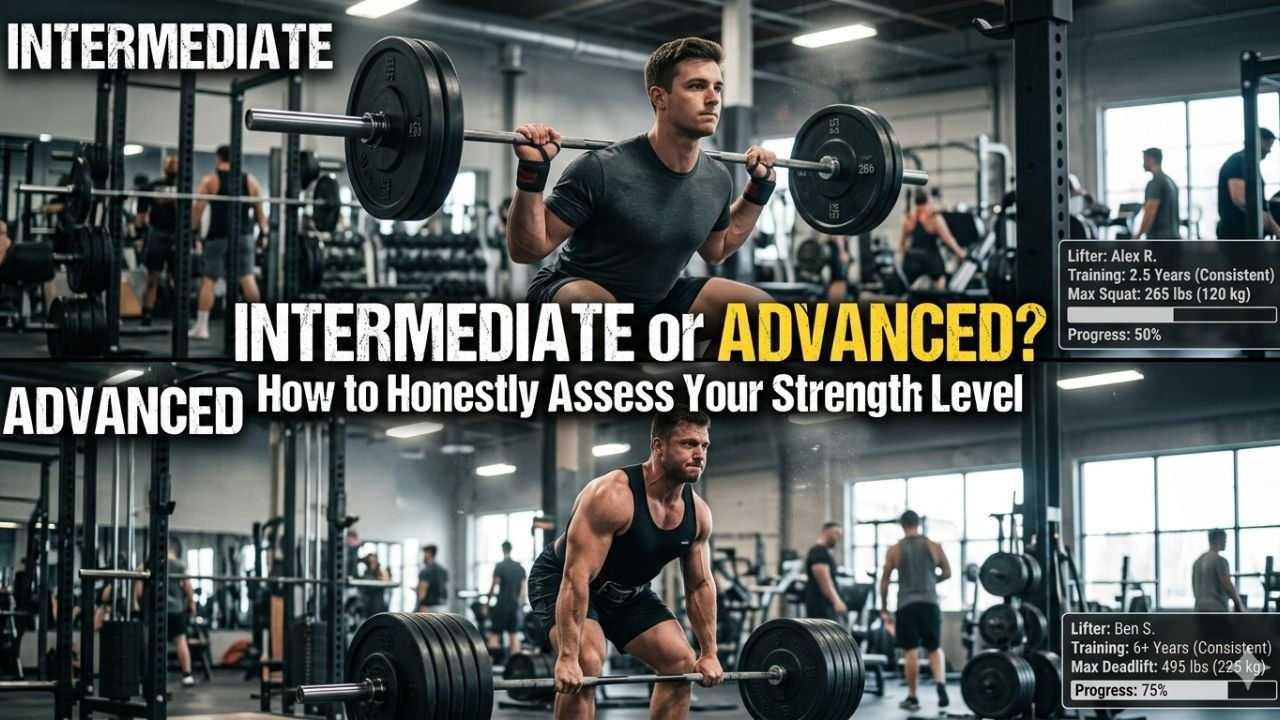
You walk into the gym. You’ve been lifting for a couple of years now. You’re not a total beginner; you know your way around a barbell. But are you actually intermediate? Or have you quietly crossed into advanced territory without realizing it?
Or maybe, and this is the question nobody wants to ask out loud, are you still kind of a beginner wearing intermediate clothes?
This is one of the most common and most confusing questions in strength training. And honestly? Most people get it wrong. Some lifters underestimate themselves and keep training like beginners, leaving serious gains on the table. Others overestimate where they are and jump into advanced programming before their body is ready, which leads to injury, burnout, or frustrating plateaus.
Here’s the truth: knowing exactly where you stand in your strength journey isn’t about ego. It’s about training smarter. When you program according to your actual level, you recover better, progress faster, and enjoy the process more.
So let’s figure this out together, honestly, practically, and without the gym bro nonsense.
What Do “Intermediate” and “Advanced” Actually Mean?
Before we start comparing numbers and programs, let’s clear up something important. These labels aren’t about how long you’ve been training. They’re not about how big your arms look or how much weight is on the bar compared to the guy next to you.
In strength training, your level is determined by how your body responds to training stimulus.
Here’s a simple breakdown:
- Beginner: Makes progress almost every single session. Add weight to the bar, get stronger. It’s that simple.
- Intermediate: Progress happens weekly, not daily. You need more variety and smarter programming to keep improving.
- Advanced: Progress happens over months. Every new pound of strength requires careful planning, periodization, and serious recovery management.
That’s the core of it. Your body’s adaptation speed tells you everything.
The Honest Strength Standards Test
Okay, let’s talk numbers because this is usually where people start. Strength standards give you a rough benchmark based on bodyweight. These aren’t perfect, but they’re a solid starting point.
For men, using a one-rep max (1RM):
- Squat: Intermediate is roughly 1.5x bodyweight. Advanced is 2x or more.
- Deadlift: Intermediate is around 2x bodyweight. Advanced is 2.5x or beyond.
- Bench Press: Intermediate is about 1.25x bodyweight. Advanced is 1.5x or more.
- Overhead Press: Intermediate sits around 0.75x bodyweight. Advanced is 1x or more.
For women, the numbers are lower relative to bodyweight, but the structure is similar. A woman deadlifting 1.5x her bodyweight is solidly intermediate. Getting to 2x or above puts her in advanced territory.
Now, before you run to a calculator, these are guidelines, not gospel. A powerlifter and a CrossFit athlete won’t use the same benchmarks. Context matters.
Signs You’re Genuinely Intermediate
Here’s where it gets real. Forget the numbers for a second. These behavioral and physical signs will tell you more than any chart.
You’ve outgrown linear progression.
Remember when you could just add 5 pounds every session, and it worked? If that stopped working months ago and you needed to switch to weekly progression, that’s a clear sign. Your body adapted. That’s growth.
You understand your body’s feedback.
Intermediate lifters know when something feels “off.” You can tell the difference between productive soreness and a warning sign. You know which exercises you respond to and which ones just beat you up. That body awareness takes time to develop, and it means you’re no longer a beginner.
Your technique is solid under fatigue.
Beginners break down technically when they get tired. If your squat form holds up on rep 8 even when your lungs are on fire, that’s intermediate-level motor pattern development.
You’ve hit your first real plateau.
Paradoxically, hitting a stubborn plateau is a sign of progress. Beginners don’t plateau; they just stall because of technique or consistency issues. Real plateaus mean your beginner gains are done, and your body needs a new challenge.
You can train consistently without falling apart.
Showing up 3-4 times a week for months without constant injury or illness? That’s nothing. It shows your body has adapted to the stress of regular training.
Signs You’re Actually Advanced (Not Just Strong)
This is where people tend to overestimate themselves. Being strong doesn’t automatically mean you’re advanced. Here’s what advanced actually looks like:
Progress is measured in months, not weeks
If you added 20 pounds to your squat over a full year of focused training, that’s impressive for an advanced lifter. If that sounds frustratingly slow to you, you might not be advanced yet.
You need periodization to keep moving forward.
Advanced lifters can’t just “train hard and eat well.” They need structured phases: hypertrophy blocks, strength blocks, peaking cycles. If random hard training still works for you, you’re probably not advanced.
Your recovery demands are high and specific.
Advanced lifters know their exact sleep requirements, their nutrition needs down to the macro level, and how stress from work or life directly tanks their performance. Their recovery protocol isn’t optional; it’s essential.
You’ve competed or seriously tested your maxes.
This isn’t a hard rule, but most truly advanced lifters have put themselves in a testing environment, a powerlifting meet, a CrossFit competition, or at minimum, serious max-out sessions with proper testing protocols.
Small details make a big difference for you.
For a beginner, lifting technique matters. For an advanced lifter, everything matters, bar path by millimeters, sleep quality, training time of day, and pre-workout nutrition. When you’re operating near your genetic ceiling, marginal gains are the only gains left.
Why People Misidentify Their Level
Let’s be real here. There are two very common mistakes people make.
The Overestimator
This person has been training for 3-4 years, reads a lot of lifting content, and starts following an advanced powerlifting program because it “looks serious.” They end up burned out, overtrained, or injured because the program assumes a level of recovery capacity and technical mastery they haven’t built yet.
Sound familiar? There’s no shame in it. Advanced programs are appealing. They look cool. But they’re designed for a specific adaptation state your body may not be in yet.
The Underestimator
This is actually more common than you’d think. This person has been training solidly for 2-3 years, their lifts are genuinely strong, but they keep running beginner or early intermediate programs because they feel “not good enough” to move on.
The result? They plateau hard. They spin their wheels. They think they’re just not genetically gifted when the real issue is they need more volume, more variation, and more complex programming.
Humility is great. But underestimating yourself keeps you stuck.
A Practical Self-Assessment Framework
Here’s a simple way to evaluate where you actually are. Answer these questions honestly:
Question 1: How long has it been since you made consistent session-to-session progress?
- Still happening? Early intermediate at most.
- Stopped more than 6 months ago? You’re likely mid-to-late intermediate or beyond.
Question 2: How long have you been training consistently (at least 3x/week with no major gaps)?
- Under 18 months? Almost certainly beginner to early intermediate.
- 2-4 years? Likely intermediate.
- 4+ years with smart programming? Possibly advanced.
Question 3: Do your lifts meet the strength standards listed earlier?
- Below them? You have beginner or early intermediate strength.
- At them? Solid intermediate.
- Significantly above them? You might be advanced, but check the other factors too.
Question 4: Do you need periodization to progress?
- No, consistent hard work still moves the needle? Intermediate.
- Yes, you’ve tried, and random hard training stopped working? Advanced territory.
Question 5: How’s your technique under max effort?
- Does it break down under heavy load? Still developing intermediate skill.
- Stays solid even at 95%+ effort? Advanced motor pattern.
Tally up your answers honestly. Most people who think they’re advanced are actually late intermediate. And that’s completely fine. Late intermediate is a powerful, productive place to be.
Practical Tips Based on Your Level
If You’re Intermediate:
- Stop chasing advanced programs. Stick with proven intermediate frameworks like Texas Method, GZCLP, or 5/3/1 Beginner.
- Focus on weak points. You now have enough foundation to identify and directly address your weaknesses.
- Prioritize technique over load. The strength will come. Moving well under load protects your long-term potential.
- Track everything. Intermediate progress is slower; you need data to see it clearly.
- Sleep 7-9 hours. Recovery is now a real variable in your results.
If You’re Advanced:
- Hire a coach or use a serious periodized program. Guessing won’t cut it anymore.
- Track recovery metrics, not just lifts. HRV, sleep quality, and stress levels all matter.
- Embrace slow progress. A 5-pound PR after a 12-week training block is genuinely impressive at your level.
- Compete or test yourself. You need pressure-tested data to know where you actually are.
- Manage volume carefully. More is not better. The right amount is better.
Frequently Asked Questions
I’ve been training for 3 years, but my lifts are still beginner numbers. What does that make me?
Great question and a common situation. Your level is based on adaptation, not time. If your lifts are still in beginner range, your training or nutrition likely has gaps. You may still respond to basic progressive overload, which makes you functionally intermediate at most. Focus on consistency, calories, and a solid program before worrying about your “label.”
Can someone be intermediate in one lift and advanced in another?
Absolutely. This is actually very common. Many people have an advanced deadlift but an intermediate bench press. Program accordingly, don’t let your strongest lift dictate the complexity of training for your weakest ones.
I hit a plateau. Does that mean I’ve moved up a level?
A plateau alone doesn’t define your level. Beginners plateau too, usually from poor programming or nutrition. A true intermediate plateau looks different; it happens despite consistent good training and eating. If your plateau comes after years of solid effort and your lifts meet intermediate standards, then yes, it might be time to program for a higher level.
Is it bad to stay intermediate for a long time?
Not at all. Most recreational lifters are happiest and healthiest in the intermediate zone. True advanced training requires a serious lifestyle commitment. There’s no shame in being a strong, healthy, injury-free intermediate lifter forever. The “advanced” label isn’t the goal; a good life with strength in it is.
How often should I reassess my strength level?
Every 6-12 months is a good rhythm. Do a proper testing week, check your lifts against standards, and honestly evaluate your recovery needs and progress rate. Your level isn’t permanent; it shifts as you grow.
Conclusion
Here’s the bottom line: most people are intermediate. And there is nothing wrong with that. The intermediate phase of training is where some of the most satisfying, meaningful strength work happens. You’re past the beginner confusion, but you’re not yet grinding through the brutally slow gains of advanced lifting.
The real danger isn’t being intermediate, it’s pretending you’re something you’re not. Train like a beginner when you’re not, and you’ll plateau forever. Train like an advanced lifter before you’re ready, and you’ll burn out or break down.
Give yourself an honest assessment. Match your program to your actual level. And then get back to what matters most: showing up, working hard, and enjoying the process.
Strength is built one honest rep at a time.