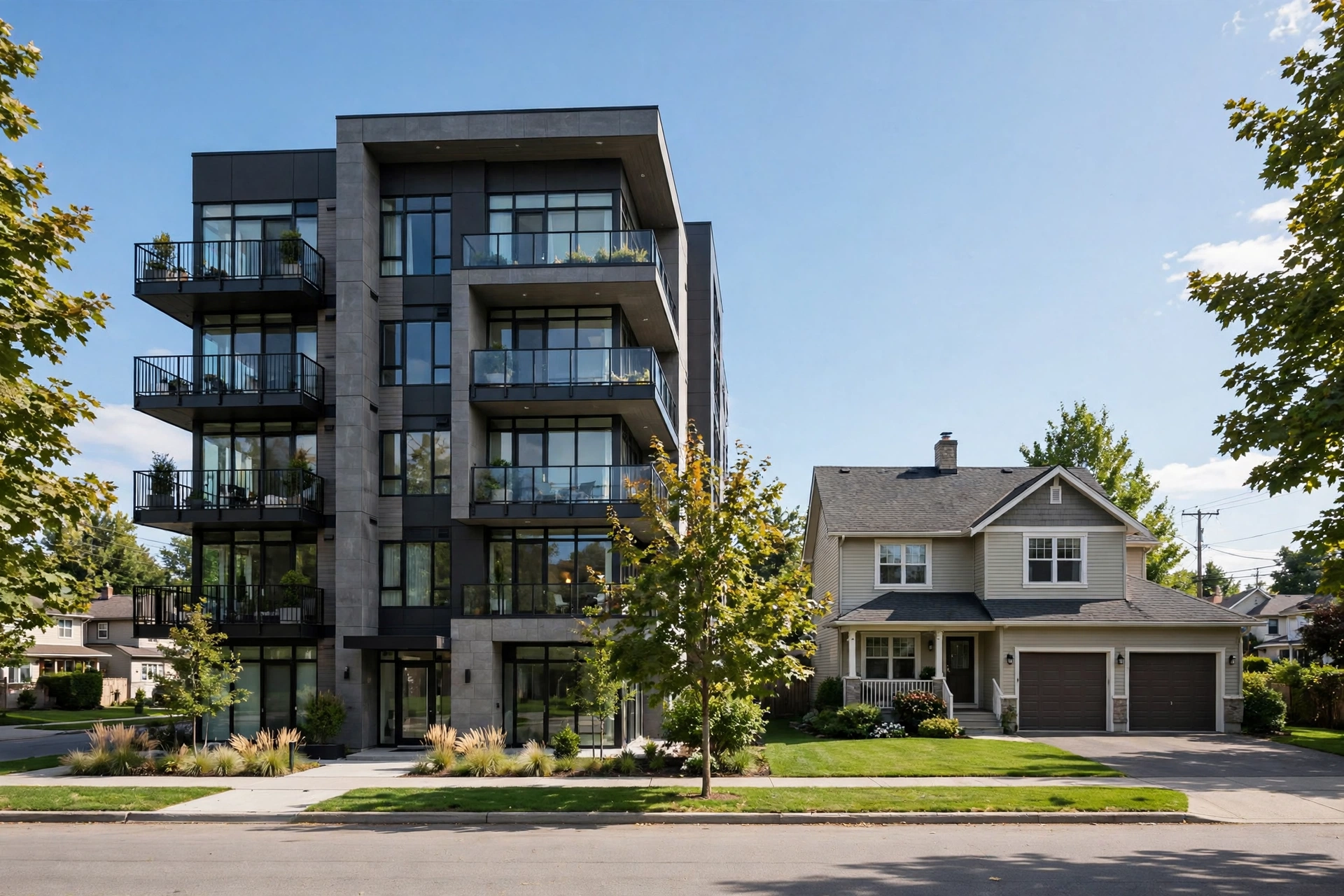
Should You Buy a Condo or a House in 2026?
Choosing between a condo and a house is one of the first decisions many buyers face in 2026. Both can be a good home, but they are very different in cost, space, maintenance, rules, and long-term value. A condo can offer a lower price, less maintenance, and a convenient location, while a house can offer more space, more privacy, and more control over the property.
In this guide, you will learn whether you should buy a condo or a house in 2026. We will compare the costs, the monthly payments, the maintenance, the homeowners association, the lifestyle, and the resale value, with real examples. You will also see who a condo suits best, who a house suits best, and the questions to ask before you decide.
This article is for general information only. It is not financial or legal advice. Prices, fees, rules, and market conditions vary by state and city and change over time. Always check current local data and speak to a licensed professional before you buy.
What Is a Condo?
A condo, short for condominium, is a home in a shared building or community where you own your individual unit, and you share ownership of common areas, such as hallways, elevators, the roof, the parking area, and amenities like a pool or gym, with other owners.
When you buy a condo, you own the inside of your unit, and you have a share in the common areas. A homeowners association, or HOA, manages the building, sets rules, and collects a monthly fee to pay for maintenance, insurance for common areas, and reserves for future repairs.
Condos are common in cities, near downtown areas, and in resort or retirement communities. They can be apartments in a high-rise building, townhouse-style units, or single-level units in a low-rise complex.
Condos often appeal to first-time buyers, downsizers, and people who want a low-maintenance home in a convenient location. They can be more affordable than a house in the same area, although the monthly HOA fee must be included in the total cost.
What Is a Single-Family House?
A single-family house, often called a house or a detached home, is a standalone home on its own lot. When you buy a house, you own the building and the land it sits on, and you are responsible for maintaining both.
A house usually offers more space, both inside and outside, than a condo. You may have a yard, a garage, a driveway, and more privacy, because you do not share walls with neighbours in the same way. You also have more control over the property: you can paint, renovate, add a deck, or change the landscaping, subject to local rules and any HOA rules if the house is in a planned community.
Houses are common in suburbs and in residential neighbourhoods, and they can range from a small starter home to a large family home. They often cost more than a condo in the same area, and they require more maintenance, but they also offer more freedom and, in many markets, stronger long-term value growth.
Cost Comparison: Purchase Price
Purchase price is often the first difference buyers notice. In many cities, a condo costs less than a house in the same area, because it is smaller, it has no private land, and it shares a building with other units.
For example, in a city where a typical single-family house costs 450,000 dollars, a similar two-bedroom condo might cost 300,000 dollars to 350,000 dollars. That lower price can mean a smaller down payment, a smaller loan, and a lower monthly mortgage payment.
However, the price difference varies by market. In some areas, condos in a desirable downtown location can cost as much as, or more than, a house in a suburb. In other areas, a house in a less expensive suburb can cost less than a condo in the city centre.
Do not compare only the purchase price. Compare the total monthly cost, including mortgage, taxes, insurance, HOA fees, and maintenance. A condo with a low price but a high HOA fee can cost as much per month as a house with a higher price and no HOA fee.
Monthly Costs: Mortgage, Taxes, Insurance, and HOA
The monthly cost of a condo and a house can be very different, even if the purchase price is similar.
Mortgage. A lower purchase price usually means a lower mortgage payment. A condo at 300,000 dollars will usually have a lower principal and interest payment than a house at 450,000 dollars, if the down payment percentage and interest rate are the same.
Property taxes. Property taxes are based on the assessed value of the home and the local tax rate. A condo with a lower value will usually have lower property taxes than a house with a higher value in the same area, although tax rates vary by city and county.
Homeowners insurance. A condo owner usually needs a condo insurance policy, often called an HO-6 policy, which covers the inside of the unit, personal belongings, and liability. The HOA usually insures the building exterior and common areas. A house owner needs a standard homeowners policy, often called an HO-3 policy, which covers the building, the land, and personal belongings. House insurance is often higher, because it covers more.
HOA fees. This is the biggest monthly difference. A condo almost always has an HOA fee, which can range from a few hundred dollars per month to over 1,000 dollars per month in a luxury building with many amenities. A house may have no HOA fee, or a lower fee if it is in a planned community. The HOA fee is paid every month, in addition to the mortgage, and it can increase over time.
Maintenance. A condo owner usually pays less for exterior maintenance, because the HOA handles the roof, the exterior, the landscaping, and common areas. A house owner pays for all maintenance, including the roof, the yard, the driveway, and the exterior, which can be costly and time-consuming.
A Real Example: Monthly Cost Comparison
Let us compare a condo and a house in the same city, using simple numbers. These are examples, not quotes, and your actual costs will vary.
Condo: purchase price 320,000 dollars, down payment 10 percent, or 32,000 dollars. Loan amount: 288,000 dollars. Monthly mortgage principal and interest will depend on the rate, but for this example, we will focus on the other costs: property taxes about 250 dollars per month, condo insurance about 80 dollars per month, HOA fee 350 dollars per month. Total before mortgage: about 680 dollars per month, plus the mortgage payment.
House: purchase price 450,000 dollars, down payment 10 percent, or 45,000 dollars. Loan amount: 405,000 dollars. Property taxes about 375 dollars per month, homeowners insurance about 150 dollars per month, HOA fee 0 dollars, maintenance budget about 200 dollars per month. Total before mortgage: about 725 dollars per month, plus the mortgage payment.
In this example, the condo has lower taxes and insurance, but the HOA fee makes the non-mortgage costs similar to the house. The main difference is the mortgage payment, which is lower for the condo because the loan is smaller. Ask your lender for a full loan estimate for each option, so you can compare the true monthly cost.
Space, Privacy, and Lifestyle
Space and lifestyle are often the deciding factors between a condo and a house.
A condo usually offers less space, both inside and outside. You may have one or two bedrooms, a small balcony, and no private yard. You will share walls, floors, or ceilings with neighbours, which can mean more noise and less privacy. On the other hand, a condo can be easier to keep clean, easier to lock up when you travel, and closer to shops, restaurants, and public transport.
A house usually offers more space, a yard, a garage, and more privacy. You can have a garden, a play area for children, a home office, and space for guests. You can also make noise without worrying as much about neighbours below or above you. On the other hand, a house requires more cleaning, more maintenance, and more time to manage.
Think about your life in 2026 and in the next five years. Do you plan to have children, work from home, host guests often, or keep pets that need a yard? A house may suit you better. Do you travel often, want a low-maintenance home, or prefer to live close to the city centre? A condo may suit you better.
Maintenance and Repairs: Who Does What?
Maintenance is a major difference between a condo and a house.
In a condo, the HOA is usually responsible for the building exterior, the roof, the common areas, the landscaping, and the shared systems, such as elevators and hallways. You are usually responsible for the inside of your unit, including appliances, flooring, paint, and fixtures. This means less work for you, but less control over when repairs are done and how they are done.
In a house, you are responsible for everything: the roof, the exterior, the yard, the driveway, the plumbing, the electrical system, and the heating and cooling. This gives you control, but it also means you need time, money, and a plan for maintenance. A good rule is to budget 1 to 2 percent of the home value per year for maintenance, although this varies by age and condition.
If you are handy, a house can be a good fit. If you do not want to spend weekends on repairs, a condo can be a better fit. If you buy a condo, check what the HOA covers and what you cover, and ask for the HOA’s maintenance history and reserve fund.
Homeowners Association: Rules and Fees
An HOA can be a benefit or a burden, depending on the building and the rules.
The HOA collects a monthly fee to pay for common expenses, such as building insurance, maintenance, landscaping, cleaning, and amenities. It also sets rules for the community, such as noise hours, pet rules, parking, rentals, and exterior changes.
Before you buy a condo, ask for the HOA documents, including the budget, the reserve fund, the rules, and the meeting minutes. Check the following:
- How much is the monthly fee, and what does it cover? Has it increased in recent years, and by how much?
- How healthy is the reserve fund? A low reserve can mean a special assessment, which is a one-time charge for a major repair, such as a new roof.
- What are the rules on pets, rentals, and guests? Can you rent out the condo if you move? Can you have a pet?
- Are there any pending lawsuits, special assessments, or major repairs planned?
- How is the HOA managed? Is it run by residents, or by a professional management company?
A well-run HOA can keep a building in good condition and protect property values. A poorly run HOA can mean high fees, strict rules, and unexpected costs. Read the documents carefully, and consider speaking to a current owner in the building.
Houses can also have an HOA, especially in planned communities, but the fee is often lower and the rules are often less strict than for a condo. If a house has an HOA, check the same documents.
Financing: Is It Harder to Get a Loan for a Condo?
Financing a condo can be slightly more complex than financing a house, because the lender will also check the condo project, not just you.
Lenders look at the HOA’s financial health, the percentage of units that are owner-occupied, the percentage that are rented out, and whether there are any lawsuits or major issues. If the condo project does not meet the lender’s requirements, the loan may be denied, or you may need a different loan type.
FHA loans have specific rules for condos. The condo project must be FHA-approved, or meet the requirements for single-unit approval. Conventional loans also have project requirements, although they are often less strict than FHA.
Houses usually have simpler financing, because the lender only needs to check the home and the borrower, not a whole project. However, houses in a planned community with an HOA may also have some project checks.
Ask your lender early whether the condo you are considering meets their requirements, and whether you will need a larger down payment or a different loan type.
Resale Value and Long-Term Growth
Resale value is an important factor, especially if you plan to sell in five to ten years.
Houses often appreciate faster than condos in many markets, because land is limited and houses are in demand from families who want space and a yard. Condos can also appreciate, especially in desirable city locations, but they may appreciate more slowly, and they can be more sensitive to changes in the market, such as a rise in HOA fees or an oversupply of new condos.
Condos can also be harder to sell if the HOA has high fees, strict rental rules, or a low reserve fund. Buyers and lenders may be cautious about a condo project with financial issues.
Houses can be harder to sell if they need major repairs or are in a less desirable location, but they generally appeal to a wider range of buyers, including families, who are often willing to pay for space and land.
Do not buy based only on expected appreciation. Buy a home that fits your life and your budget, in a location you like, with costs you can afford. If it also grows in value, that is a bonus.
Who Should Buy a Condo?
A condo may be a good choice if you want a lower purchase price, less maintenance, and a convenient location, and you are comfortable with HOA rules and fees.
Condos suit first-time buyers who want to get into homeownership with a smaller budget, downsizers who want less space and less work, people who travel often and want a lock-and-leave home, and buyers who want to live close to work, shops, and public transport.
A condo may also suit you if you do not want a yard, you do not need a lot of space, and you are happy to follow community rules.
Who Should Buy a House?
A house may be a good choice if you want more space, more privacy, a yard, and more control over your property, and you are ready for the maintenance and costs that come with it.
Houses suit families who need extra bedrooms and a yard, people who work from home and need a dedicated office, pet owners who want outdoor space, and buyers who want to renovate, expand, or customise their home.
A house may also suit you if you plan to stay for many years, you want land, and you prefer to make your own decisions about repairs and changes.
Questions to Ask Before You Decide
Before you choose, ask yourself and your agent these questions:
- What is my total monthly budget, including HOA, taxes, insurance, and maintenance?
- How much space do I need now, and how much will I need in five years?
- Do I want a yard, or do I prefer a low-maintenance home?
- Am I comfortable with HOA rules and fees, and have I read the HOA documents?
- How long do I plan to stay, and what is the resale outlook for this type of home in this area?
- Can I get financing for this condo project, or is a house loan simpler for me?
Visit both types of homes in your price range, compare the true monthly costs, and talk to owners in the building or neighbourhood if you can. The right choice will feel clear when you compare the numbers and the lifestyle side by side.
Frequently Asked Questions
Is a condo cheaper than a house?
Often yes, on purchase price, but not always on total monthly cost. A condo may have a lower mortgage payment, but the HOA fee can add hundreds of dollars per month. Always compare the full monthly cost, not just the price.
Do condos appreciate as fast as houses?
In many markets, houses appreciate faster than condos, because land is limited and families want space. Condos can still appreciate, especially in desirable locations, but the growth may be slower and more sensitive to HOA fees and new supply.
Can I rent out my condo?
It depends on the HOA rules. Some HOAs allow rentals, some limit the percentage of units that can be rented, and some ban rentals or require a minimum lease length. Check the HOA documents before you buy if you may want to rent out the home later.
Do I own the land if I buy a condo?
No, not in the same way as a house. You own your unit and a share of the common areas, but you do not own a private lot. The HOA owns and manages the land and common areas on behalf of all owners.
Is HOA fee worth it?
It can be, if the fee covers services you would otherwise pay for, such as exterior maintenance, landscaping, building insurance, and amenities. It may not be worth it if the fee is high, the building is poorly maintained, or you do not use the amenities. Check what the fee covers and how it has changed over time.
Should a first-time buyer choose a condo or a house?
It depends on budget, location, and lifestyle. A condo can be a good first home because it is often more affordable and lower maintenance. A house can be a good first home if you need space, plan to stay long term, and can afford the higher price and maintenance. Compare both in your area before you decide.
Conclusion
Should you buy a condo or a house in 2026? There is no single right answer. A condo offers a lower price, less maintenance, and a convenient location, but it comes with HOA fees, shared walls, and less control. A house offers more space, more privacy, and more freedom, but it costs more upfront and requires more maintenance.
The best choice depends on your budget, your lifestyle, and your long-term plans. Compare the total monthly cost, read the HOA documents if you buy a condo, and visit both types of homes in your area. Choose the home that fits your life now and in the next few years, not just the one with the lowest price.
Disclaimer: This article is for general information only. It is not financial advice or legal advice. Prices, fees, rules, and market conditions change over time and vary by state and city. Please speak to a licensed real estate professional or financial adviser before making a home purchase decision.