So, you signed up for your first powerlifting meet. Maybe you did it on a whim. Maybe a friend dared you. Or maybe you’ve been training for months and finally decided, “Okay, it’s time.” Either way, welcome to one of the most exciting (and nerve-wracking) decisions you’ll ever make as a lifter.
Here’s the thing nobody tells you before your first meet: training hard is only half the battle. The other half is peaking correctly. And if you get that part wrong, you could walk onto the platform feeling flat, tired, or just… off.
I’ve been there. I remember showing up to my first meet having no idea what “peaking” even meant. I trained like crazy the week before, thinking more work = better results. Big mistake. My squat felt like I had cement in my legs.
This guide is everything I wish someone had handed me before that day. We’re going to break down a simple, practical 4-week peak for powerlifting, one that’s beginner-friendly, easy to follow, and actually works. No complicated formulas. No overwhelming science. Just real, actionable stuff.
Let’s get into it.
What Does “Peaking for a Powerlifting Meet” Actually Mean?
Before we get into the week-by-week plan, let’s get one thing straight.
Peaking doesn’t mean training harder. It actually means training smarter and strategically pulling back so your body is fully recovered, strong, and ready to perform on meet day.
Think of it like sharpening a knife. You’ve spent months building the blade (your strength). The peak is when you sharpen it so it’s razor-ready for competition day.
A good peak does three things:
- Reduces fatigue accumulated from months of hard training
- Maintains (or slightly improves) the strength you’ve built
- Gets your nervous system primed to perform at its absolute best
Most beginners skip this process. They either keep training the same, or they completely stop lifting the week before the meet. Both extremes are wrong. The sweet spot is in between, and that’s what this guide gives you.
Why Your First Meet Peak Matters More Than You Think
You might be thinking, “I’m just a beginner. Does peaking really matter for me?”
Yes. Actually, it matters more.
Advanced lifters have years of experience reading their body. They know instinctively when they’re ready. You don’t have that experience yet. A structured peak gives you a roadmap so you’re not guessing.
Plus, your first meet is already going to have plenty of unknowns: the warm-up room, the commands from the judges, the nerves, the crowd. You don’t want your fatigue level to be another unknown.
A proper 4-week powerlifting peak gives you confidence. And on meet day, confidence is everything.
The 4-Week Powerlifting Peak: Week-by-Week Breakdown
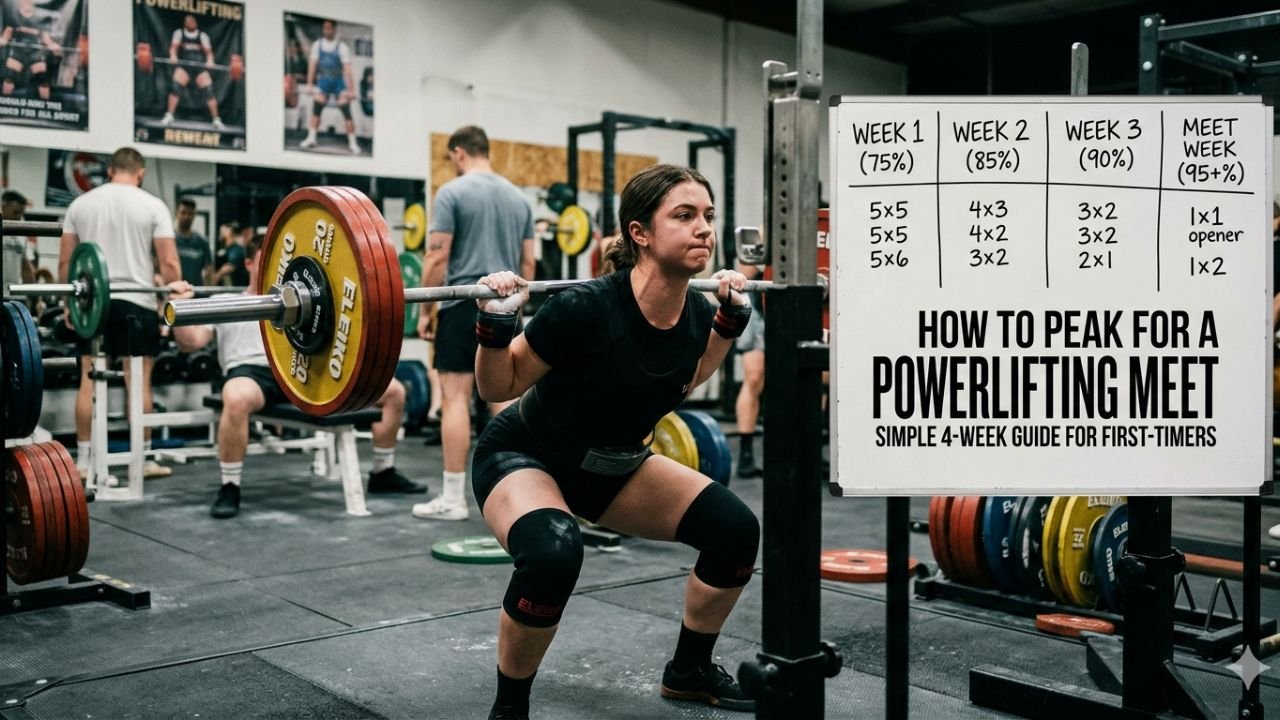
Let’s break this down simply. Here’s the big picture before we dive in:
- Week 4 (4 weeks out): Last heavy week
- Week 3 (3 weeks out): Volume drops, intensity stays
- Week 2 (2 weeks out): Big reduction in volume
- Week 1 (Meet week): Openers only, stay fresh
Got it? Good. Now let’s go deep.
Week 4 Out: Your Last Heavy Week
This is your final “training” week in the traditional sense. You’re still pushing hard, but you’re not trying to set PRs. This week is about cementing what you’ve built.
What to do:
- Keep your main lifts (squat, bench, deadlift) at around 85–90% of your one-rep max
- Do 3–5 sets of 2–3 reps per lift
- Reduce accessory work slightly (you don’t need heavy Romanian deadlifts 4 weeks out from a meet)
- Sleep like it’s your job, seriously, 8+ hours
Real talk: A lot of first-timers want to hit a PR this week “just to know they can do it.” Don’t. Save it for the platform. That’s what you trained for.
Week 3 Out: Drop the Volume, Keep the Intensity
Here’s where the peak really begins. This week, you’re going to cut your total training volume (sets and reps) significantly, but you’ll keep the weights heavy.
What to do:
- Lift at 80–87% of your max
- Cut your sets roughly in half compared to your normal training
- Keep rest periods generous, 3 to 5 minutes between heavy sets
- Start practicing your competition commands: “squat,” “rack,” “press,” “start,” “press,” “rack.”
A practical example: If you normally do 5 sets of 3 on squat, do 3 sets of 2 this week. You’re not losing strength, you’re letting your body absorb all the hard work you’ve done.
This is also a great week to finalize your attempt selections. Talk to a coach or an experienced lifter if you can. Your openers should be weights you could lift on your worst day, half asleep.
A good rule of thumb: opener = 90% of what you’re confident hitting on any given day.
Week 2 Out: The Big Taper
Now things get noticeably lighter, and that might feel weird. You might feel strong and want to add weight. Resist that urge.
What to do:
- Drop intensity to around 70–80% of your max
- Keep reps very low, singles and doubles only
- Reduce overall training days if needed (3 days is plenty)
- Start focusing heavily on sleep, nutrition, and hydration
- Lock in your weight class if you’re cutting, and know your plan
Here’s something nobody warns beginners about: you’ll probably feel amazing in Week 2. Your muscles are recovering, your joints feel good, and you feel explosive. This is called “feeling good from the taper.” Use it as motivation, not as a reason to go heavier.
Your only job in Week 2 is to stay healthy, stay confident, and get your head right.
Week 1 (Meet Week): Stay Sharp, Stay Calm
This is it. Meet week. And the golden rule is simple: do not do anything new.
What to do in the days before the meet:
- Monday/Tuesday: Light squat, bench, and deadlift, just your openers or slightly below. One or two singles, nothing more.
- Wednesday: Complete rest or a very light walk. No heavy lifting.
- Thursday/Friday: Rest. Maybe light stretching or a short walk.
- Meet Day: You’re ready.
Nutrition tip: Eat foods you know and trust. Meet week is not the time to try a new pre-workout or a weird carb protocol you read about at midnight. Stick to what your stomach knows.
Sleep tip: The night before the meet, you might not sleep great. That’s normal and okay. The two nights before the meet matter more. Prioritize that one.
Meet day morning: Have a solid breakfast 2–3 hours before your first lift. Something with carbs and a moderate amount of protein. Think oatmeal with fruit, or rice with eggs, whatever you normally eat before a training session.
Practical Tips to Make Your Peak Even Better
Here are some bonus tips that most guides skip over:
- Practice your commands out loud. Judges will disqualify your lift if you don’t follow commands. Practice saying “squat” out loud in your training sessions. It sounds silly until you bomb out on a technicality.
- Know the federation’s rules. Every federation (USAPL, IPF, SPF, RPS, etc.) has slightly different rules on depth, bar placement, and bench press commands. Read the rulebook at least once. At least.
- Warm up smarter on meet day. The warm-up room is chaotic. Build your warm-up pyramid based on your opener, not your max. A common mistake is warming up too heavily and leaving your best lift in the back room.
- Don’t skip carbs. Carbs are your friend during a peak. This is not the week for low-carb dieting. Your muscles need glycogen to perform. Eat real food, stay hydrated, and don’t obsess over the scale unless you’re actually cutting weight.
- Have fun with it. Your first meeting is a learning experience. Even if everything doesn’t go perfectly, you’ll walk away with more knowledge than any YouTube video can give you. Soak it in.
Frequently Asked Questions
How long should a peak be for a beginner?
For most beginners, a 3–4 week peak is ideal. You haven’t accumulated as much fatigue as an advanced lifter, so you don’t need a super long taper. Four weeks gives you enough time to reduce volume gradually without losing strength.
Should I lift at all the week of the meet?
Yes, but very lightly. A couple of light sessions early in meet week help keep your nervous system activated and your movement patterns sharp. Just don’t do anything that leaves you sore or tired.
What if I feel weak during the taper?
Feeling flat or “weak” during the taper is incredibly common. It’s often psychological that your body is adapting and recovering, not getting weaker. Trust the process. Most lifters feel strong again on meet day.
How do I choose my opening attempts?
Your opener should be a weight you could lift easily on your worst day. For most people, this is around 88–92% of their expected max. You want to go 9 for 9 (all three attempts in all three lifts), especially at your first meet.
Can I still do cardio during a powerlifting peak?
Light cardio (a 20-minute walk, easy cycling) is totally fine and can actually help with recovery. Avoid anything intense like sprints, heavy conditioning, or long runs that could add fatigue or risk of injury in the final weeks.
Conclusion
Here’s what I want you to take away from all of this: peaking for a powerlifting meet isn’t complicated. It’s just different from regular training. You’re shifting your focus from building strength to expressing it.
The 4-week plan in this guide has a heavy final week, volume drop in week 3, big taper in week 2, and a calm meet week, which is simple enough for any first-timer to follow. And if you do it right, you’ll walk onto that platform feeling strong, confident, and ready.
Your first meeting won’t be perfect. Nobody’s is. But you’ll finish it, you’ll learn a ton, and you’ll probably be signing up for your second one before the day is even over.
Now go lift heavy things and enjoy every second of it. You’ve earned this.