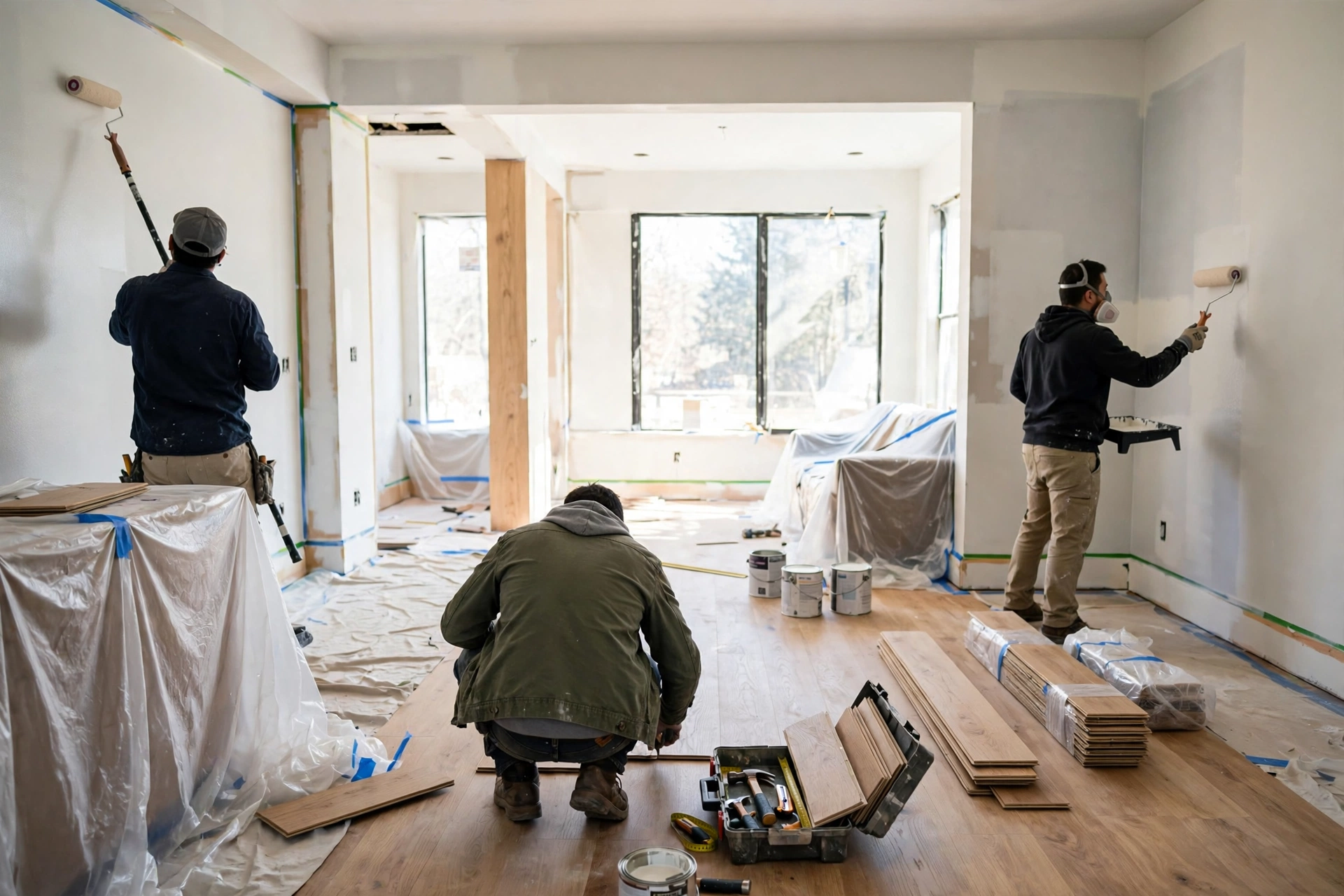
How to Flip a House for Beginners: Complete Guide 2026
Flipping a house means buying a property, improving it, and selling it for a profit, usually within a few months. It can be a rewarding way to invest in real estate, but it is also one of the riskiest strategies for beginners. A good flip can earn a strong profit, while a bad flip can lose money quickly if the purchase price is too high, the repairs cost more than expected, or the home takes too long to sell.
In this guide, you will learn how to flip a house for beginners in 2026, step by step. We will explain how flipping works, how to find a deal, how to estimate costs, how to finance a flip, how to manage the renovation, and how to sell. You will see real examples, common mistakes, and the questions to ask before you buy your first flip.
This article is for general information only. It is not financial, tax, or legal advice. Flipping rules, costs, taxes, and market conditions vary by state and city and change over time. Always check current local data and speak to a licensed professional before you invest.
What Is House Flipping?
House flipping is buying a residential property with the goal of reselling it at a higher price after making improvements. The flipper, also called the investor, usually buys a home that needs work, such as cosmetic updates, repairs, or a full renovation, then sells it to a buyer who wants a move-in-ready home.
A typical flip has four stages. First, you find and buy a property below market value, or at a price that leaves room for profit after repairs. Second, you renovate the home, fixing what is broken and updating what looks dated. Third, you list and sell the home, often with a real estate agent. Fourth, you pay off the loan, pay closing costs and taxes, and keep the remaining profit, if there is any.
Flipping is different from buying a rental property. A rental is bought to hold for years and earn monthly income. A flip is bought to sell quickly, usually in three to nine months. That short timeline means you need to be organised, fast, and careful with costs, because every extra month adds holding costs such as mortgage payments, taxes, insurance, and utilities.
How Much Money Can You Make Flipping?
Profit depends on the purchase price, the renovation cost, the sale price, and the holding costs. A common way to estimate profit is to work backwards from the sale price.
Suppose you think a renovated home will sell for 350,000 dollars. You estimate renovation costs at 60,000 dollars, closing and selling costs at 30,000 dollars, and holding costs at 10,000 dollars. That leaves 250,000 dollars for the purchase price if you want to break even. If you want a profit of 30,000 dollars, you would need to buy for 220,000 dollars or less.
This is a simple example, and real flips have many more costs, including loan interest, agent commissions, taxes, and unexpected repairs. A realistic profit target for a beginner is often 10 to 20 percent of the sale price, before taxes, although this varies widely by market and by deal.
Some flips earn much more, and some lose money. The key is to buy right. If you pay too much for the home, no amount of good renovation work can save the profit. That is why experienced flippers say you make your money when you buy, not when you sell.
The 70 Percent Rule
Many flippers use a simple guideline called the 70 percent rule to decide the maximum price they should pay for a property.
The rule is: maximum purchase price equals 70 percent of the after-repair value, minus the estimated repair costs.
After-repair value, or ARV, is the price the home is likely to sell for after renovation, based on comparable sales of similar renovated homes in the area.
For example, if the ARV is 300,000 dollars, 70 percent is 210,000 dollars. If repairs will cost 50,000 dollars, the maximum purchase price is 160,000 dollars.
The 70 percent rule is a guide, not a law. It leaves room for profit, closing costs, and holding costs, and it protects you from overpaying. In a competitive market, you may need to adjust the percentage, but you should always have a clear maximum price before you make an offer, and you should stick to it.
Do not use the 70 percent rule without checking the ARV carefully. If your ARV is too high, the rule will tell you to pay too much. Base the ARV on real comparable sales, not on hope.
How to Find a Flip Property
Finding a good flip starts with finding a home that is priced below its potential value because it needs work, or because the seller needs to sell quickly.
Here are the main ways beginners find flips:
- Real estate agents. Work with an agent who understands investment properties. They can send you listings that match your criteria, including homes that need work, estate sales, and homes that have been on the market for a long time.
- Online listings. Search listing sites for homes that are priced below similar homes, have been listed for many days, or are described as needing work, being sold as-is, or being a fixer-upper. Look at photos carefully for signs of needed repairs.
- Wholesalers. A wholesaler finds a distressed property, puts it under contract, and sells the contract to an investor for a fee. This can be a fast way to find a deal, but you need to check the numbers yourself and understand the wholesaler fee.
- Auctions and foreclosures. Homes sold at auction, bank-owned homes, and short sales can be cheaper, but they often come with more risk, less time for inspection, and more competition. Beginners should be cautious with auctions until they have more experience.
- Direct mail and driving for dollars. Some investors send letters to owners of distressed homes or drive through neighbourhoods looking for homes that look vacant or in poor condition. This takes time, but it can find deals that are not listed online.
- Networking. Talk to other investors, contractors, and agents in your area. Many deals are shared through local investor groups before they are listed publicly.
Whatever method you use, do not buy a home just because it is cheap. A cheap home in a weak neighbourhood, with major structural problems, can be a bad flip. Look for a home in a decent neighbourhood, with a solid structure, that needs mainly cosmetic updates.
How to Estimate Repair Costs
Estimating repair costs is one of the hardest skills for a beginner, and one of the most important. Underestimating repairs is a common reason flips lose money.
Start with a thorough inspection. Hire a home inspector to check the roof, foundation, plumbing, electrical system, heating and cooling, and structure. Also get a contractor to walk through the home with you and give a written estimate for the work you plan to do.
Break repairs into categories:
- Cosmetic updates. Paint, flooring, fixtures, kitchen cabinets, countertops, and bathroom updates. These are the most common flip repairs, and they can make a home look new without major structural work.
- Systems. Roof, heating and cooling, plumbing, and electrical. These can be expensive, especially if a system needs to be replaced. A new roof can cost many thousands of dollars, and a new heating system can also be costly.
- Structural issues. Foundation cracks, water damage, mould, or termite damage. These can be very expensive and time-consuming. Beginners should be cautious with homes that have major structural problems.
- Exterior and curb appeal. Landscaping, driveway, siding, windows, and front door. First impressions matter, and a clean exterior can help a home sell faster.
Always add a contingency budget, usually 10 to 20 percent of the repair estimate, for unexpected issues. When you open walls or floors, you often find problems that were not visible before. A contingency protects your profit.
Get at least two or three contractor bids for major work, and make sure the bids are in writing, with a clear scope, timeline, and payment schedule. Do not pay the full amount upfront. Pay in stages, as work is completed and inspected.
How to Finance a Flip
Most beginners do not pay cash for a flip. They use a loan, and the type of loan affects the cost and the timeline.
Cash. Paying cash is the simplest option, with no loan payments or interest, and it can help you close quickly. However, it ties up a large amount of money in one property, and most beginners do not have enough cash for the purchase plus repairs.
Hard money loan. A hard money loan is a short-term loan from a private lender, secured by the property. It is common for flips because it can close quickly and is based more on the property value than on the borrower’s credit. Hard money loans usually have higher interest rates and fees than a traditional mortgage, often with a term of six to twelve months. They can work for a fast flip, but the cost adds up if the project takes longer than expected.
Fix-and-flip loan. Some lenders offer a specific fix-and-flip loan that covers both the purchase and the renovation, with funds released in stages as work is completed. These loans are similar to hard money loans, but they may have clearer terms for beginners.
Conventional loan. A traditional mortgage can be used for a flip if the home is habitable and meets lender requirements. However, conventional loans are slower, have stricter property standards, and may not work for a home that needs major repairs.
Home equity loan or line of credit. If you own a home with equity, you may be able to borrow against it to fund a flip. This can have a lower interest rate, but it puts your own home at risk if the flip fails.
Partner or private lender. Some beginners partner with another investor who provides money, while the beginner manages the project. The profit is then split according to the agreement. Make sure any partnership is in writing, with clear terms for who pays what and who earns what.
Before you choose a loan, compare the interest rate, fees, term, and how quickly the funds are available. Ask what happens if the project takes longer than the loan term. A loan that is cheap for three months can become expensive if the flip takes nine months.
Step-by-Step: Your First Flip
- Step 1: Learn your market. Study your city and neighbourhood. Look at sold prices for renovated homes, rental demand, and how long homes stay on the market. Choose a neighbourhood you understand.
- Step 2: Build your team. Find a real estate agent, a contractor, a home inspector, a lender, and, if needed, a real estate attorney. A good team can save you time and money, and help you avoid costly mistakes.
- Step 3: Set your budget and criteria. Decide your maximum purchase price, your repair budget, and your target profit. Write down the type of home, the price range, and the neighbourhoods you will consider. Do not look at homes outside your criteria.
- Step 4: Find and analyse a property. When you find a candidate, check comparable sales, estimate repairs, and run the numbers using the 70 percent rule. If the numbers do not work, walk away. There will be another deal.
- Step 5: Make an offer and inspect. Make an offer with an inspection contingency if possible, so you can check the home before you commit. Hire an inspector and a contractor to verify the repair costs.
- Step 6: Close and start renovation. Once you close, start work quickly. Create a timeline, order materials early, and check progress regularly. Every week of delay adds holding costs.
- Step 7: Renovate with the buyer in mind. Choose updates that appeal to a wide range of buyers, such as neutral paint, durable flooring, and a clean, functional kitchen and bathroom. Avoid overly personal or expensive custom features that may not add value.
- Step 8: List and sell. Work with your agent to price the home based on comparable sales, stage it simply, and market it well. Be ready to negotiate, and respond quickly to offers and inspection requests.
- Step 9: Close and review. After the sale, pay off the loan, pay taxes and closing costs, and calculate your actual profit. Write down what went well and what you would do differently next time.
Renovation Tips for Beginners
Focus on the kitchen and bathrooms. These rooms have the biggest impact on buyers, but you do not need a luxury remodel. Clean, modern, and functional is often enough. New paint, new hardware, and new fixtures can make a big difference for a modest cost.
Paint is one of the cheapest ways to transform a home. Use light, neutral colours that make rooms feel larger and brighter. Avoid bold colours that may not appeal to all buyers.
Replace worn flooring. Old carpet can make a home feel dated. Hardwood, laminate, or luxury vinyl plank are popular choices that are durable and easy to clean.
Fix what is broken first. A beautiful kitchen will not sell a home with a leaking roof or a broken heating system. Fix safety and system issues before you spend on cosmetic updates.
Do not over-improve. In a neighbourhood where homes sell for 250,000 dollars, a 50,000 dollar luxury kitchen may not add 50,000 dollars in value. Match your renovation to the neighbourhood price range.
Keep the home clean and safe during renovation. A clean site helps contractors work faster, and it makes it easier to show the home to buyers if needed.
How to Sell a Flip for the Best Price
Pricing is critical. If you price too high, the home may sit on the market, and you will pay more holding costs. If you price too low, you may leave profit on the table.
Price based on comparable sales of similar renovated homes that sold recently in the same area. Your agent can help with this. Look at homes with similar size, age, condition, and location.
Stage the home simply. Clean, declutter, and arrange furniture to show the space. You do not need expensive staging, but an empty or messy home is harder for buyers to imagine living in.
Take good photos. Most buyers first see a home online. Professional photos, good lighting, and a clean exterior can increase interest and showings.
Be ready for inspection and appraisal. The buyer’s inspector may find issues, and the appraiser must agree that the home is worth the sale price. Fix any major issues before listing if you can, and keep records of the work you did.
Taxes on Flipping
Flipping has tax implications that are different from buying a rental or a home to live in. In the United States, profit from a flip is often treated as ordinary income or as a short-term capital gain, depending on how the IRS and your state view the activity, how long you held the property, and whether you are considered a dealer.
You may also need to pay self-employment tax in some cases, and you cannot use the same tax benefits as a long-term rental, such as depreciation, in the same way.
Tax rules are complex and depend on your situation. Keep detailed records of purchase price, repair costs, holding costs, and sale price. Speak to a tax professional before you flip, not after you sell, so you can plan for taxes and set aside money to pay them.
Common Mistakes Beginners Make
Paying too much is the most common mistake. If you overpay, you start the flip with no room for profit. Use the 70 percent rule, check comparable sales, and walk away if the numbers do not work.
Underestimating repairs is another common mistake. Always add a contingency budget, get written contractor bids, and do not assume the work will be quick or cheap.
Taking too long is also costly. Every extra month means more mortgage payments, taxes, insurance, and utilities. Create a timeline, order materials early, and check progress weekly.
Over-improving for the neighbourhood is a mistake many beginners make. A luxury renovation in a modest neighbourhood may not return its cost. Match the renovation to what buyers in that area expect and can afford.
Skipping the inspection is risky. An inspection can reveal foundation, roof, or plumbing problems that could cost tens of thousands of dollars. Always inspect, even if you are buying as-is.
Not having enough cash reserves is another risk. If a repair costs more than expected, or the home takes longer to sell, you need cash to cover it. Keep a reserve beyond your repair budget.
Frequently Asked Questions
How much money do I need to flip a house?
It depends on the home price and the loan type. Many flippers need a down payment of 10 to 25 percent, plus money for repairs, closing costs, and holding costs. Some hard money lenders may finance most of the purchase and repairs, but you will still need cash for fees, reserves, and unexpected costs.
How long does a house flip take?
A typical flip takes three to nine months from purchase to sale, including renovation and marketing. Cosmetic flips can be faster, while full renovations can take longer. Delays in permits, materials, or contractor schedules can extend the timeline.
Is house flipping profitable in 2026?
It can be, but it depends on the market, the purchase price, and the repair costs. In a market with rising prices and strong buyer demand, flips can be profitable. In a slow market, or if you overpay, a flip can lose money. Run the numbers carefully for each deal.
Do I need a real estate licence to flip houses?
No, you do not need a licence to buy, renovate, and sell a property you own in most states. However, you will need to follow local rules for permits, contractors, and sales, and you may need a licence if you act as an agent for others. Check your state rules.
Can I flip a house with no experience?
Yes, but start small and learn first. Choose a cosmetic flip, build a good team, get a thorough inspection, and do not overpay. Many beginners learn by working with an experienced investor or by starting with a smaller project.
What is the 70 percent rule in house flipping?
The 70 percent rule says your maximum purchase price should be 70 percent of the after-repair value, minus repair costs. It is a guide to help you avoid overpaying and leave room for profit and costs.
Conclusion
Flipping a house for beginners in 2026 is possible, but it is not a quick or easy way to make money. It requires research, a clear budget, a good team, and discipline to walk away from a bad deal.
Start by learning your market, building your team, and setting clear criteria. Use the 70 percent rule, estimate repairs carefully, add a contingency, and choose financing you understand. Renovate for the buyer, price based on comparable sales, and keep detailed records for taxes.
Your first flip should be a learning experience as much as a profit opportunity. Choose a manageable project, focus on the numbers, and do not rush. If the deal does not work on paper, it will not work in real life.
Disclaimer: This article is for general information only. It is not financial advice, tax advice, or legal advice. Flipping costs, rules, and market conditions change over time and vary by state and city. Please speak to a licensed real estate professional, lender, or tax adviser before investing in a house flip.