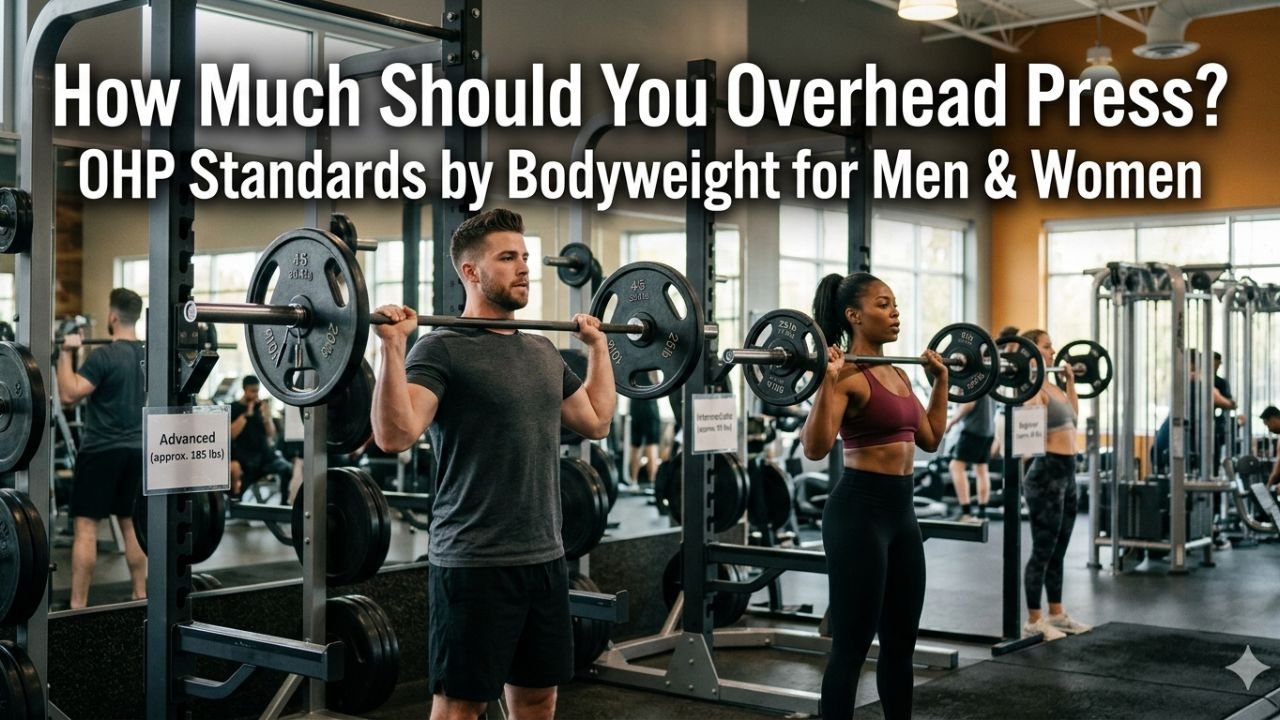
Let me guess, you’ve been grinding away at the gym, adding plates to the barbell, and somewhere between your second and third set, you’ve asked yourself: “Am I actually strong? Is this weight good for someone my size?”
If that sounds familiar, you’re not alone. The overhead press, also called the OHP, is one of those lifts that humbles almost everyone. Unlike the bench press, which gets all the Instagram glory, the overhead press quietly reveals your true upper body strength. And honestly? It’s one of the most functional, impressive lifts you can master.
But here’s the thing: knowing where you stand matters. Whether you’re a beginner just starting or someone who’s been lifting for years, having a realistic benchmark helps you set goals, track progress, and stay motivated.
So in this post, we’re going to break down exactly how much you should be able to overhead press based on your bodyweight for both men and women across different experience levels. No fluff, no complicated jargon. Just real, useful information.
Let’s get into it.
What Is the Overhead Press (OHP) and Why Does It Matter?
The overhead press is a compound barbell exercise where you press a loaded barbell from your upper chest straight up overhead until your arms are fully extended. You’re standing (usually), your core is braced, and you’re pushing against gravity with nothing but your own strength.
It works your:
- Shoulders (anterior and lateral deltoids)
- Triceps
- Upper chest
- Core and stabilizers
- Upper back and traps
What makes the OHP special is that it’s a true test of functional strength. You’re not lying on a bench. You’re standing up, using your whole body to control and press the weight. That’s why it’s a staple in strength programs like Starting Strength, 5/3/1, and StrongLifts.
If you want strong, broad shoulders and real pressing power, the overhead press is your best friend.
How to Measure Your OHP Strength
Before we get to the numbers, let’s talk about how strength standards work.
Most OHP standards are measured using a one-rep max (1RM) the maximum weight you can lift for a single repetition with good form. If you don’t want to test your 1RM (which is fine, especially for beginners), you can estimate it based on what you can lift for 3, 5, or 10 reps using online calculators.
For everyday gym-goers, the working weight, the weight you’re using in your regular sets of 5 or 8 reps, is usually around 75–85% of your 1RM.
Overhead Press Standards for Men by Bodyweight
These numbers are based on 1RM (one-rep max) and are widely used in the strength training community. Keep in mind these are general guidelines,s not hard rules.
Beginner Just starting, training for 0–6 months
|
Bodyweight |
Beginner OHP |
|
130 lbs (59 kg) |
55 lbs (25 kg) |
|
150 lbs (68 kg) |
65 lbs (30 kg) |
|
175 lbs (79 kg) |
75 lbs (34 kg) |
|
200 lbs (91 kg) |
90 lbs (41 kg) |
|
220 lbs (100 kg) |
100 lbs (45 kg) |
At the beginner stage, you’re still learning the movement. Don’t rush the weight. Focus on form, consistency, and showing up.
Intermediate Training consistently for 1–2 years
|
Bodyweight |
Intermediate OHP |
|
130 lbs (59 kg) |
85 lbs (39 kg) |
|
150 lbs (68 kg) |
100 lbs (45 kg) |
|
175 lbs (79 kg) |
120 lbs (54 kg) |
|
200 lbs (91 kg) |
140 lbs (64 kg) |
|
220 lbs (100 kg) |
155 lbs (70 kg) |
This is where most gym regulars fall. You’ve built a foundation, but there’s still a lot of room to grow. Hitting these numbers means you’re doing genuinely solid work.
Advanced Experienced lifter, 3+ years of focused training
|
Bodyweight |
Advanced OHP |
|
130 lbs (59 kg) |
115 lbs (52 kg) |
|
150 lbs (68 kg) |
135 lbs (61 kg) |
|
175 lbs (79 kg) |
160 lbs (73 kg) |
|
200 lbs (91 kg) |
185 lbs (84 kg) |
|
220 lbs (100 kg) |
205 lbs (93 kg) |
Reaching advanced numbers takes years of smart, consistent training. If you’re here, you’ve earned it.
Elite Competitive-level strength
For reference, elite-level lifters (powerlifters, serious strength athletes) are pressing numbers that would shock most people. A 175 lb elite male might press 225+ lbs overhead. These numbers are inspiring to look at, but they’re not what the average gym-goer should stress over.
Overhead Press Standards for Women by Bodyweight
Women are often told they “can’t” lift heavy. That’s nonsense. Women who train seriously develop incredible pressing strength. Here are realistic benchmarks:
Beginner 0–6 months of training
|
Bodyweight |
Beginner OHP |
|
110 lbs (50 kg) |
35 lbs (16 kg) |
|
130 lbs (59 kg) |
40 lbs (18 kg) |
|
150 lbs (68 kg) |
50 lbs (23 kg) |
|
165 lbs (75 kg) |
55 lbs (25 kg) |
Starting with just the bar (which is usually 45 lbs) is completely normal for women. No shame in that at all.
Intermediate 1–2 years of consistent training
|
Bodyweight |
Intermediate OHP |
|
110 lbs (50 kg) |
55 lbs (25 kg) |
|
130 lbs (59 kg) |
65 lbs (30 kg) |
|
150 lbs (68 kg) |
75 lbs (34 kg) |
|
165 lbs (75 kg) |
85 lbs (39 kg) |
At this stage, women who train smart and eat well are pressing weights that would impress many casual gym-goers of either gender.
Advanced 3+ years of dedicated strength training
|
Bodyweight |
Advanced OHP |
|
110 lbs (50 kg) |
75 lbs (34 kg) |
|
130 lbs (59 kg) |
90 lbs (41 kg) |
|
150 lbs (68 kg) |
105 lbs (48 kg) |
|
165 lbs (75 kg) |
115 lbs (52 kg) |
Women pressing bodyweight overhead or close to it are genuinely strong. That’s a serious achievement worth celebrating.
A Simple Rule of Thumb for OHP
If you want a quick mental shortcut:
- Beginner men aim for roughly 0.5x their bodyweight
- Intermediate men aim for roughly 0.75x their bodyweight
- Advanced men aim for roughly 1x your bodyweight (pressing your own bodyweight is a real milestone)
- Beginner women aim for roughly 0.3x their bodyweight
- Intermediate women aim for roughly 0.5x their bodyweight
- Advanced women aim for roughly 0.65–0.75x their bodyweight
These aren’t gospel, but they give you a solid goal to chase.
Why Is the Overhead Press So Hard?
Honestly? A lot of people wonder why their OHP seems so weak compared to their bench press or squat. There are real reasons for this:
- It’s a smaller muscle group. Your shoulders and triceps are smaller muscles than your chest or legs. Smaller muscles mean less total force production.
- It demands core stability. Unlike the bench press,s where you’re lying down, the OHP requires your core, glutes, and legs to work together to stabilize the lift. If any of those are weak, your press suffers.
- Mobility limitations: ns Tight shoulders, poor thoracic spine mobility, or limited wrist flexibility can all cap your overhead pressing ability before your muscles even get a chance to show up.
- It’s just technically demanding. The bar path, the bar position on your chest, and the way you brace all take time to dial in.
If your OHP feels stuck, don’t panic. It’s a notoriously stubborn lift. Even experienced lifters make slow progress here.
Practical Tips to Improve Your Overhead Press
Here’s what actually works, from real-world lifting experience:
- Press more often. The overhead press responds well to frequency. If you’re only pressing once a week, try adding a second session. Even a lighter technique day can help.
- Strengthen your weak link
- Weak triceps? Add close-grip bench press or skull crushers.
- Unstable core? Add planks, Pallof presses, and ab wheel rollouts.
- Lagging shoulders? Add lateral raises and face pulls.
- Work on the mobile.ty Spend 5–10 minutes before pressing, working on shoulder and thoracic mobility. A lacrosse ball on your upper back, doorway stretches, and band pull-aparts can make a bigger difference than you’d expect.
- Nail your setup. Feet shoulder-width apart. Bar resting on your upper chest. Wrists stacked over elbows. Glutes and core tight. Elbows slightly in front of the bar. Press, and at the top, shrug your traps up to “lock out” the lift properly.
- Don’t skip accessory work.k Push press, dumbbell shoulder press, Arnold press, these all build the muscles that support your OHP without beating up your joints the same way.
- Eat and sleep. This sounds obvious, but the overhead press is a strength lift. If you’re under-eating or under-sleeping, your press will stall no matter how hard you train.
Real-Life Example: Where Should a 180 lb Man Be?
Let’s put this in real terms. Say you’re a 180 lb male who’s been lifting for about a year and a half.
- Beginner standard: ~80 lbs
- Intermediate standard: ~130 lbs
- Advanced standard: ~165 lbs
If you’re pressing around 115–130 lbs for a clean single, you’re right in the intermediate zone. That’s solid work. Your next goal? Work toward that 150–160 lb range over the next 6–12 months with smart programming.
That’s not a dream, that’s a realistic, achievable target.
Frequently Asked Questions
Is it okay if my OHP is way below the standard for my level?
Absolutely. These are averages, not tests you pass or fail. Genetics, training history, injury history, and even arm length all affect your numbers. Use the standards as direction, not judgment.
How long does it take to go from beginner to intermediate OHP?
For most people training consistently (2–3 times per week), 6–12 months of focused effort is enough to hit intermediate numbers. Progress is faster early on and slows down as you get stronger.
Should women train the overhead press differently from men?
Not really. The same principles apply: good form, progressive overload, accessory work, rest. The only difference is that women may need to start with lighter loads or even just the bar. That’s perfectly fine and doesn’t change the programming approach.
What’s considered a “good” overhead press for the average person?
For men, pressing close to your bodyweight is genuinely impressive to the average gym-goer. For women, pressing 70–80% of bodyweight puts you well ahead of most people. But honestly, “good” is relative. If you’re making consistent progress, you’re doing great.
Why is my bench press so much higher than my overhead press?
This is completely normal. Most people bench 50–70% more than they overhead press. The bench involves larger muscles, a more stable position, and usually gets more training time. Don’t worry, it’s not a problem. It’s just how the numbers work.
Conclusion
Here’s the truth: the overhead press doesn’t care about your ego. It’s one of the few lifts that keeps you humble, no matter how strong you get.
But that’s also what makes it so rewarding.
When you finally press your bodyweight overhead, or hit a new personal record after months of grinding, it hits different. Because you know exactly how much work it took.
Use the standards in this post as a compass, not a scorecard. Whether you’re a beginner just getting your first reps in or an advanced lifter chasing elite numbers, there’s always a next step. Always a next goal.
Focus on progress over perfection. Be consistent. Fix your technique. Eat well. Sleep enough. And trust the process.
The bar will go up. It always does for people who keep showing up.
Now go press something.