Let me ask you something. You walk into the gym, you see the squat rack on one side and the leg press machine on the other, and you wonder, “Which one should I actually be doing?”
If you’ve ever stood there overthinking it while someone else grabbed the squat rack, you’re not alone. This is one of the most debated questions in the fitness world. And honestly? Both sides have passionate fans.
Some people swear by squats. They call it the “king of all exercises.” Others prefer the leg press because it’s easier on the joints and you can load up serious weight without feeling like you’re about to tip over.
So which one actually builds more strength? Let’s break it down, no fluff, no confusing science jargon. Just real talk, practical tips, and everything you need to make the right choice for your body and your goals.
What Is the Squat and Why Do People Love It?
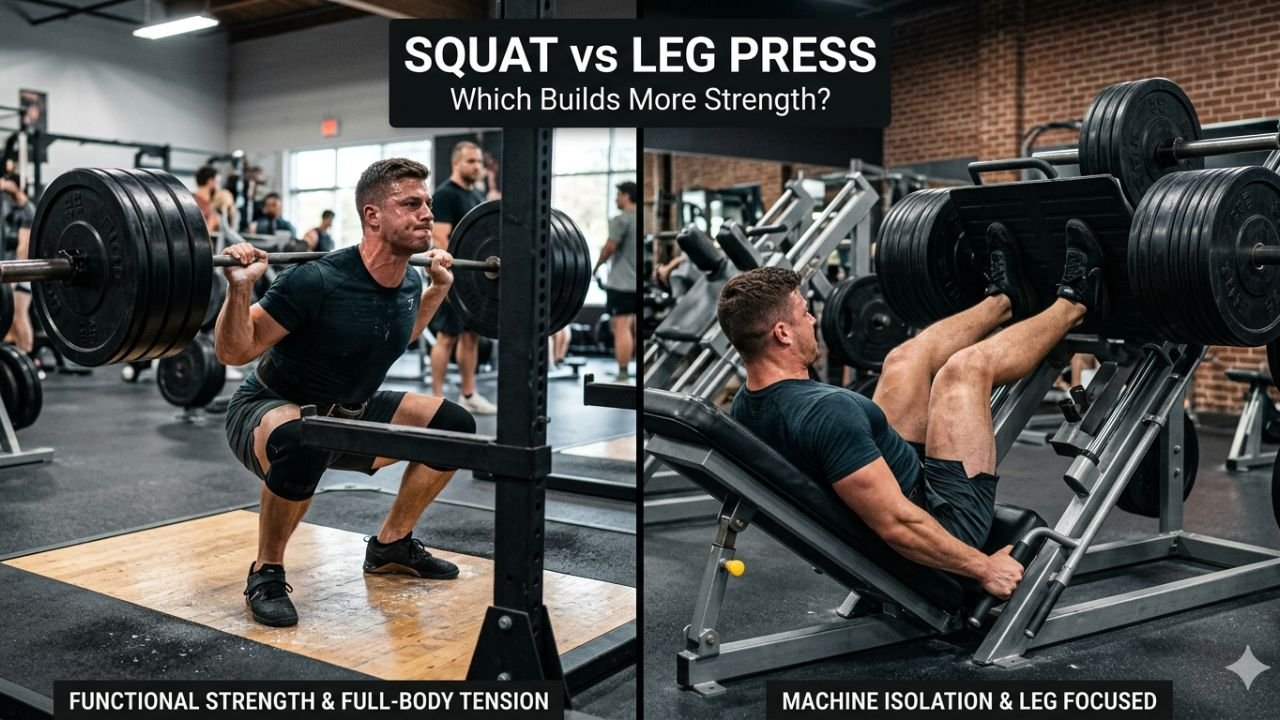
The squat is a full-body, compound movement. You put a barbell on your back (or hold dumbbells, or just use your bodyweight), you bend your knees, lower your body down like you’re sitting in a chair, and push back up.
Simple concept. Hard to master.
The reason people love squats is that they work so many muscles at once:
- Quadriceps (front of the thighs)
- Hamstrings (back of the thighs)
- Glutes (your backside)
- Core muscles (abs and lower back)
- Calves
- Even your upper back and shoulders (when barbell squatting)
When you squat, your entire body is engaged. You’re not just lifting weights, you’re stabilizing it, balancing it, and controlling it from head to toe. That’s why athletes, powerlifters, and coaches have always considered the squat a foundational movement.
Think about it this way: when you pick up something heavy in real life, a box, a child, a piece of furniture, your body moves like a squat. It’s one of the most functional movements humans can do.
What Is the Leg Press and Why Do People Use It?
The leg press machine looks like a big reclining seat with a platform in front of you. You push the platform away with your feet while sitting at an angle. It’s guided, controlled, and let’s be honest, a lot less intimidating than walking up to a barbell.
Muscles worked in the leg press:
- Quadriceps (the main target)
- Glutes
- Hamstrings (to a lesser degree)
- Calves (depending on foot placement)
The big advantage here is that the machine handles all the balance and stabilization for you. Your lower back isn’t under the same load as it is in a squat. That means you can often push heavier weights, and people with knee issues or back problems sometimes find it more manageable.
A lot of bodybuilders use the leg press as an accessory exercise after squats to really burn out the quads. And beginners often start on the leg press before building the confidence and mobility to squat with a barbell.
Squat vs Leg Press: The Strength-Building Showdown
Okay, here’s where it gets interesting.
1. Overall Muscle Activation
Squats win here, and it’s not even close.
Studies have consistently shown that squats activate more total muscle mass than the leg press. When your core, glutes, hamstrings, and stabilizer muscles all fire together, your body is doing more work per rep. More work = more stimulus for growth and strength.
The leg press isolates the quads more directly, which can be great for hypertrophy (muscle size), but it misses out on a lot of the secondary muscles that make you functionally strong.
2. Functional Strength and Real-World Carryover
Squats train your body to move as a unit. If you want to be strong in everyday life, carrying groceries, climbing stairs, and playing sports, squat strength transfers directly.
Leg press strength, while real, doesn’t carry over as well because your body isn’t learning to stabilize and coordinate multiple muscle groups together. You’re just pushing in one controlled direction.
Think of it like this: if two guys both have massive legs, but one built them with squats, and the other only did leg press, the squat guy is probably going to be stronger in practical situations.
3. Hormonal Response
Here’s something most people don’t talk about. Compound movements like squats trigger a bigger hormonal response in the body, including a release of testosterone and growth hormone. These hormones are crucial for building strength and muscle all over your body, not just your legs.
The leg press, because it uses less total muscle mass, doesn’t produce the same hormonal spike. So squats are kind of secretly training your whole body, even when you’re focused on your legs.
4. Joint Stress and Safety
This is where the leg press gains some ground.
Squats, when done with poor form, can put a lot of stress on your knees, hips, and lower back. They require good mobility, proper posture, and consistent technique. If you’re rushing through reps or loading too much weight too soon, you’re asking for trouble.
The leg press is more forgiving. Because the machine controls the movement path, there’s less room for error. For people recovering from injuries or just starting, this is actually a meaningful benefit.
However, and this is important, the leg press isn’t automatically “safe.” If you go too heavy, lock out your knees, or let your lower back peel off the seat, you can still get hurt. No machine removes the need for proper form entirely.
5. Progressive Overload Potential
Both exercises allow you to progressively add weight over time, which is the core driver of strength gains. But leg press machines often allow for more incremental weight adjustments, which some people find easier to track and progress on.
On the squat, loading up even 5 lbs more can feel like a significant jump when you’re working with heavy loads. But this also means every small gain on the squat rack is a real achievement.
Which One Is Better for Beginners?
If you’re just starting, the honest answer is: start with both, but learn the squat first.
The squat teaches your body how to move under load. It builds coordination, body awareness, and real foundational strength. Yes, it’s harder to learn. Yes, the form takes time. But investing in that learning curve will pay off for years.
The leg press is a great supplement, especially while your squat form is still developing. It lets you train the legs hard without as much technical demand.
Practical Tip for Beginners:
- Use the leg press to warm up the legs and build basic strength
- Practice bodyweight squats and goblet squats to work on form
- Gradually progress to barbell squats as your confidence grows
Which One Is Better for Building Muscle (Hypertrophy)?
If pure muscle size is your goal, then honestly, you might want both.
Squats build overall leg mass and trigger systemic muscle growth. But the leg press lets you really isolate and pump the quads with high volume and controlled technique. Many bodybuilders do heavy squats and then follow up with 4-5 sets of leg press to completely exhaust the muscles.
The combination is more powerful than either alone.
Which One Should You Prioritize for Powerlifting or Athletic Training?
If you’re training for powerlifting, squats. Period. Squats are one of the three main lifts in powerlifting (along with bench press and deadlift), so they have to be your priority.
If you’re an athlete, a footballer, a basketball player, sprinter, squats again. Athletic performance demands explosive, multi-joint strength that squats develop better than machines.
The leg press is rarely a priority for athletes. It’s a useful tool, but it’s not the foundation.
Practical Tips to Get the Most Out of Each Exercise
For Squats:
- Warm up your hips and ankles before you squat. Tight ankles ruin squat depth
- Keep your chest up and don’t let your knees cave inward
- Push through your whole foot, not just your toes
- Start with lighter weight and focus on depth and control
- Film yourself occasionally to check your form
For Leg Press:
- Don’t lock out your knees at the top; keep a slight bend
- Don’t let your lower back lift off the seat
- Experiment with foot placement, higher and wider targets glutes/hamstrings, lower and narrower targets quads
- Use a full range of motion for maximum muscle activation
- Don’t go so heavy that your form breaks down
A Real-Life Example
Let me tell you about my friend Ahmed. He spent two years only doing leg press because the squat rack always felt intimidating. His quads got bigger, sure, but his lower back felt weak, his balance was off, and when he tried a heavy squat for the first time, he struggled.
Once he committed to learning the squat, starting with goblet squats, then front squats, then barbell back squats, everything changed. His legs got stronger AND more balanced. His athletic performance improved. And, funny enough, his leg press numbers also went up because his overall leg strength improved.
The lesson? Don’t avoid the hard exercise. Embrace it.
Frequently Asked Questions
Can I replace squats with the leg press?
Technically, yes, but it’s not ideal. You’ll miss out on the full-body engagement, core training, and functional strength that squats provide. Use the leg press as a supplement, not a replacement.
Is the leg press better for bad knees?
Sometimes, yes, but it depends on the individual. Some people find the controlled movement of the leg press easier on their knees. Others find that the machine’s angle actually aggravates their knees. If you have knee issues, speak with a physiotherapist before loading up either exercise.
Which burns more calories, squats or leg press?
Squats burn more calories because they involve more total muscle mass and greater energy expenditure. If fat loss is a goal alongside strength, squats give you more bang for your buck.
How many sets should I do for each?
A good starting point is 3-4 sets of squats with moderate-heavy weight (5-8 reps), followed by 3-4 sets of leg press with slightly higher reps (8-12) if you’re including both in a workout. Adjust based on your goals and recovery.
Which exercise is better for the glutes?
Squats, especially deep squats. They engage the glutes through a fuller range of motion. On the leg press, you can increase glute activation by placing your feet higher on the platform, but squats are still the better overall glute builder.
Conclusion
Here’s the truth: this isn’t really a competition. Both exercises have a place in a well-rounded training program.
But if you’re asking which one actually builds more strength? Squats take the crown. They train more muscles, trigger a bigger hormonal response, develop functional strength, and make you stronger in ways that carry over into real life.
The leg press is a valuable tool, especially for beginners, people with certain injuries, or bodybuilders chasing quad hypertrophy. But it works best alongside squats, not instead of them.
So here’s my challenge for you: if you’ve been avoiding squats, this week, give them a real shot. Start light. Focus on form. Be patient. Your legs and your whole body will thank you for it.
Now go crush that leg day. You’ve got this.