Have you ever finished a powerlifting meet, looked at the scoreboard, and thought, “Wait, what on earth is a DOTS score?” You’re not alone. A lot of lifters, especially beginners, get confused when they hear terms like DOTS or Wilks thrown around at competitions. These numbers can feel like some mysterious math formula that only scientists understand.
But here’s the thing: once you get it, it actually makes a lot of sense. And knowing your DOTS score can completely change how you see your progress as a lifter.
In this post, I’m going to break down exactly what a DOTS score means in powerlifting, why it exists, how it’s calculated (without making your brain explode), and why so many federations are now switching from Wilks to DOTS. Whether you’re a brand-new lifter or someone who’s been competing for years, this one’s for you.
Let’s get into it.
What Is a DOTS Score in Powerlifting?
At its core, a DOTS score is a number that tells you how strong you are relative to your body weight. That’s it. Simple, right?
Here’s the thing: Powerlifting has weight classes. A 60kg lifter and a 120kg lifter can’t be compared just by looking at their total lifted weight. That wouldn’t be fair. The heavier person naturally has more muscle mass and a structural advantage. So how do you compare them on equal footing?
That’s where DOTS comes in.
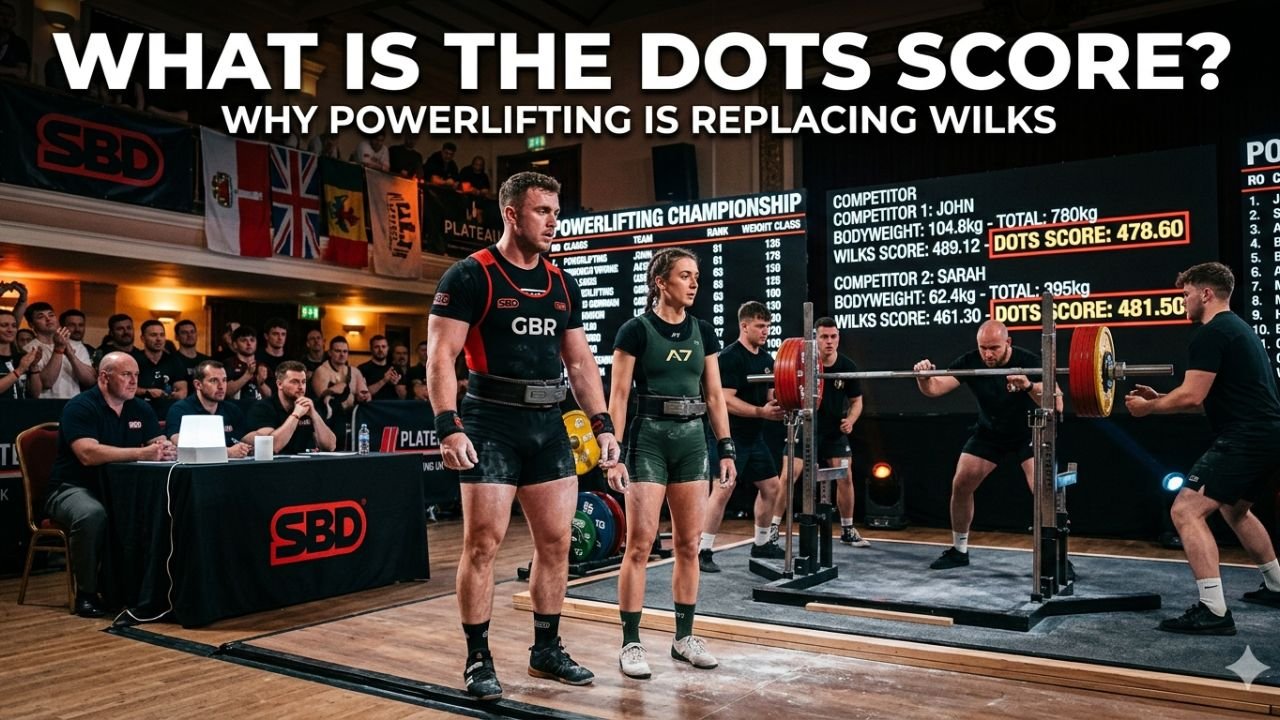
DOTS is a formula that gives every lifter a single score based on their total (the combined weight of their best squat, bench press, and deadlift) adjusted for their body weight. The higher your DOTS score, the more impressive your lifting is relative to your size.
Think of it like this: if you weigh 70kg and your friend weighs 100kg, and you both lift a total of 400kg, your DOTS score is going to be higher. Because lifting 400kg at 70kg bodyweight is genuinely harder and more impressive.
Where Did the DOTS Formula Come From?
DOTS was developed by Tim Konertz, a German powerlifter and statistician. He introduced it around 2018 as a response to growing criticism of the older Wilks formula. Konertz wanted to create something more statistically accurate and fairer across all weight classes,s especially for heavier and lighter lifters who were being shortchanged by the older system.
The word DOTS doesn’t stand for anything specific; it’s just the name given to the formula. But what it represents is a big step forward in how we measure powerlifting performance fairly.
How Is the DOTS Score Calculated?
Okay, here’s where it gets a little mathy, but don’t worry, I’ll keep it simple.
The DOTS formula uses your body weight to generate a coefficient. You then multiply that coefficient by your powerlifting total (squat + bench + deadlift). The result is your DOTS score.
The formula looks something like this:
DOTS Score = Total Lifted (in kg) × DOTS Coefficient
The coefficient itself is calculated using a polynomial equation that accounts for body weight. You don’t need to memorize the formula; there are free DOTS calculators all over the internet where you just plug in your numbers.
For example:
- A 75kg male lifter with a 500kg total might get a DOTS score of around 380–390.
- A 90kg male lifter with the same 500kg total would score lower, maybe around 350–360.
The important thing to understand is that the coefficient goes down as body weight increases (up to a point), which is what makes heavier lifters need to lift more to compete with lighter lifters on the scoreboard.
What Is a Good DOTS Score?
This is one of the most common questions beginners ask, and honestly, it depends on your level and goals. But here’s a rough general guide for male lifters:
- Under 200, you’re just starting. Keep training!
- 200–300 Intermediate range. You’ve got a solid foundation.
- 300–350 Advanced. You’re lifting more than most people.
- 350–400 Elite territory. Competitive at national levels.
- 400+ World-class. You’re competing with the best on the planet.
For female lifters, the numbers are slightly different because the DOTS formula uses separate coefficients for men and women. A score of 300+ for a female lifter is considered very strong. World-class female lifters often score 350 and above.
The beauty of DOTS is that you’re not competing against someone else’s total; you’re competing against your own coefficient. It gives everyone, regardless of weight class or gender, a fair shot at the top of the scoreboard.
What Was the Wilks Score, and Why Did People Use It?
Before DOTS, there was Wilks. For decades, the Wilks coefficient was the gold standard in powerlifting for comparing lifters across weight classes.
Robert Wilks, a former powerlifting official from Australia, developed the Wilks formula back in the early 1990s. It worked similarly to DOTS; it multiplied your total by a body-weight-based coefficient to give you a single comparable score.
And for a long time, it worked well enough. Many federations, including the International Powerlifting Federation (IPF), used Wilks to determine best lifter awards at meets.
But over time, people started noticing some problems.
Why Is DOTS Replacing Wilks?
Here’s where it gets interesting. The Wilks formula had some real flaws that became harder to ignore as the sport grew.
The problems with Wilks:
- It favored mid-range weight classes. Lighter lifters and heavier lifters consistently scored lower on Wilks compared to lifters in the middle weight classes (like 83kg or 93kg). This meant that someone lifting at an elite level in the 59kg class was being statistically undervalued.
- It wasn’t updated with modern data. The Wilks formula was based on older competition data from the 1990s. As the sport evolved and records changed, the formula became less accurate.
- Heavier lifters were penalized unfairly. Lifters in the 120kg+ class often felt the formula didn’t represent their relative strength properly.
DOTS fixed a lot of these issues. It was built using more modern competition data and a better polynomial fit across all body weight ranges. The result is a more even playing field.
In 2019, the IPF officially switched from Wilks to DOTS for its scoring system. That was a massive move. When the largest international powerlifting federation makes a switch, the rest of the world pays attention.
Many national federations followed suit, and today DOTS is widely considered the fairer and more modern standard.
Real-World Example: DOTS in Action
Let me give you a real-world scenario to make this click.
Imagine two lifters at the same competition:
Lifter A Body weight: 66kg, Total: 475kg Lifter B Body weight: 105kg, Total: 575kg
Just looking at the totals, Lifter B wins easily. But when you run the numbers through the DOTS calculator:
- Lifter A might score around 380 DOTS
- Lifter B might score around 355 DOTS
Suddenly, the lighter lifter comes out on top and rightly so. Lifting nearly 7x their bodyweight is an incredible feat. DOTS captures that.
This is exactly why DOTS matters at competitions where a “best lifter” award is given out. It’s not just about who moved the most weight; it’s about who performed the best relative to their size.
DOTS vs. Wilks: A Quick Side-by-Side
|
Feature |
Wilks |
DOTS |
|
Developed |
Early 1990s |
2018 |
|
Data Used |
Older records |
More modern records |
|
Fairness Across Weight Classes |
Uneven |
More balanced |
|
Used by IPF |
Until 2019 |
2019–present |
|
Gender Adjustment |
Yes |
Yes |
Practical Tips: How to Use Your DOTS Score
Now that you understand what DOTS means, here’s how you can actually use it in your powerlifting journey.
Track your progress over time. Your total in kg is great, but DOTS gives you a cleaner picture. If you gained 5kg of bodyweight and your total went up by 20kg, did you actually get relatively stronger? Your DOTS score will tell you the truth.
Set goal scores. Instead of just saying “I want to squat 200kg,” set a DOTS goal. Aiming for a 300 DOTS score gives you a target that adjusts as your weight changes.
Compare yourself fairly at meets. If you’re the lightest person in an open meet, your DOTS score lets you compete legitimately for best lifter honors against heavier athletes.
Use free calculators. Websites like Strength Level and various IPF-affiliated tools let you plug in your numbers instantly. Don’t do the math by hand; there’s no need.
Don’t obsess over it. DOTS is a tool, not a verdict on your worth as a lifter. Use it to learn, not to compare yourself negatively to others.
Does DOTS Apply to All Powerlifting Federations?
Not quite. While DOTS has become very popular, especially since the IPF adopted it, not every federation uses it.
Some federations still use Wilks. Others use their own formulas, like Glossbrenner or Reshel. And some newer formulas, like IPF GL Points, are also being used in certain contexts.
The key takeaway is that DOTS is now the most widely recognized modern coefficient, but you should always check which formula your specific federation uses before a competition. Don’t show up expecting DOTS scoring and find out they’re using something else!
Frequently Asked Questions
Is DOTS used for both raw and equipped powerlifting?
Yes! DOTS can be applied to both raw (no supportive gear) and equipped (with squat suits, bench shirts, etc.) powerlifting. The formula itself doesn’t change; it’s just applied to whatever total you lift in your respective category.
Can I use DOTS to compare my score to professional lifters?
Absolutely. That’s one of the coolest things about it. You can look up what world-record holders score on DOTS and use that as a long-term goal or benchmark. Most elite international lifters score 400+ DOTS.
Does body weight matter a lot in DOTS scoring?
Yes, but in a fair way. DOTS is designed so that you’re not rewarded just for being heavier. The coefficient adjusts accordingly. That said, being too light or cutting too much weight before a competition can hurt your total, which ultimately brings your score down. Balance is key.
What’s the difference between DOTS and IPF GL Points?
IPF GL Points (also called Goodlift Points) are another formula used specifically by the IPF in some of its competitions. They’re similar in concept to DOTS but use a slightly different calculation. Both are improvements over Wilks, and both aim for fairness across weight classes. DOTS is more widely used across multiple federations, while GL Points are IPF-specific.
I’m a beginner. Should I even care about my DOTS score yet?
Honestly? A little, yes, but don’t stress about it. As a beginner, your main job is to learn the lifts, build consistency, and stay healthy. But knowing your DOTS score can help you see how much progress you’re making beyond just the numbers on the bar. It’s a motivating tool, not a pressure point.
Conclusion
If you’ve made it this far, you now know more about DOTS scoring than most recreational lifters out there. And that knowledge can genuinely help you.
The DOTS score exists because powerlifting is a sport that celebrates strength in all shapes and sizes. A 60kg woman who deadlifts three times her body weight deserves to be recognized just as much as a 140kg man who pulls a monster total. DOTS makes that possible.
It replaced Wilks because it’s simply better, more accurate, more modern, and fairer across every weight class. And with the IPF backing it since 2019, it’s safe to say DOTS isn’t going anywhere.
So the next time you step on the platform, take a second to look up your DOTS score after the meet. It might just give you a whole new perspective on how strong you’ve become and how far you can still go.
Keep lifting, keep improving, and trust the process. The numbers will follow.