
If you’ve ever scrolled through fitness forums or tried to figure out how many calories you actually need, you’ve probably stumbled across two confusing acronyms: BMR and TDEE. And honestly? The more you read about them, the more jumbled it gets.
Here’s the thing: most fitness content makes this way harder than it needs to be. People throw around these terms like everyone knows what they mean, and if you don’t, you’re left feeling lost and frustrated.
But here’s the good news: understanding TDEE and BMR is actually pretty straightforward once someone explains it like a normal human being. And knowing the difference between these two can literally change how you approach fitness and nutrition.
In this guide, I’m going to break down exactly what BMR and TDEE are, why they’re different (and why both matter), and most importantly,y which one you should actually focus on tracking. Let’s jump in.
What is BMR? Understanding Your Baseline
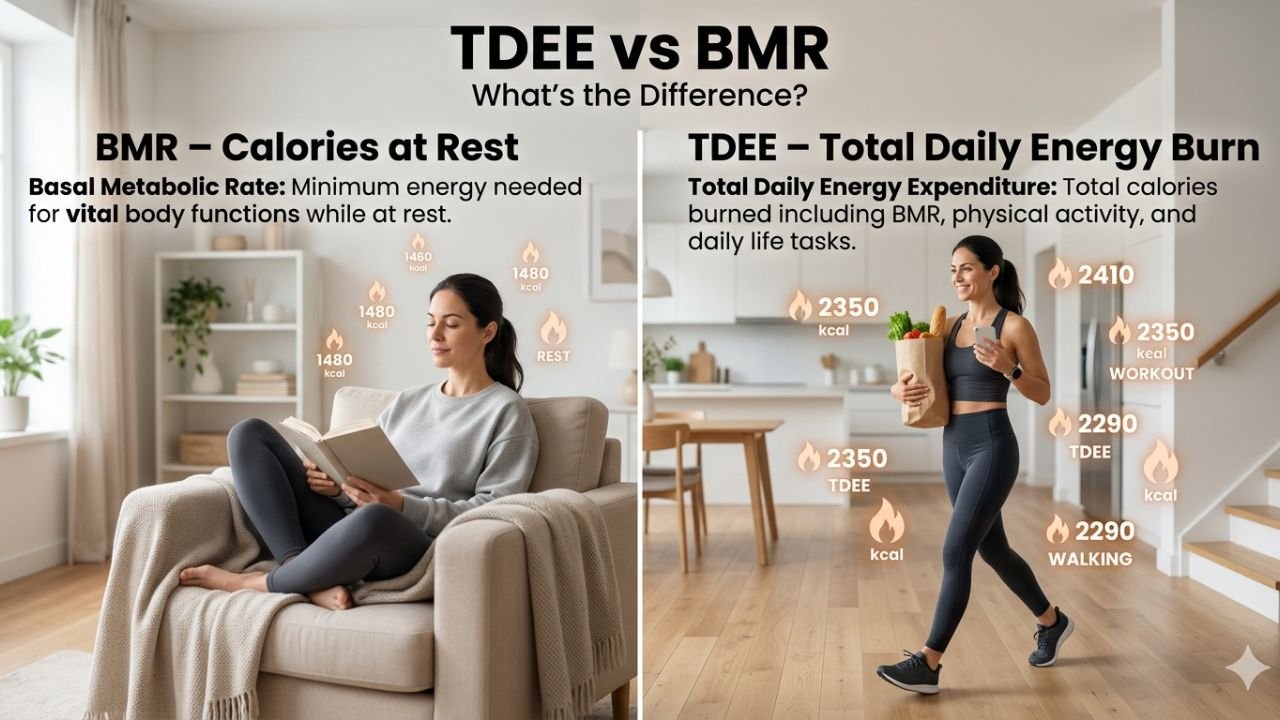
BMR stands for Basal Metabolic Rate. Think of it as the bare minimum number of calories your body burns just to exist.
Right now, even if you’re sitting on the couch doing absolutely nothing, your body is working. Your heart is beating, your lungs are breathing, your brain is thinking, and your cells are repairing themselves. All of that activity requires energy in the form of calories.
Your BMR is specifically what it takes to keep these basic life functions running. It’s the calories you’d burn if you literally did nothing but sleep for a day.
Here’s a practical way to think about it: If you were to put yourself in a dark, temperature-controlled room and tell you to lie there all day without moving, the calories you’d burn are roughly your BMR. It’s that foundational number.
BMR typically accounts for about 60-75% of your total daily calorie burn for most people (though this varies based on activity level). It’s mostly determined by:
- Your age (older people tend to have lower BMR)
- Your sex (men typically have higher BMR than women)
- Your body composition (muscle tissue burns more calories at rest than fat)
- Your height and weight
- Your genetics
For example, a 30-year-old woman who weighs 150 pounds might have a BMR of around 1,400 calories. That means her body burns 1,400 calories just existing, without any intentional movement.
What is TDEE? The Complete Picture
TDEE stands for Total Daily Energy Expenditure. This is the total number of calories you burn in an entire day, including everything.
So if BMR is just your baseline, TDEE is your baseline PLUS everything you do on top of that. It includes:
- Walking around your house
- Going to work
- Exercising
- Playing with kids or pets
- Fidgeting, stretching, and random movements
- Everything else that requires energy
TDEE is basically the answer to the question: “How many total calories am I burning today?”
Let’s stick with that 30-year-old woman from before. If her BMR is 1,400 calories and she has a moderately active lifestyle (gym 3-4 times a week, regular work), her TDEE might be around 2,100 calories per day. Those extra 700 calories come from her daily activities and workouts.
TDEE = BMR + all activity on top of resting metabolism
This is why TDEE is the number that actually matters when you’re trying to lose weight, gain muscle, or maintain your current situation. It tells you how many calories you’re actually burning in real life, not in a hypothetical do-nothing scenario.
TDEE vs BMR: The Key Differences
Let me put these side-by-side so you can see exactly how they differ:
BMR (Basal Metabolic Rate):
- Calories burned at complete rest
- Doesn’t include any daily activity
- Stays pretty stable day-to-day
- About 60-75% of the total calorie burn
- Mostly genetic and fixed (harder to change)
TDEE (Total Daily Energy Expenditure):
- Calories burned throughout the entire day
- Includes all movement and activity
- Fluctuates based on what you do
- The full picture of your calorie burn
- Influenced by your choices (exercise, movement)
Here’s the analogy that made it click for me: BMR is like the base model of a car, and TDEE is the car fully loaded with all the options and features. The base model is important to know, but the fully loaded version is what you actually drive.
Which One Should You Actually Track?
Okay, this is the million-dollar question. And here’s my honest answer: You should focus on TDEE, not BMR.
Here’s why.
When you’re trying to lose weight, gain muscle, or change your body composition, what matters is how many total calories you’re burning and eating. BMR is interesting from a scientific standpoint, but it’s not the number that’s going to guide your nutrition decisions.
If you only knew your BMR was 1,400 calories, you might think you could eat 1,400 calories and maintain your weight. But if your TDEE is actually 2,100 calories, you’d actually be eating at a huge deficit and losing weight way faster than you intended.
That said, understanding BMR is helpful because:
- It helps you understand how much your baseline metabolism contributes to your total burn
- It shows you that your body is always burning calories, even when you’re resting
- It can motivate you, knowing that just existing burns significant energy
- It helps you understand why you can’t just “starve yourself” into weight loss (you still need energy for basic functions)
But for practical purposes? Knowing your TDEE is what changes the game.
How to Calculate Both (The Simple Way)
Calculating BMR
There are fancy equations like the Mifflin-St Jeor formula, but here’s the thing:g they’re pretty annoying to do by hand. The good news is that most online calculators do this for you.
Generally, you’ll need:
- Your age
- Your sex
- Your height
- Your current weight
Pop these into any BMR calculator online, and boom, you’ve got your number.
Calculating TDEE
Once you know your BMR, calculating TDEE is straightforward. You multiply your BMR by an activity factor:
- Sedentary (little to no exercise): BMR × 1.2
- Lightly active (exercise 1-3 days/week): BMR × 1.375
- Moderately active (exercise 3-5 days/week): BMR × 1.55
- Very active (exercise 6-7 days/week): BMR × 1.725
- Extremely active (intense daily exercise): BMR × 1.9
So if that woman from before has a BMR of 1,400 and exercises 4 days a week, her TDEE would be: 1,400 × 1.55 = 2,170 calories per day.
That’s a much more useful number for actual nutrition planning.
Real-Life Examples (This Is Where It Clicks)
Example 1: Sarah’s Weight Loss Journey
Sarah is a 28-year-old woman, 5’5″, weighing 165 pounds. She calculated her BMR at 1,450 calories. She’s currently sedentary but wants to lose weight and start exercising.
Her TDEE right now (sedentary): 1,450 × 1.2 = 1,740 calories
If she just knows her BMR, she might think eating around 1,450 calories is maintenance. But she’s actually burning 1,740 calories daily without any additional exercise. If she ate 1,450 calories, she’d already be in a deficit of 290 calories.
Once she starts exercising 4 times a week, her TDEE jumps to: 1,450 × 1.55 = 2,248 calories.
Now she has much more flexibility. She could eat 1,750 calories and create a healthy deficit without feeling deprived. Without knowing this, she might have made the mistake of eating too little, ruining her metabolism and energy levels.
Example 2: James’ Muscle Gain Goal
James is a 35-year-old man, 5’10”, weighing 180 pounds. His BMR is 1,750 calories. He’s moderately active and wants to build muscle.
His TDEE (moderate activity): 1,750 × 1.55 = 2,713 calories
To build muscle, he needs to eat in a slight surplus. Knowing his TDEE, he can aim for 2,900-3,000 calories per day, getting adequate protein to support muscle growth. If he only knew his BMR, he’d have no idea where to start.
Practical Tips for Using These Metrics
Use TDEE as Your Starting Point
Calculate your TDEE and use it as your baseline for nutrition planning. If you want to lose weight, aim for 300-500 calories below your TDEE. If you want to gain, aim for 300-500 above.
Track What Actually Matters
After you know your TDEE, focus on eating close to that number (or your target number, depending on your goals). Tracking BMR separately doesn’t add much practical value.
Be Honest About Your Activity Level
The activity multipliers only work if you’re realistic about your actual activity. If you say you’re “very active” but you hit the gym once a week, your calculations will be way off.
Expect Some Variation
Your actual calorie burn varies day-to-day. If you run a marathon on Tuesday, you’ll burn way more than your TDEE. If you lie in bed all day Wednesday, you’ll burn less. TDEE is an average, not a gospel.
Adjust as You Change
As you lose or gain weight, your BMR changes, which means your TDEE changes. Recalculate every 10-15 pounds of weight change.
Remember That Calories Aren’t Everything
Just knowing you should eat 2,200 calories isn’t enough. The source of those calories matters. 2,200 calories of junk food isn’t the same as 2,200 calories of whole foods.
Frequently Asked Questions
Should I eat at my BMR or my TDEE?
You should never eat below your BMR for extended periods; that’s not sustainable or healthy. You should eat around your TDEE (adjusted for your goals). Eating below your TDEE creates a deficit for weight loss, and eating above creates a surplus for muscle gain.
Can I increase my BMR?
Not dramatically, but you can increase it slightly by building muscle (muscle tissue is more metabolically active than fat). You can also increase your TDEE much more easily through exercise and daily activity.
Why do online calculators give me different numbers?
Different calculators use different formulas and make different assumptions. The Mifflin-St Jeor, Harris-Benedict, and Katch-McArdle formulas can give slightly different results. Pick one and stick with it, then adjust based on real results.
Is TDEE accurate?
TDEE calculations are estimates. They’re usually pretty close, but individual variation exists. Use the calculated number as a starting point, then adjust based on how your body actually responds over 2-3 weeks.
Do I need to track calories at all?
No, but for most people trying to reach specific fitness goals, having an idea of your calorie intake is helpful. Some people do better with intuitive eating, but knowing your TDEE gives you the knowledge to make informed decisions either way.
Conclusion
BMR is your calorie burn at rest. It’s interesting to know, but not super practical for daily decisions.
TDEE is your total calorie bur. This is the number that actually helps you plan your nutrition and reach your goals.
Focus on knowing your TDEE, plan your nutrition around it, and adjust based on real results. That’s it. That’s the secret that most fitness content doesn’t want to tell you because it’s not complicated enough to sell expensive programs.
You don’t need to become a calorie-counting obsessive. You just need to understand roughly how many calories you’re burning so you can make informed decisions about how many you’re eating.
If you want to lose weight, get stronger, gain muscle, or just feel better, understanding these numbers gives you the foundation to make a real plan instead of just guessing. And honestly? That’s what separates people who get results from people who just spin their wheels.
Now that you know the difference, go calculate your TDEE and use that information to move toward your actual goals. You’ve got this.