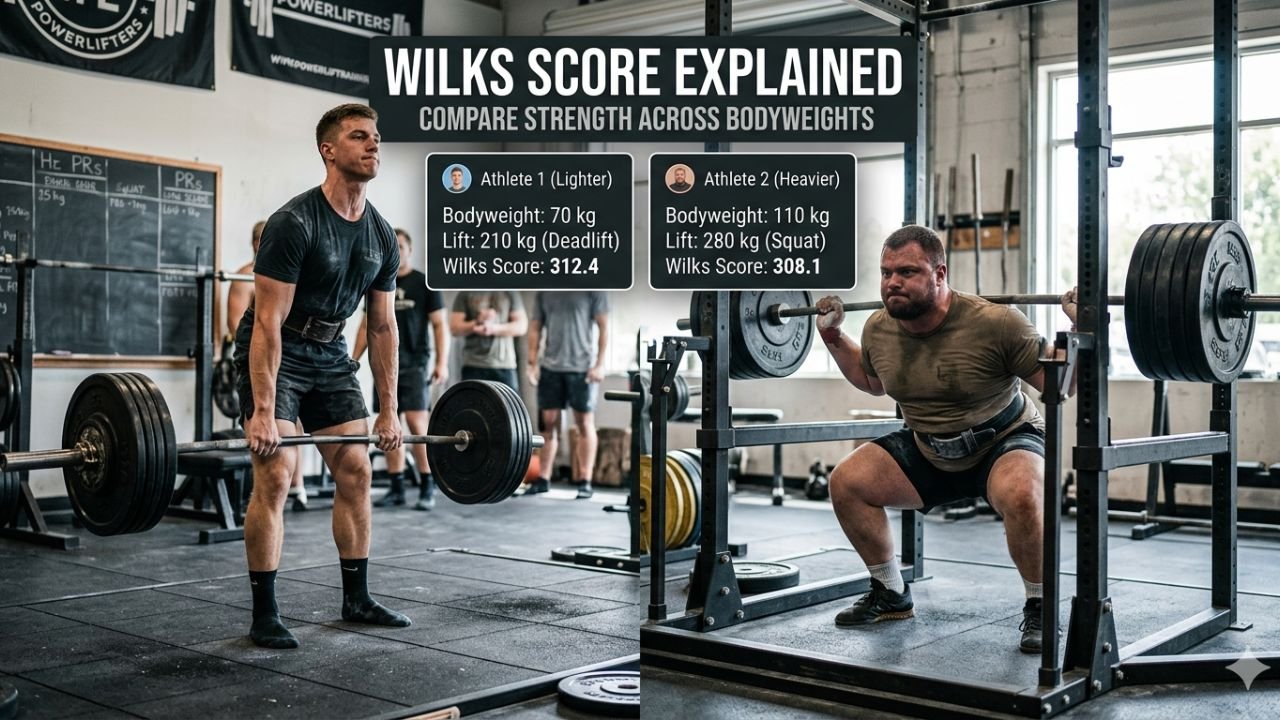
Imagine two powerlifters standing on the same stage. One weighs 60 kg and just squatted 150 kg. The other weighs 120 kg and squats 250 kg. Who’s stronger? The heavier lifter moved more weight, but is that the whole story?
This is the kind of question that keeps powerlifting coaches, competitors, and fans up at night. And honestly, it’s a fair one to ask. Comparing lifters across different weight classes feels like comparing apples to oranges. That’s exactly why the Wilks Score exists.
Whether you’re a competitive powerlifter, a gym enthusiast curious about where you stack up, or just someone who loves the sport, understanding the Wilks Score can completely change how you look at strength. Let’s break it all down in plain, simple language, no math degree required.
What Is the Wilks Score, Exactly?
The Wilks Score (also called the Wilks Coefficient) is a formula used in powerlifting to level the playing field between athletes of different body weights. It was developed by Robert Wilks, the former CEO of Powerlifting Australia, and it became one of the most widely used tools for comparing total lifts across weight classes.
Here’s the simple version: the heavier you are, the more you’re expected to lift. But the Wilks Score adjusts for that expectation. It rewards lifters who outperform what their body weight would predict, giving every athlete, big or small, a fair shot at being recognized as the strongest.
Think of it like golf’s handicap system. It doesn’t eliminate the differences between players; it accounts for them, so competition stays meaningful.
Why Bodyweight Comparison Matters in Powerlifting
Raw numbers can be misleading. A 130 kg lifter benching 200 kg sounds impressive. But a 60 kg lifter benching 140 kg? That’s actually a much more remarkable feat relative to body size.
Without a standardized comparison tool, strength sports would always favor heavier athletes. Bigger bodies tend to have:
- More total muscle mass
- Greater bone density
- Longer leverage in certain lifts
- A higher hormonal baseline for muscle building
None of that makes heavy lifters “cheaters.” Biology is biology. But it does mean that lighter lifters deserve a fair way to compete for overall recognition. The Wilks Score provides exactly that.
How the Wilks Score Is Calculated
Okay, here’s where it gets a little technical, but don’t worry, I’ll keep it friendly.
The Wilks Score is calculated using this formula:
Wilks Score = Total Lifted (kg) × Wilks Coefficient
The Wilks Coefficient is derived from a polynomial equation based on the lifter’s body weight. It uses different coefficients for men and women because the relationship between body weight and strength potential differs between sexes.
The formula looks intimidating on paper (it involves six constants labeled a through f), but in practice, you never need to calculate it by hand. There are dozens of free online Wilks Score calculators where you just plug in:
- Your body weight
- Your total lift (squat + bench press + deadlift)
- Your sex
And the calculator spits out your score in seconds.
A Quick Real-Life Example
Let’s say:
- Lifter A weighs 75 kg and has a powerlifting total of 500 kg
- Lifter B weighs 110 kg and has a powerlifting total of 620 kg
Looking at raw totals, Lifter B wins easily. But when you apply the Wilks formula:
- Lifter A’s Wilks Score might come out to around 330
- Lifter B’s Wilks Score might come out to around 310
Suddenly, Lifter A, the lighter competitor, is actually performing at a higher level relative to their body weight. The Wilks Score flipped the result, and that’s exactly what it’s designed to do.
(Note: these are illustrative numbers; use a calculator for precise results.)
How to Use the Wilks Score Step by Step
Using the Wilks Score doesn’t have to be complicated. Here’s a simple, practical guide:
Step 1: Know Your Total
In powerlifting, your “total” is the combined weight of your best squat, bench press, and deadlift in a competition. If you’re not competing, just add up your best lifts in training.
Step 2: Find Your Body Weight
Use your competition weigh-in weight, or just your current body weight if you’re using it for personal tracking. Make sure you’re consistent, don’t use your morning weight one day and your post-meal weight another.
Step 3: Use a Wilks Calculator
Head to a trusted resource like:
- Strength Level (strengthlevel.com)
- Open Powerlifting (openpowerlifting.org)
- Wilks Calculator tools on various lifting apps
Enter your body weight, total, and sex. Hit calculate.
Step 4: Interpret Your Score
Here’s a rough guide for interpreting Wilks Scores for recreational and competitive lifters:
| Wilks Score | Level |
| Below 150 | Beginner |
| 150 – 250 | Intermediate |
| 250 – 350 | Advanced |
| 350 – 450 | Elite Amateur |
| Above 450 | World-Class |
These are general benchmarks and can vary by federation and era. But they give you a solid starting point.
Step 5: Track It Over Time
One of the best uses of the Wilks Score is personal tracking. Log your score every few months. Are you getting stronger relative to your body weight? Are you improving your efficiency as a lifter? Your Wilks Score tells you that story better than your raw total alone.
Wilks Score vs. Other Comparison Methods
The Wilks Score isn’t the only tool out there. Over the years, other formulas have been developed to address its limitations. Here are the main competitors:
IPF Points (GL Points)
The International Powerlifting Federation moved away from the Wilks Score in 2019, replacing it with IPF Points (also called the Goodlift Formula or GL Points). This formula was built using a larger, more modern dataset and is considered more statistically accurate for today’s lifters.
If you compete in IPF-affiliated federations, your official ranking uses GL Points, not Wilks.
Dots Score
The DOTS formula is another alternative that many federations now use. It’s similar in concept to Wilks but uses a different mathematical approach. Some lifters and coaches feel it handles extreme body weights (very light or very heavy lifters) more fairly.
Schwartz/Malone Coefficients
These are older systems used specifically in weightlifting (Olympic-style), not powerlifting. They follow the same general idea but are calibrated differently.
So Which One Should You Use?
- For personal comparison and fun: Wilks Score is perfectly fine — it’s well-known and easy to find calculators for.
- For official competition: Check your federation’s rules. IPF uses GL Points; many other feds still use Wilks.
- For academic or research purposes, GL Points or DOTS may be more appropriate.
Practical Tips for Improving Your Wilks Score
If you want to boost your Wilks Score, you’ve got two levers to pull: increase your total, or manage your body weight more effectively (or both).
Here are some tips that actually work:
Improve Your Big Three Lifts
- Hire a coach or follow a structured powerlifting program like 5/3/1, Sheiko, or GZCLP
- Focus on weak points if your deadlift is lagging, address it directly
- Don’t neglect accessory work that supports your main lifts
Optimize Your Body Composition
- More muscle at the same body weight means a better Wilks Score
- Consider working with a sports nutritionist if body composition is a major goal
- Avoid crash dieting before competitions, it tanks performance and doesn’t help long term
Be Consistent
- Strength builds slowly. Track your Wilks Score quarterly, not weekly
- Progress in powerlifting is measured in months and years, not days
Compete (Even Locally)
- Competition totals are often higher than gym totals due to adrenaline and focus
- Real meet experience teaches you how to peak properly
Who Benefits Most from Using the Wilks Score?
Honestly? Everyone involved in strength sports can benefit from understanding the Wilks Score, but here are the people who get the most out of it:
Lighter Lifters The Wilks Score is a massive morale boost for athletes in lower weight classes who are outperforming athletes twice their size. It gives them the recognition they deserve.
Coaches, when you’re working with multiple athletes across different weight classes, the Wilks Score helps you objectively evaluate who’s progressing, who’s peaking, and who needs more attention.
Meet Directors and Judges. Best lifter awards at powerlifting meets are almost always determined by Wilks Score or an equivalent formula.
Gym Enthusiasts Even if you never compete, comparing your Wilks Score with friends or online standards adds a fun, motivating dimension to your training.