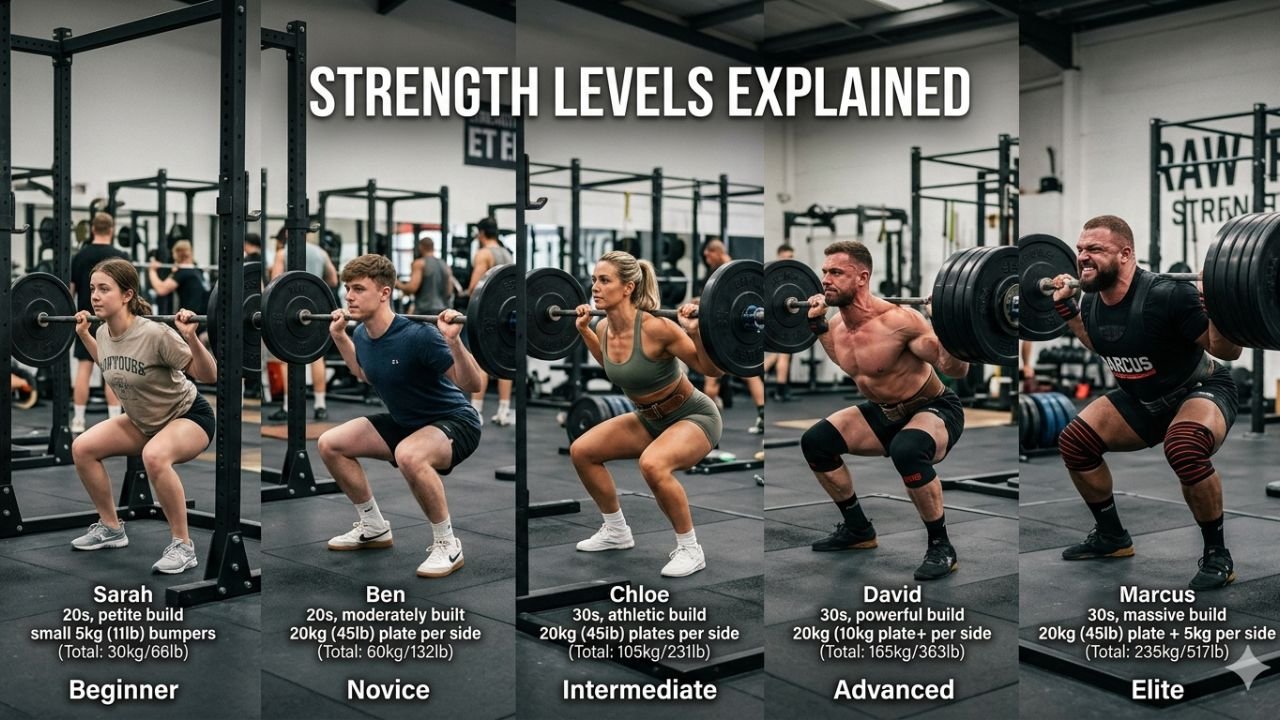
Let’s be honest, most of us have no idea where we really stand when it comes to strength.
You’ve been going to the gym for a year or two. You’re squatting more than you did on day one. You feel stronger. But then someone in a Facebook fitness group calls themselves “intermediate,” and you think… wait, am I intermediate too? Or am I still a beginner? And what does any of this even mean?
Here’s the thing: strength levels aren’t just labels. They’re incredibly useful tools. They help you set realistic goals, choose the right training program, avoid frustrating plateaus, and, maybe most importantly, stop comparing yourself to people who are playing a completely different game than you.
In this post, we’re going to break down every strength level: beginner, novice, intermediate, advanced, and elite in plain, simple English. No gatekeeping. No intimidation. Just clarity.
Whether you’re just picking up a barbell for the first time or you’ve been at it for years, this guide will help you figure out exactly where you are and what to do next.
Why Strength Levels Even Matter
Before we dive in, let’s address the elephant in the room: why should you care what “level” you are?
Because training that’s wrong for your level is one of the biggest reasons people stall, get injured, or quit altogether.
A beginner doing an advanced powerlifting program is like a new driver jumping onto a Formula 1 track. Technically possible. Practically disastrous.
Strength levels also help you:
- Choose the right program. Beginner programs are built differently from advanced ones for good reason
- Set realistic expectations, knowing your level helps you understand how fast progress actually comes
- Track your progress objectively; it’s not just about how you feel, but where you stand
- Communicate with coaches and the fitness community, shared language matters
Alright, let’s get into it.
Beginner Strength Level: Everyone Starts Here
What It Means
A beginner is someone who has been training with weights consistently for less than six months or someone who has been going to the gym on and off for years but never really followed a structured program.
The defining characteristic of a beginner isn’t weakness. It’s neurological inefficiency. Your muscles might have potential, but your nervous system hasn’t learned how to recruit muscle fibers effectively yet. Basically, you haven’t learned how to “use” your body properly under load.
What Beginner Strength Looks Like
For most adult men at the beginner level, common benchmarks look something like this:
- Squat: Around bodyweight or less
- Deadlift: Around 1.25x bodyweight
- Bench press: Around 0.5–0.75x bodyweight
Women’s numbers will be lower relative to bodyweight in upper body lifts, but the gap closes significantly in lower body movements.
These aren’t rules carved in stone; they’re reference points.
The Good News About Being a Beginner
Here’s something nobody tells beginners enough: this is the best time to be training.
Why? Because of a glorious phenomenon called newbie gains. When you first start lifting, your body responds dramatically to even modest training. You can get noticeably stronger almost every single week just by showing up consistently and eating enough protein.
Enjoy it. It doesn’t last forever.
What Beginners Should Focus On
- Learning proper movement patterns (squat, hinge, press, pull)
- Training 3 days per week with full-body programs
- Eating enough to support recovery
- Not overcomplicating things seriously, keep it simple
Novice Strength Level: You’re Past the Honeymoon Phase
What It Means
A novice is someone who has been training consistently for roughly 6 months to a year and has moved past the initial explosive period of newbie gains. Progress still comes relatively fast; weekly or bi-weekly improvements are still realistic, but it’s no longer automatic.
At this stage, you’ve developed decent form on the main lifts and have built a real foundation of muscle and movement skill.
What Novice Strength Looks Like
- Squat: Around 1.25–1.5x bodyweight
- Deadlift: Around 1.5–2x bodyweight
- Bench press: Around 0.75–1x bodyweight
Again, these are generalizations. Individual variation is huge.
What Novices Should Focus On
- Still running linear progression programs (adding weight regularly)
- Starting to pay more attention to recovery and sleep
- Learning to eat more strategically, protein timing, and caloric awareness
- Avoiding the trap of jumping to intermediate programming too early
The novice stage is where a lot of people make the mistake of thinking they’re more advanced than they are. Stick with what’s working. If you’re still adding weight every week or two, you’re not out of novice territory yet, and that’s a good thing.
Intermediate Strength Level: This Is Where Most Dedicated Lifters Live
What It Means
Intermediate is probably the most misunderstood level. It gets used as a catch-all term, but it has a real definition: an intermediate lifter can no longer make progress every session or even every week. Progress comes in cycles, typically over weeks or months.
You’ve been training seriously for 1–3 years. Your form is solid. You know what you’re doing. But the gains have slowed considerably compared to your early days.
What Intermediate Strength Looks Like
- Squat: Around 1.5–2x bodyweight
- Deadlift: Around 2–2.5x bodyweight
- Bench press: Around 1–1.5x bodyweight
The Mental Challenge of Being Intermediate
This is where training gets hard, not just physically, but psychologically.
You remember how fast progress used to come. Now you’ve been grinding for months to add 10 pounds to your squat. It can feel demoralizing.
But here’s the reframe: adding 20 pounds to your squat in a year as an intermediate is actually extraordinary progress. You’re no longer a new driver. You’re navigating real terrain now.
What Intermediates Should Focus On
- Switching to weekly or monthly progression models (not daily)
- Adding periodization to their training, things like wave loading, deload weeks, and accessory work
- Paying serious attention to sleep, nutrition, and stress management
- Picking a clear goal: strength, hypertrophy (muscle size), or performance
Advanced Strength Level: Few People Get Here, and That’s Okay
What It Means
An advanced lifter has been training seriously and consistently for 3–5+ years. Progress is measured over months, sometimes longer. Every pound added to the bar requires intelligent programming, disciplined recovery, and often real sacrifice.
Advanced lifters typically have very well-developed muscle mass, refined technique, and a deep understanding of how their body responds to training.
What Advanced Strength Looks Like
- Squat: Around 2–2.5x bodyweight
- Deadlift: Around 2.5–3x bodyweight
- Bench press: Around 1.5–2x bodyweight
What Makes Advanced Different
It’s not just the numbers. It’s the thinking behind the training.
An advanced lifter doesn’t just show up and lift. They manage fatigue, plan training blocks months in advance, adjust based on life stressors, and make micro-adjustments to their nutrition around their training cycle.
At this point, the margin for error is tiny. Sleep one hour less per night for a week? You’ll feel it in your training. Eat a little below maintenance for a month during a hard training block? Your recovery tanks.
What Advanced Lifters Should Focus On
- Highly individualized programming often works with a coach
- Competing (if interested) to have objective benchmarks
- Managing cumulative fatigue carefully with planned deloads
- Protecting their joints and longevity above all else
Elite Strength Level: This Is Genetic Lottery Territory
What It Means
Elite lifters represent the top 1% (or less) of the strength training population. We’re talking about people who have likely been training for 5–10+ years, often competed at a national or international level, and in many cases have genetic advantages that most people simply don’t have.
This isn’t a knock on anyone; it’s just reality. Elite performance in any physical discipline involves a combination of hard work, smart training, and genetics.
What Elite Strength Looks Like
Elite standards vary heavily by body weight and federation, but as a rough guide:
- Squat: 2.5–3x bodyweight or more
- Deadlift: 3–3.5x bodyweight or more
- Bench press: 2x bodyweight or more
Some elite powerlifters pull 4x their bodyweight. These numbers seem surreal because they are for most humans.
The Reality Check
Here’s something important: you don’t have to be elite to have an amazing, healthy, strong body.
The vast majority of the benefits from strength training, better health markers, improved body composition, more confidence, reduced injury risk, and greater longevity, are fully available to beginners, novices, and intermediates.
Chasing elite numbers without the genetics, lifestyle, or goals to support it is a recipe for injury and burnout.
Practical Tips: How to Use Your Strength Level Effectively
No matter where you are right now, here are some universal truths that apply across all levels:
- Be honest about your level. Overestimating where you are leads to poor program choices and stalled progress.
- Use a calculator as a reference, not a verdict. Sites like Strength Level or symmetricstrength.com let you plug in your lifts and get a rough classification. Useful, not gospel.
- Progress, don’t compare. The only meaningful comparison is you vs. you six months ago.
- Hire a coach if you’re stuck. This is especially true at intermediate and above; a good coach can shortcut years of guesswork.
- Track your lifts. You can’t know you’re progressing if you’re not keeping records.
Frequently Asked Questions
Can I be at a different level in different lifts?
Absolutely. It’s completely normal to be intermediate in the squat but still novice in the overhead press. Train each lift based on where you actually are in that movement.
How do I know if I’ve moved from beginner to novice?
The simplest way: if you can no longer add weight to the bar every single session (assuming you’re sleeping and eating well), you’ve moved past beginner.
Are strength level standards different for men and women?
Yes. Women generally have less absolute strength due to differences in muscle mass and hormonal profiles, particularly in upper-body movements. Most reputable strength standards are adjusted by sex and bodyweight.
Do body weight and age affect strength levels?
Yes, both matter. Heavier lifters can typically move more absolute weight. Older lifters may plateau sooner or need more recovery. Strength standards are most meaningful when compared within similar weight classes and age groups.
Is it worth trying to reach elite strength?
For most people? Probably not as a goal in itself. But if you love competing and have the genetics and lifestyle to support it, go for it. For everyone else, aiming for “strong intermediate to advanced” will give you an incredible physique and all the health benefits you could want.
Conclusion
Strength levels are tools, not judgments.
Whether you’re a beginner still figuring out how to squat without your knees caving in, or an advanced lifter grinding for a 10-pound deadlift PR over six months, you’re doing the work. That already puts you ahead of most.
What matters more than the label is the direction you’re moving. Are you training consistently? Are you recovering well? Are you a little stronger than you were last month?
Then you’re doing it right.
Understand your level. Train accordingly. Trust the process. And stop comparing your chapter three to someone else’s chapter twenty.
Now lift something.