Ever Felt Like You’re Guessing at the Gym?
You’ve probably been there. You finish a workout, and someone asks, “How hard did you push today?” You shrug and say, “Pretty hard, I guess?” But what does that even mean?
Here’s the thing: most beginners (and even some experienced gym-goers) train completely by feel without any real system behind it. Some days they go too easy and wonder why they’re not progressing. Other days, they go so hard they can barely walk the next morning.
What if there was a simple, science-backed way to measure exactly how hard you’re working without any fancy equipment, heart rate monitors, or expensive gadgets?
There is. It’s called RPE, Rate of Perceived Exertion, and once you understand it, your workouts will never be the same.
This guide is going to break it all down for you in plain, simple English. No jargon. No confusion. Just real, practical knowledge that you can start using today.
What Is RPE (Rate of Perceived Exertion)?
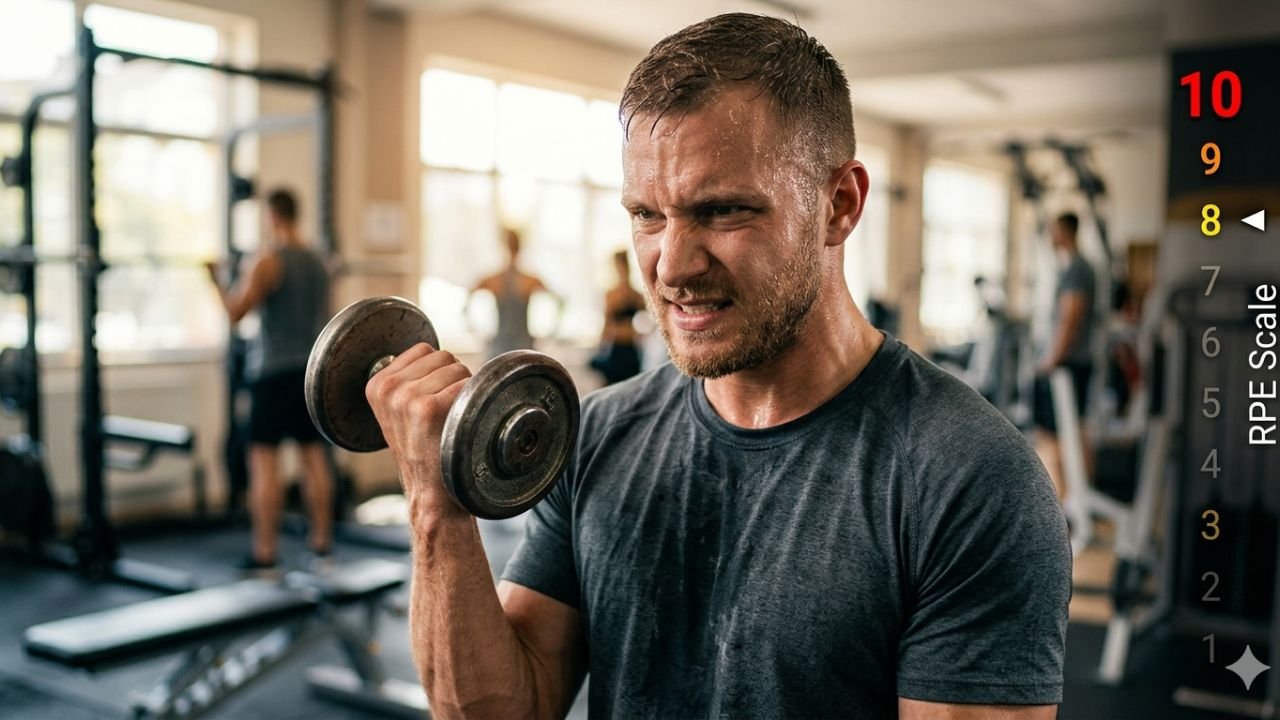
RPE stands for Rate of Perceived Exertion. In simple terms, it’s a scale that measures how hard your body feels like it’s working during exercise.
Think of it like a pain-and-effort meter in your own head. It’s completely personal. It’s based on how you feel your breathing, your muscle fatigue, your overall effort, not what a machine or a number on a screen tells you.
The idea was originally developed by Swedish scientist Dr. Gunnar Borg back in the 1960s. He created what’s now called the Borg Scale, which originally ran from 6 to 20. But over the years, a simpler version of the 1 to 10 RPE scale became popular in fitness communities, and that’s the one most coaches and trainers use today.
Here’s the short version:
- RPE 1–2: Almost no effort. You’re basically just sitting still.
- RPE 3–4: Easy. Light movement, warm-up pace.
- RPE 5–6: Moderate. You’re working, but you could hold a conversation.
- RPE 7–8: Hard. Breathing is heavy. Talking is tough.
- RPE 9: Very hard. You can push maybe one or two more reps, but it’s a real struggle.
- RPE 10: Maximum effort. Everything you’ve got. Completely spent.
That’s it. That’s the whole system at its core.
Why Does RPE Matter for Beginners?
You might be thinking, “Okay, but why can’t I just count reps and sets like everyone else?”
Great question. And the honest answer is that counting reps is useful, but it doesn’t tell the whole story.
Here’s a real-life example. Imagine two people both bench press 100 pounds for 10 reps. For one person, that’s RPE 6 manageable, with a few reps left in the tank. For the other person, it’s RPE 9; they’re shaking, gasping, barely squeezing out that last rep.
Same weight. Same reps. Completely different experience and training effect.
RPE helps you understand your personal effort level, and that’s gold when it comes to building a smarter training plan.
For beginners, especially, RPE is powerful because:
- Your body is still adapting. What felt like RPE 8 three months ago might now feel like RPE 5. RPE helps you track that progress.
- You don’t have a baseline yet. You might not know your one-rep max on exercises, so RPE gives you a way to gauge effort without needing that data.
- It prevents overtraining. Beginners often go too hard too soon. RPE teaches you to listen to your body rather than push blindly.
- It’s flexible. Bad sleep? Stressed at work? Your RPE will naturally reflect that, and you can adjust your training accordingly.
Breaking Down the RPE Scale: What Each Level Really Feels Like
Let’s get really practical here. Numbers are great, but feelings are better. Here’s what each RPE zone actually feels like in your body.
RPE 1–3: The “I Could Do This All Day” Zone
This is your warm-up territory. A slow walk, gentle stretching, or a light jog. Your breathing is easy and relaxed. You could sing a full song without losing your breath. This isn’t really “training,” it’s more like moving your body.
Example: A 10-minute casual walk to warm up before a run.
RPE 4–5: The “Comfortably Working” Zone
Now you’re actually exercising. Your heart rate is up a bit. You’re breathing a little harder, but you could still hold a full conversation. You might feel a light sweat coming on.
Example: A moderate bike ride on flat ground, or light resistance training with weights that feel easy.
RPE 6–7: The “Working Hard but Sustainable” Zone
This is the sweet spot for a lot of training sessions. You’re breathing noticeably. Talking is possible, but you’d prefer short sentences. You feel the effort, but you’re not falling apart.
Example: A 5K run at a pace you could maintain for 30–45 minutes. Or squats, where you could do a few more reps, but it’s getting challenging.
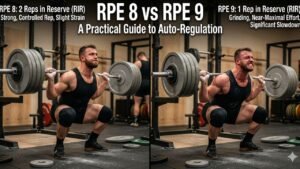
RPE 8: The “This Is Tough” Zone
You’re working hard. Your muscles are burning. Conversation is limited to a word or two. You’re focused. This is where real progress happens for most intermediate to advanced training goals.
Example: Your last few sets of strength training where you’re leaving 1–2 reps in reserve.
RPE 9: The “Almost Everything” Zone
You could do one more rep. Maybe. You’re breathing hard. Your face is probably red. You’re very close to your max, but not quite there.
Example: Your second-to-last set before going to failure.
RPE 10: Maximum Effort
Total exertion. You literally cannot do one more rep or run one more step. Everything is exhausted. This should be rare in training; it’s not sustainable and increases injury risk if done too often.
Example: A true one-rep max on a barbell squat with everything you’ve got.
How to Use RPE in Your Actual Workouts
Knowing the scale is one thing. Using it is another. Here’s how to actually apply RPE in your training life.
Start Every Session With a Check-In
Before you even pick up a weight or lace up your shoes, ask yourself: “How am I feeling today physically and mentally?” If you slept poorly or you’re stressed, your natural RPE for the same workout will likely feel higher. That’s okay. Adjust accordingly.
Use RPE as a Rep Guide
Instead of just saying “do 3 sets of 10,” many coaches now prescribe workouts like this: “3 sets of 8 at RPE 7.” That means your 8th rep should feel like a 7 moderately hard, with about 3 reps left in the tank.
This is a far more intelligent way to train because it accounts for how you’re actually feeling that day.
Track Your RPE Over Time
Keep a simple training journal. Write down the exercise, weight, reps, and RPE. Over weeks and months, you’ll notice patterns. If the same weight that was RPE 8 three months ago now feels like RPE 5, congratulations, you’ve made real progress.
Use RPE to Know When to Push and When to Pull Back
Feeling like everything is RPE 9 today, even in your warm-up? That might be a sign of fatigue or early illness. Use RPE as your body’s check-engine light. It’s smarter than ignoring how you feel and pushing through blindly.
Common Mistakes Beginners Make With RPE
Even with a simple system like RPE, people make mistakes. Here are the most common ones to avoid.
- Rating too low because of ego. Some beginners don’t want to admit they’re struggling, so they say RPE 7 when it’s really a 9. Be honest with yourself. Nobody’s judging.
- Rating too high because of anxiety. First time doing an exercise? Everything might feel like RPE 9 simply because it’s unfamiliar. Give yourself a few weeks to calibrate.
- Ignoring RPE completely. Some people track everything else, calories, steps, sleep, but never think about training intensity. That’s a missed opportunity.
- Using RPE 10 every session. Going all-out every workout is a fast road to burnout and injury. Most of your training should live between RPE 6 and 8.
Practical Tips to Get Better at Reading Your RPE
The more you practice, the more accurate your RPE ratings become. Here are some tips to speed up that process.
- Focus on your breathing. Your breath is one of the best real-time indicators of effort. Short, gasping breaths = high RPE.
- Check your muscles. Are they burning? Fatiguing? How many more reps could you realistically do?
- Notice your mental state. At RPE 9–10, many people feel a strong urge to stop. That mental resistance is real data.
- Compare workouts. Over time, comparing how different sessions felt will sharpen your internal scale.
- Talk to yourself mid-set. Could you have a conversation right now? That simple test is surprisingly accurate.
Benefits of Training With RPE
Let’s step back and look at the bigger picture. Why is RPE worth using consistently?
- No equipment needed. You don’t need a heart rate monitor or smartwatch.
- Works for any fitness level. Whether you’re a total beginner or a seasoned athlete, RPE applies.
- Makes you more self-aware. You become much more in tune with your body’s signals.
- Improves long-term progress. Training smarter, not just harder, leads to better results over time.
- Reduces injury risk. When you know how hard you’re actually pushing, you’re less likely to overtrain.
Frequently Asked Questions
Is RPE accurate enough to use instead of heart rate monitors?
For most everyday fitness purposes, yes, absolutely. Research has shown that RPE correlates well with objective measures like heart rate and oxygen consumption. That said, heart rate monitors can add an extra layer of data if you want it. But for beginners? RPE alone is more than enough.
What RPE should I aim for most of my workouts?
For general fitness and beginners, most of your training should fall between RPE 5 and 7. That’s enough to create meaningful progress without overloading your recovery. Save RPE 8–9 for specific hard sessions, and RPE 10 for rare, intentional maximum effort days.
Does RPE change as I get fitter?
Yes, and that’s the whole point! As you get stronger and more conditioned, the same workout will feel easier. If you ran 3 miles at RPE 8 two months ago, but now it feels like RPE 5, that’s measurable progress. You’d then need to increase pace, distance, or difficulty to keep the challenge at the right RPE.
Can I use RPE for cardio as well as strength training?
Absolutely. RPE works beautifully for both. For cardio, it helps you gauge pace, duration, and effort. For strength training, it helps you determine how close to failure you’re working on any given set.
What if I’m not sure what RPE I’m at?
That’s completely normal at first. Just make your best guess and keep logging. Over time, your sense of it will get sharper. Many coaches suggest erring on the side of caution early on if you’re unsure between RPE 7 and 9, assume 8, and plan your next set accordingly.
Conclusion
Here’s the truth that most beginners don’t realize: your body gives you feedback constantly during exercise. Every breath, every burning muscle, every moment of mental resistance is all information. RPE just gives you a language to make sense of it.
You don’t need a $300 smartwatch. You don’t need a coach standing next to you at every session. What you need is the habit of checking in with yourself, being honest about how hard you’re actually working, and using that information to train smarter.
Start simple. During your next workout, pause after each set and ask: “On a scale of 1 to 10, how hard was that?” Write it down. Do that for a month. You’ll be amazed at how much more you understand about your own body.
Because at the end of the day, the best training program is one that respects where you are, not where someone else is. RPE helps you do exactly that.
Now train smart. Your future self will thank you.