Let me tell you a quick story.
Back when I was seventeen and thought I was invincible, I wanted to know my bench press max. Badly. So I loaded up 225 pounds, took a deep breath, and immediately got stapled to the bench. The bar didn’t move an inch. I needed two guys to peel me off that thing, and my shoulder ached for a week.
Why am I telling you this? Because chasing your one-rep max the wrong way is a fast track to injury, embarrassment, or both.
But here’s the good news. You don’t need to almost kill yourself to figure out how strong you really are. In fact, most seasoned lifters rarely, if ever, attempt a true, all-out 1RM. It’s just not worth the risk.
What do they do instead? They calculate it. Smartly.
Whether you are following a powerlifting program, adjusting your training percentages, or just curious about where you stand, knowing your 1RM is incredibly useful. But doing it safely? That takes a little know-how.
So grab a water bottle, pull up a bench, and let’s walk through exactly how to find your max without ending up on a gym fail compilation.
Wait, Why Do You Even Need Your One-Rep Max?
Before we jump into math, let’s talk about the “why.”
You might think the one-rep max is only for powerlifters or meatheads throwing around chalk. But that isn’t true at all. Knowing your estimated 1RM changes how you train.
Most solid strength programs use percentages. They’ll tell you to do “3 sets of 5 at 75% of your max.” Well, 75% of what exactly? Without a baseline, you’re just guessing. And guessing leads to lifting too light (no progress) or too heavy (poor form).
I’ve seen guys grind through reps that look like a dying fish flopping on deck. All because they thought their max was higher than reality. Don’t be that guy.
Having an accurate 1RM, even an estimated one, lets you dial in your working sets. It helps you push hard enough to grow, but light enough to keep your joints happy. That’s a win-win.
The Brutal Truth About “True” Maxes
Let’s get one thing straight right now.
A true one-rep max means you give everything you’ve got. We’re talking maximum voluntary contraction. Grunting, shaking, the whole nine yards. That is physically and mentally exhausting. It also spikes your blood pressure like crazy and puts tremendous stress on your connective tissues.
For most people? You don’t ever need to do this.
Seriously. Unless you are stepping on a competition platform, skip the true max. The risk-to-reward ratio is terrible. One bad rep can sideline you for months. I’d rather have a healthy lifter who makes steady progress than a broken one who ego-lifts themselves onto the couch.
So here is the rule I teach all my clients: Test your 3-rep max or 5-rep max, then calculate the rest. Safer. Smarter. And honestly, almost just as accurate.
Method 1: The Epley Formula (Your New Best Friend)
Alright, let’s get into the good stuff. This is where math actually becomes useful in the gym.
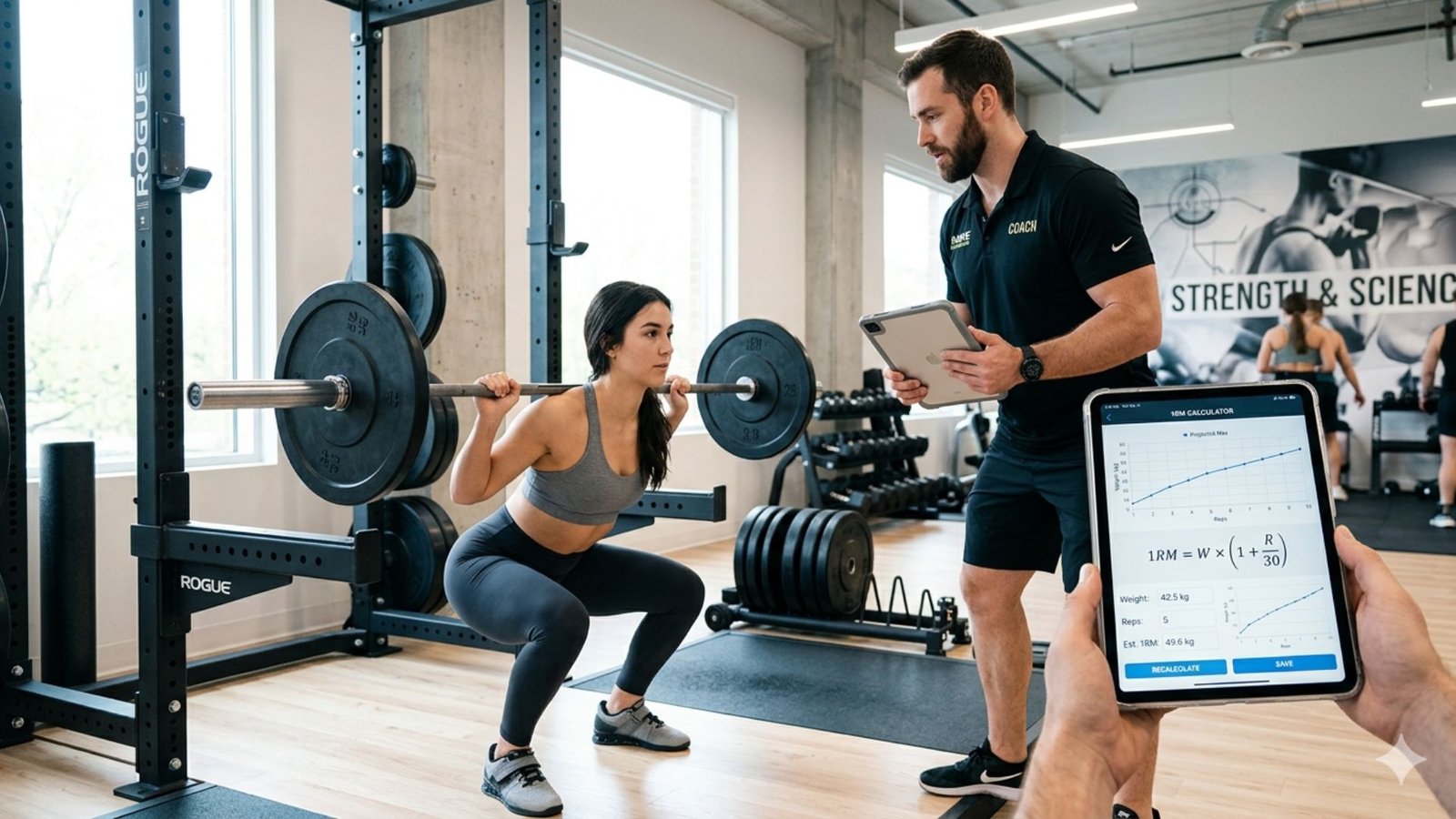
The most common way to estimate your 1RM without attempting it is called the Epley formula. Don’t let the name scare you. It’s simple.
Here it is:
1RM = Weight Lifted × (1 + 0.0333 × Number of Reps)
Looks a little weird, right? Let me break it down with a real example.
Last week, one of my clients squatted 225 pounds for 8 clean reps. He probably could have squeezed out a ninth, but his form was starting to break, so we stopped there. Smart move.
Let’s plug those numbers in:
225 × (1 + 0.0333 × 8)
225 × (1 + 0.2664)
225 × 1.2664
= 284.94 pounds
So his estimated 1RM is roughly 285 pounds.
Does that mean he can walk in tomorrow and squat 285? Maybe. But we aren’t going to test it. Instead, we’ll use that 285 number to plan his workouts. For example, if his program calls for 70% of his max, he’ll do 200 pounds. Perfectly challenging. Totally safe.
Why the Epley Formula Works So Well
Here is what I love about this formula. It works best in the rep range of 2 to 10. That’s the sweet spot for most lifters anyway. If you go above 10 reps, the estimate gets a little fuzzy. Fatigue starts playing tricks on your form, and the math isn’t as reliable.
Stick to weights you can lift for 3 to 8 reps with solid technique. That’s your golden ticket.
Method 2: The Brzycki Method (A Close Second)
There’s another formula floating around the lifting world called the Brzycki method. Some people swear by it. I think it’s a great backup, especially for higher rep ranges.
The formula looks like this:
1RM = Weight Lifted × (36 / (37 – Reps))
Yeah, that one looks even weirder. But hang with me.
Let’s use the same squat example: 225 pounds for 8 reps.
225 × (36 / (37 – 8))
225 × (36 / 29)
225 × 1.241
= 279.2 pounds
See the difference? The Brzycki method gives you about 279 pounds, while the Epley method gives you 285. That’s a 6-pound difference. In the real world, that is basically nothing. Your daily energy levels, sleep quality, and coffee intake will affect your performance more than that tiny gap.
So which one should you use?
Honestly, pick one and stick with it for consistency. I personally lean toward Epley because the math is faster in my head. But Brzycki is slightly more conservative, which some coaches prefer for newer lifters.
Either way, you are getting a solid estimate. Don’t overthink it.
Real Talk: Common Mistakes That Ruin Your 1RM Calculation
I have coached hundreds of people through this process. And I see the same mistakes over and over again. Let me save you the trouble.
1: Testing Your Max When You’re Tired
You know that feeling. You had a terrible night of sleep. You skipped breakfast. Your lower back is still sore from deadlifts two days ago.
And yet, you want to test your max anyway.
Don’t do it. You are setting yourself up for a low number that doesn’t reflect your true strength. Worse, you are begging for an injury. Test your max only when you are fresh, fed, and fully recovered. That means at least 48 hours after a heavy lower-body session.
2: Using Sloppy Reps for Your Calculation
Remember the Epley formula? It assumes every rep you logged was clean. But if your 8th rep looked like a question mark, hips shooting up, back rounding, bar path all over the place, that rep doesn’t count.
I tell my clients this all the time: Your calculated max is only as good as your cleanest rep. If you have to cheat, the number is fake. Lower the weight and try again next week.
3: Obsessing Over the Exact Number
Here is something nobody tells you. Your 1RM is not a fixed number. It changes day to day.
Feeling amazing after a good night’s sleep and a big meal? Your max might be 5% higher. Stressed from work and dehydrated? It might be 5% lower. That is completely normal.
Don’t treat your calculated 1RM like it is carved in stone. Treat it like a useful range. A tool, not a trophy.
How Often Should You Recalculate Your Max?
Great question. And the answer depends on your experience level.
Beginners (less than 1 year of consistent training):
You are getting stronger almost every week. Recalculate every 4 to 6 weeks. Your numbers will jump faster than you expect.
Intermediate lifters (1 to 3 years):
Progress slows down a bit. Recalculate every 8 to 12 weeks. Focus more on adding 5 pounds to your 5-rep max rather than chasing a big 1RM number.
Advanced lifters (3+ years):
You probably already know what you are doing. But for everyone else in this category, test every 3 to 4 months. Gains come slowly now. Patience is your best friend.
Here is a little secret I’ve learned. Most people don’t need to recalculate as often as they think. If your working sets are going up, your max is going up. That’s just logic. Don’t fix what isn’t broken.
A Worked Example: From Calculation to Program
Let me walk you through a real scenario so you can see exactly how this works in practice.
Meet Sarah. She’s been lifting for about 8 months. She wants to follow a popular deadlift program that asks for percentages based on her 1RM.
Last week, she deadlifted 185 pounds for 5 clean reps. No hitching, no rounded back, just smooth pulls.
Using the Epley formula:
185 × (1 + 0.0333 × 5)
185 × (1 + 0.1665)
185 × 1.1665
= 215.8 pounds
So her estimated 1RM is about 215 pounds.
Now her program says:
- Week 1: 70% for 5 sets of 5
- Week 2: 80% for 4 sets of 4
- Week 3: 90% for 3 sets of 3
Let’s do the math:
70% of 215 = 150 pounds (easy to remember, right?)
80% of 215 = 172 pounds
90% of 215 = 193 pounds
See how that works? Sarah never has to pull a true max. She just trusts the math, shows up, and works hard at the prescribed weights. That is intelligent training.
What About Machines and Dumbbells?
People always ask me if these formulas work for exercises other than barbell lifts.
The short answer? Sort of.
For dumbbell presses, goblet squats, or machine work, you can absolutely use the same formulas. But here is the catch. Those movements often have a different strength curve. You might be able to bench press 300 pounds with a barbell, but only press 90-pound dumbbells. That is normal.
Use the formulas to track progress on the same movement over time. Just don’t try to compare your barbell squat max to your leg press max. Different exercises, different rules.
The One Rep You Should Never Do
Let me put on my concerned coach hat for a second.
I have seen some truly wild attempts in commercial gyms. People are trying to one-rep max on the leg extension machine. Someone attempting a max upright row with terrible shoulder mobility. A kid loading 315 on the deadlift bar when he couldn’t even pull 225 with a straight back.
Please, for the love of your spine, do not attempt a true max on any movement that puts your lower back or shoulders in a compromised position. That means good mornings, upright rows behind the neck, or anything that makes you wince just looking at it.
Stick to the big, stable lifts for max testing: squat, bench press, deadlift (conventional or sumo), and overhead press. Those movements have been tested millions of times. They are safe when done correctly.
A Simple Cheat Sheet for the Locker Room
I know you might not have a calculator handy when you are at the gym. So here is a rough guide I give my clients who want a quick estimate without doing math.
Based on the Epley formula:
- If you can lift a weight for 2 reps, that weight is roughly 94% of your max
- 3 reps = 91%
- 4 reps = 88%
- 5 reps = 85%
- 6 reps = 83%
- 8 reps = 78%
- 10 reps = 75%
Here is how you use this. Let’s say you squat 200 pounds for 6 hard reps. According to the chart, 200 pounds is about 83% of your max. So your max would be roughly 200 ÷ 0.83 = 241 pounds.
See? No fancy calculator needed. Just a little division, and you are good to go.
Frequently Asked Question
Do I need a spotter to test my 1RM?
Absolutely. Even if you’re just doing a heavy 3-rep max, have someone nearby. Not because you’re weak, but because stuff happens. Bars slip. Grip fails. A good spotter costs you nothing and saves you a crushed chest.
Can I use these formulas for pull-ups or bodyweight exercises?
Tricky one. You can, but you’d need to add weight via a dip belt. For example, if you weigh 180 pounds and add 45 pounds for 5 reps, your “total weight” is 225. Then run the Epley formula. For strict bodyweight only? Just track rep maxes instead. 10 pull-ups today, aim for 12 next month.
My calculated max seems too high. What gives?
Two possibilities. One, your form on the test set was sloppy fix that. Two, you’re just not used to heavy singles. Some people are great at repping but freeze under a heavy bar. That’s fine. Use a 3-rep max instead of a 5-rep max for a more conservative estimate.
How long should I rest between heavy sets when testing?
Longer than you think. For sets of 3–5 reps near your limit, rest 3 to 5 minutes. Your muscles recover ATP faster than your brain recovers courage. Don’t rush. Grab some water, pace around, then go again.
Is it safe for beginners to calculate their 1RM?
Yes, but only using the formulas, never attempting a true max. A beginner should not load up a bar they can’t handle for at least 6 clean reps. Stick to the Epley method with a 5-8 rep max. That keeps ego in check and shoulders in sockets.
Conclusion
Look, you don’t need to be a hero in one single rep. You need to be smart for hundreds of reps over years of training.
Calculating your one-rep max safely is not about feeding your ego. It’s about giving yourself a real number to aim at. A target that moves as you get stronger, but never asks you to grind through a rep that feels wrong.
So here is my challenge to you. This week, skip the ego lifting. Go find a weight you can handle for 5 crisp reps. Do the math. Write that number down. Then build your next four weeks of training around it.
Your joints will feel better. Your progress will actually show up on the bar. And you won’t be the person everyone secretly watches because they’re afraid you’re about to hurt yourself.