You’re standing in the gym, watching the guy next to you squat 315 pounds like it’s warm-up weight. Meanwhile, you just hit a new personal record of 185 pounds, and you’re genuinely proud of it. But then doubt creeps in. Is that even good? Am I behind? Where do I actually stand?
Every serious lifter asks this at some point. And it’s a fair question.
Strength standards exist for a reason. They give you a benchmark, a realistic snapshot of where you are and where you can realistically go. Without them, you’re just lifting numbers with no context. That’s like running a race without knowing the distance.
In this post, I’ll break down exactly how strength standards work, what the numbers actually mean, and most importantly, how to use them to train smarter instead of just harder.
What Are Strength Standards, Exactly?
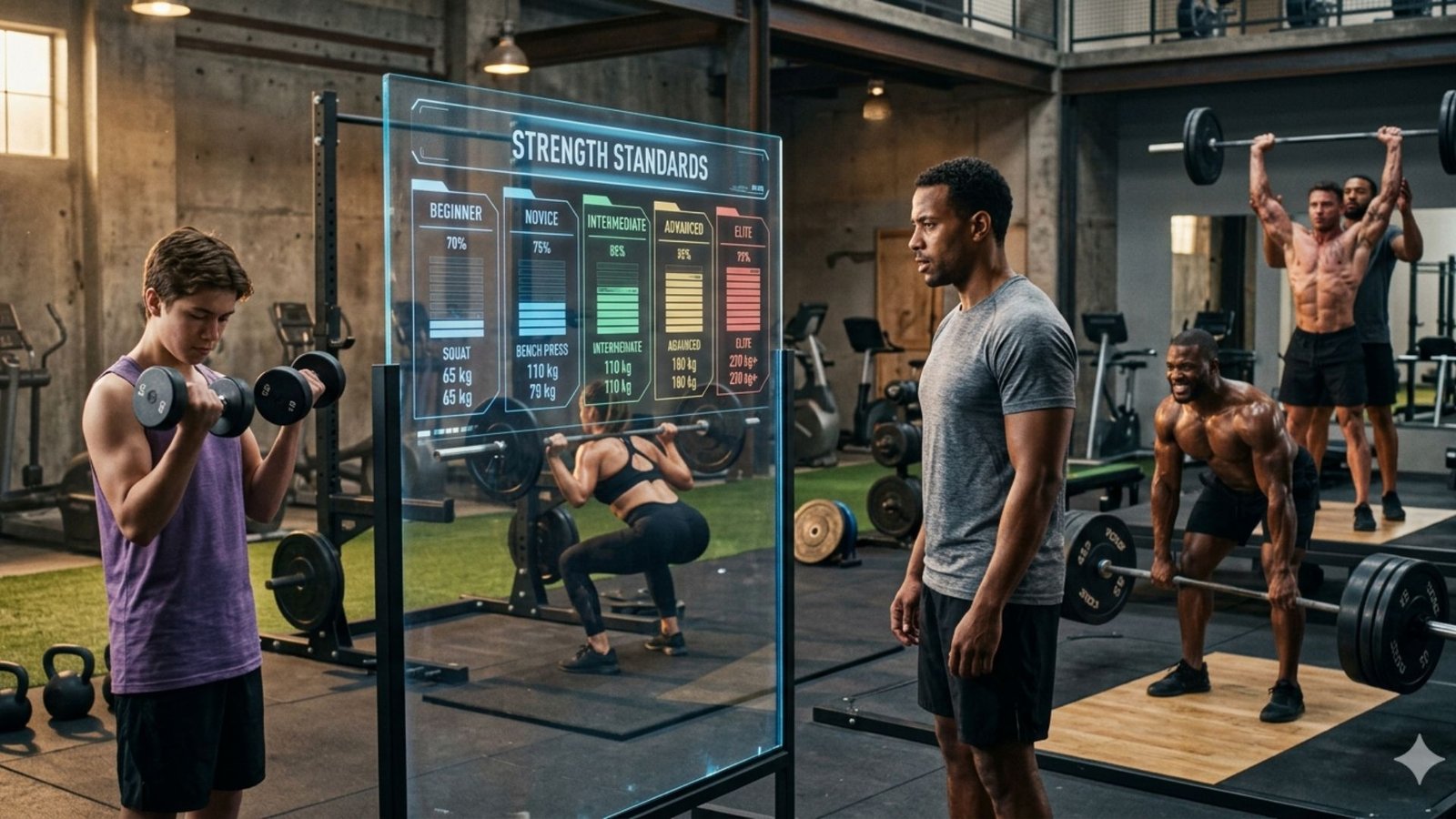
Strength standards are performance benchmarks based on body weight and gender that help classify a lifter’s level, usually across four categories: Beginner, Novice, Intermediate, and Advanced (some systems add “Elite” at the top).
They’re built from data collected across thousands of lifters over many years. Organizations like ExRx, Symmetric Strength, and various powerlifting federations have published their own versions.
The key thing to understand? These aren’t goals. They’re reference points.
A standard doesn’t tell you what you should lift. It tells you where you currently sit compared to other trained lifters of similar body weight. That’s a big difference.
Why Body Weight Matters
A 150-pound person squatting 225 pounds and a 250-pound person squatting 225 pounds are not at the same relative strength level. Body weight dramatically changes the context of any lift.
That’s why good strength standards are always body-weight-relative. When someone says “intermediate squat,” they don’t mean a fixed number. They mean a multiple of your body weight, typically around 1.5x to 2x for most people at that stage.
The Four Main Strength Levels
Let me walk you through each level, honestly. I’ve coached lifters at all of these stages, and I’ll tell you what each one actually looks like in a real gym.
Beginner
This is where everyone starts, and there’s zero shame in it. A beginner is typically someone who has been lifting consistently for less than six months or has never followed a structured program.
At this stage, your strength increases almost every single session, a phenomenon coaches call newbie gains. Your nervous system is adapting fast. Your form is still developing. The weight feels awkward sometimes.
For most male beginners (around 170–180 lbs), a beginner-level squat is roughly body weight or slightly above. For females of similar proportions, it’s typically around 50–65% of body weight.
The biggest mistake beginners make? Chasing weight too fast. They add plates before they’ve earned it, form breaks down, and they get hurt. Slow, consistent progress beats aggressive jumps every time.
Novice
After three to twelve months of structured training, most lifters move into novice territory. You’ve built a foundation. Your form is more consistent. You’re no longer confused about the big lifts.
A novice male lifter at around 175 lbs is typically squatting somewhere between 1.0x and 1.5x body weight. Bench is often around 0.75x to 1.0x. Deadlift is usually the strongest, closer to 1.25x to 1.75x body weight.
At this stage, the real game begins. You stop making progress every session and start working in weekly cycles. This is where most people plateau for the first time and where a good program becomes critical.
Intermediate
This is the stage most dedicated gym-goers reach after one to three years of consistent, structured training. You know the lifts well. You’ve had some plateaus and pushed through them. You understand progressive overload in a real, practical way.
For a male lifter at around 175 lbs, intermediate strength typically looks like:
- Squat: 1.5x to 2.0x body weight
- Bench Press: 1.0x to 1.5x body weight
- Deadlift: 2.0x to 2.5x body weight
- Overhead Press: 0.75x to 1.0x body weight
For female lifters, multiply those ratios by roughly 0.75 to get a comparable estimate, though individual variation is wide.
Here’s what I tell every intermediate lifter I work with: this is where most people get stuck permanently. Not because they stop training, but because they stop progressing intentionally. They coast on familiar weights, skip recovery, and wonder why they’re not moving forward.
Advanced
Advanced lifters have typically been training for four or more years with real structure and purpose. Getting here takes time, patience, and honest effort. There are no shortcuts.
An advanced male lifter (175 lbs) is generally:
- Squatting: 2.0x to 2.5x+ body weight
- Benching: 1.5x to 2.0x body weight
- Deadlifting: 2.5x to 3.0x body weight
These numbers require years of smart, consistent work. Not years of random gym sessions, years of deliberate, progressive training with attention to recovery, nutrition, and technique.
The Big Four Lifts: Quick Reference Guide
Most strength standards focus on four compound movements. Here’s why each one matters:
Squat
The squat is arguably the best overall lower-body strength test. It demands quad strength, hip mobility, core stability, and full-body coordination. If someone squats well and heavily, they’ve usually put in real work.
Bench Press
Upper-body horizontal pushing strength. It’s the most popular lift in most gyms and one of the first numbers people talk about. Beginner benchers often have shoulder imbalances that limit progress early; fixing those is more valuable than chasing plates.
Deadlift
The king of raw strength. Most people can deadlift more than they squat, especially in the early stages, because the movement pattern is more natural for most body types. It tests your entire posterior chain: glutes, hamstrings, back, and grip.
Overhead Press (OHP)
The most humbling lift for most people. Strict pressing standards are lower than the other lifts because it’s a harder movement with less muscle mass involved. If your OHP is lagging, shoulder mobility and upper back weakness are usually the culprits.
How to Actually Use Strength Standards
Here’s where most people go wrong. They look at the chart, feel either great or terrible, and then… nothing changes. That’s the wrong way to use this information.
Step 1: Find your current numbers. Test your actual 1RM (one-rep max) or use a reliable 1RM calculator based on a recent heavy set. Don’t guess.
Step 2: Compare against your body weight. Divide your lift by your body weight. That ratio is what matters, not the raw number.
Step 3: Identify your weakest lift. Almost everyone has one. For most people, it’s the overhead press or the squat. That’s where your focus should go.
Step 4: Set a six-month target. Pick the next level up and work backward. What do you need to add per month to get there? That becomes your training goal.
Step 5: Choose a program that matches your level. A beginner doesn’t need the same program as an intermediate. Linear progression programs (like Starting Strength or StrongLifts) work great for early stages. Intermediate lifters need periodized programs with more variation.
Practical Tips From the Gym Floor
- Stop comparing your numbers to social media. Most of what you see online is elite-level lifting presented as normal. It’s not.
- Test your 1RM safely. Work up gradually with a spotter. Never test a true max on your first session back or when fatigued.
- Track your body weight alongside your lifts. Strength-to-weight ratio matters more than absolute numbers.
- Prioritize the lifts you’re worst at. Most people do the opposite; they train what they’re already good at. That’s how imbalances develop.
- Progress in the gym is non-linear. You’ll have months where everything clicks and months where you stall. Both are normal.
Common Mistakes People Make With Strength Standards
1: Treating standards as ceilings. Some lifters hit “intermediate” and mentally relax, as they’ve arrived somewhere. Standards are checkpoints, not destinations.
2: Ignoring body weight. A lifter who gains 30 pounds of bodyweight to add 20 pounds to their squat hasn’t really gotten stronger in any meaningful sense. Track ratios.
3: Testing 1RM too often. Your 1RM should be tested maybe twice a year under controlled conditions. Testing it every few weeks is a good way to get injured and a bad way to build actual strength.
4: Using standards from the wrong source. Some charts online are wildly unrealistic, built from competitive powerlifter data that doesn’t apply to general gym-goers. Stick to sources like ExRx or Symmetric Strength for realistic reference points.
5: Skipping the overhead press entirely. Because it’s hard and the numbers are “embarrassing,” many lifters drop it from their program. That’s exactly why they develop shoulder problems later. Train your weaknesses.
Frequently Asked Question
What’s considered a good squat for a natural lifter?
For an average-weight male natural lifter, squatting 1.5x to 2x body weight is genuinely strong and achievable with a few years of consistent training. For females, 1.0x to 1.5x is comparable.
How do strength standards differ for women?
Women typically have lower absolute strength numbers but often have similar or better strength-to-weight ratios in lower body movements. Standards for women are scaled accordingly and don’t compare raw numbers across genders.
Should I care about strength standards if I just train for looks?
Yes, actually. Strength and muscle building are deeply connected. Getting stronger in the 8–12 rep range is one of the most reliable ways to build visible muscle. Strength standards give you a practical way to track progress even if your goal is purely aesthetic.
My deadlift is way stronger than my squat. Is that normal?
Very common, especially early on. The hip hinge pattern tends to come more naturally than the squat. If the gap is huge, though, it usually means your squat technique or mobility needs work, not that your squat is broken.
How long does it realistically take to reach intermediate level?
With consistent training three to four days per week and a solid program, most people hit intermediate standards within two to three years. Some get there faster with good coaching and great recovery habits.
Conclusion
Strength standards aren’t there to make you feel behind. They’re there to give you honest context and context is how you train smart.
Whether you’re a beginner who just found out you’re stronger than you thought, or an intermediate lifter who realized your overhead press has been quietly lagging for two years now you know where you stand. And more importantly, you know what to do about it.
Find your weakest lift. Set a realistic six-month target. Follow a program that actually matches your level. And stop comparing yourself to the guy who’s been training for a decade.
Progress is personal. But knowing where you rank is the first step toward knowing exactly where you’re going.