Picture this. You walk into the gym after a rough week, bad sleep, stress at work, and maybe skipped a meal or two. You’ve got squats on the program today, and your training spreadsheet says 4 sets of 5 at 85% of your max. You grind through it, but something feels off. Every rep feels like a fight. You finish the session, but your lower back is talking to you, your knees ache, and you’re not sure if you just trained smart or just survived.
Sound familiar?
Here’s the thing: Percentage-based training doesn’t know how you’re feeling today. It doesn’t care that you slept five hours or that you’re fighting off a cold. It just tells you to lift a number. And sometimes, that number is either too easy or way too hard for that particular day.
That’s exactly where RPE comes in.
RPE Rate of Perceived Exertion is a simple but powerful tool that helps you train based on how your body feels, not just what a calculator says. And once you understand the difference between RPE 8 and RPE 9, your training will never look the same again.
Let’s break it all down in plain, simple language, no fluff, no complicated jargon.
What Is RPE in Strength Training?
RPE stands for Rate of Perceived Exertion. Originally used in cardio training, it was adapted for strength sports, particularly by powerlifting coach Mike Tuchscherer, to help lifters gauge how hard a set truly is.
In strength training, RPE is measured on a scale from 1 to 10:
- RPE 1–4: Very easy, barely any effort
- RPE 5–6: Moderate effort, you could keep going for many more reps
- RPE 7: Challenging but comfortable, maybe 3 reps left in the tank
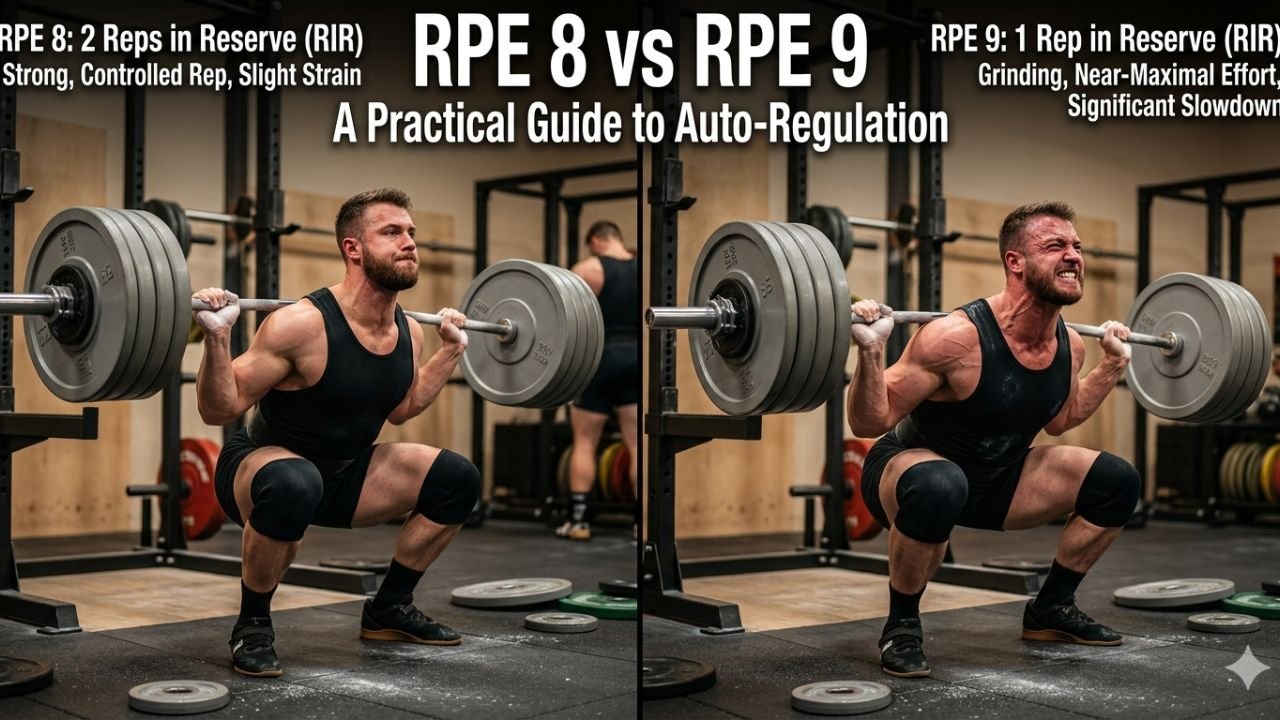
- RPE 8: Hard, you could have done about 2 more reps
- RPE 9: Very hard, you had maybe 1 more rep in you
- RPE 10: Maximum effort, you gave everything you had, no more reps possible
The key idea here is something called “reps in reserve” or RIR. Each RPE level basically tells you how many more reps you could have done if you pushed to absolute failure.
RPE 8 = 2 reps in reserve RPE 9 = 1 rep in reserve RPE 10 = 0 reps in reserve (true failure)
Simple, right? But here’s where it gets really interesting and really useful.
RPE 8 vs RPE 9: What’s the Real Difference?
On paper, RPE 8 and RPE 9 are just one rep apart. But in practice, that one rep makes a massive difference, especially over weeks and months of training.
RPE 8: The Sweet Spot for Most Lifters
At RPE 8, you’re working hard. You’re not coasting. But you’re leaving two reps in the tank, which means:
- Your form is still solid
- Your nervous system isn’t completely fried
- You can recover faster and train more frequently
- You’re building strength without risking burnout or injury
This is the zone where most of your training volume should live, especially if you’re an intermediate lifter who trains 3 to 5 days a week. It’s challenging enough to create adaptation, but not so draining that you’re crawling out of the gym.
Think of RPE 8 like driving at 80% of your car’s top speed. You’re moving fast, making real progress, but you’ve got room to respond if something unexpected happens on the road.
RPE 9: Pushing the Edge
RPE 9 is a different beast. At this level, you’re one rep away from failure. Your technique might start to break down slightly. Your breathing gets heavy. That last rep was a real grind.
RPE 9 sets are valuable; they push your limits and teach you what you’re actually capable of. But they also:
- Demand more recovery time
- Increase injury risk if overused
- Accumulate more fatigue in your joints and nervous system
RPE 9 work is best used strategically at the end of a training block, during a peak phase, or on days when you’re feeling unusually strong and want to push the bar a little further.
Think of RPE 9 like sprinting. It’s powerful. It builds speed and toughness. But if you sprint every single day, your legs will eventually give out.
What Is Auto-Regulation and Why Should You Care?
Auto-regulation is the practice of adjusting your training on the fly based on how your body is actually performing that day. RPE is the most popular tool for doing this.
Here’s a real-life example:
Let’s say your program calls for 3 sets of 3 at RPE 8 on the deadlift. You load up the bar and pull your first set. It felt like an RPE 7 easier than expected. With auto-regulation, you’d add a little weight to the next set to hit that RPE 8 target. Conversely, if the first set felt like RPE 9 harder than expected, you’d drop the weight slightly to stay within your target zone.
This is auto-regulation in action. And it’s genuinely one of the smarter ways to train.
Why Percentage-Based Training Alone Falls Short
Traditional percentage-based programming assumes that your 1-rep max (1RM) is constant. But we all know that’s not true. Your performance fluctuates based on:
- Sleep quality
- Nutrition and hydration
- Stress levels (work, family, life)
- Time of day
- How recovered are you from previous sessions
On a great day, your 80% might feel like 70%. On a bad day, it might feel like 90%. RPE-based training accounts for this. Percentages don’t.
How to Use RPE 8 and RPE 9 in Your Training Program
Understanding the theory is one thing. Putting it into practice is another. Here’s how to actually use RPE 8 and RPE 9 in your weekly training.
Step 1: Learn to Judge Your Effort Honestly
This is the hard part, and honestly, most beginners struggle with it at first. When you’re new, you often underestimate how many reps you have left. You stop at what feels like RPE 9, but you actually had 4 more reps in you.
The fix? Practice. Over time, you’ll develop an accurate internal gauge. You can also test yourself by occasionally taking a set to failure just to calibrate what RPE 10 actually feels like for you.
Step 2: Assign RPE Targets to Your Main Lifts
A solid starting point for most lifters:
- Main compound lifts (squat, bench, deadlift): RPE 7–9 depending on the phase
- Accessory work: RPE 6–8
- Warm-up and technique work: RPE 5–6
During a hypertrophy or volume phase, keep most sets at RPE 7–8. During a strength or peaking phase, push closer to RPE 8–9.
Step 3: Use RPE 9 Sparingly, but Don’t Avoid It
Some lifters get so comfortable with RPE 8 that they never really push themselves. That’s a mistake. RPE 9 sets are how you find out what you’re capable of. Use them once a week on your most important lift, or save them for the final week of a training block.
Step 4: Track Your Numbers
After each session, write down what you lifted and what the RPE felt like. Over time, you’ll notice patterns, maybe you’re always stronger on Tuesday than Friday, or maybe your squat RPE tanks when you skip breakfast. This data is gold.
Practical Benefits of Training with RPE
Still not sure if RPE is worth the effort? Here are some real, tangible benefits:
- Reduced injury risk. By capping your effort at RPE 8 most of the time, you avoid grinding through ugly, technique-breaking reps that get people hurt.
- Better long-term progress. Consistent, sustainable training beats heroic but destructive sessions every time. RPE helps you stay in the game for years, not just months.
- Mental confidence. When you know you have reps left in the tank, training feels more controlled and less scary. You stop dreading heavy sessions.
- Smarter peaking. As you approach a competition or a max-effort test, gradually increasing your RPE targets (from 7 to 8 to 9 over several weeks) is one of the most effective peaking strategies around.
- It’s flexible for real life. Bad day? Drop to RPE 7. Feeling incredible? Push to RPE 9. RPE permits you to train in a way that actually matches your life.
Common Mistakes When Using RPE
Even experienced lifters mess this up sometimes. Here’s what to watch out for:
- Ego lifting: Refusing to drop weight because you don’t want to admit the bar felt heavy. Your RPE doesn’t lie; listen to it.
- Sandbag RPE: Reporting RPE 7 when it was really RPE 9, just to avoid pushing yourself. Honesty is everything with this system.
- Ignoring technique: An ugly RPE 8 with a rounded back isn’t actually RPE 8; it’s a set that should have stopped earlier. Always factor form into your RPE judgment.
- Forgetting fatigue accumulates: Just because each set feels like RPE 8 doesn’t mean your body isn’t building up fatigue across the week. Manage your weekly volume carefully.
RPE 8 vs RPE 9: When to Use Each One
Here’s a quick, no-nonsense breakdown of when each RPE level makes sense:
Use RPE 8 when:
- You’re in a volume or hypertrophy phase
- You’re training a movement more than twice a week
- You’re still building technique on a lift
- You’re coming back from a deload or layoff
- You’re feeling average or slightly below average on a given day
Use RPE 9 when:
- You’re in a strength or peaking phase
- You’re testing your limits on a specific lift
- You’re feeling exceptionally strong and recovered
- It’s the final set of a top set/back-off set structure
- You’re an advanced lifter who can recover from higher intensities
Frequently Asked Questions
Is RPE the same as the percentage of 1RM?
Not exactly. RPE and percentages are related but not interchangeable. Generally, RPE 8 on a 5-rep set might correspond to around 80–85% of your 1RM, but this varies based on the individual, the lift, and the day. RPE is more flexible; it adjusts to your actual performance, not a fixed number.
Should beginners use RPE-based training?
Beginners can use RPE, but it takes time to calibrate. Most coaches recommend that true beginners spend a few months on simple percentage-based or rep-based programs first, so they build a baseline of strength and movement patterns. Once you know your body a little better, adding RPE to your training becomes much more accurate and useful.
What’s the difference between RPE and RIR?
They’re two sides of the same coin. RPE measures how hard a set was on a scale of 1–10. RIR (Reps In Reserve) measures how many more reps you could have done. RPE 8 = 2 RIR. RPE 9 = 1 RIR. Some lifters find RIR easier to think about in the moment instead of asking “how hard was that?” They ask, “How many more reps did I have?” Both get you to the same place.
Can I mix RPE with percentage-based programming?
Absolutely, and many top coaches do exactly this. For example, a program might prescribe “4 sets of 4 at 80%, with a 5th set at RPE 9.” This gives you the structure of percentages with the flexibility of RPE on your top set. It’s a great hybrid approach.
How long does it take to get accurate at judging RPE?
Most lifters develop reasonable accuracy within 3 to 6 months of consistent practice. The more you train and the more intentional you are about logging your RPE, the faster you’ll calibrate. Don’t stress if you’re off in the beginning; it’s a skill, and skills take time.
Conclusion
Here’s the bottom line: understanding RPE 8 vs RPE 9 isn’t just an academic exercise. It’s a practical shift in how you approach every single session.
When you train with RPE, you stop being a robot following a spreadsheet and start being an athlete who actually listens to their body. You’ll have better sessions, fewer injuries, more consistent progress, and a healthier relationship with training overall.
RPE 8 is your reliable training partner, always there, pushing you hard enough to grow, but not so hard that you break. RPE 9 is the edge you visit when you’re ready, when the conditions are right, when you want to find out what you’re truly made of.
The goal isn’t to train as hard as possible every single day. The goal is to train as effectively as possible day after day, week after week, year after year.
So next time you step under the bar, instead of just chasing a number, ask yourself: how does this actually feel? Your body knows the answer. RPE just gives you the language to understand it.
Now go train and train smart.