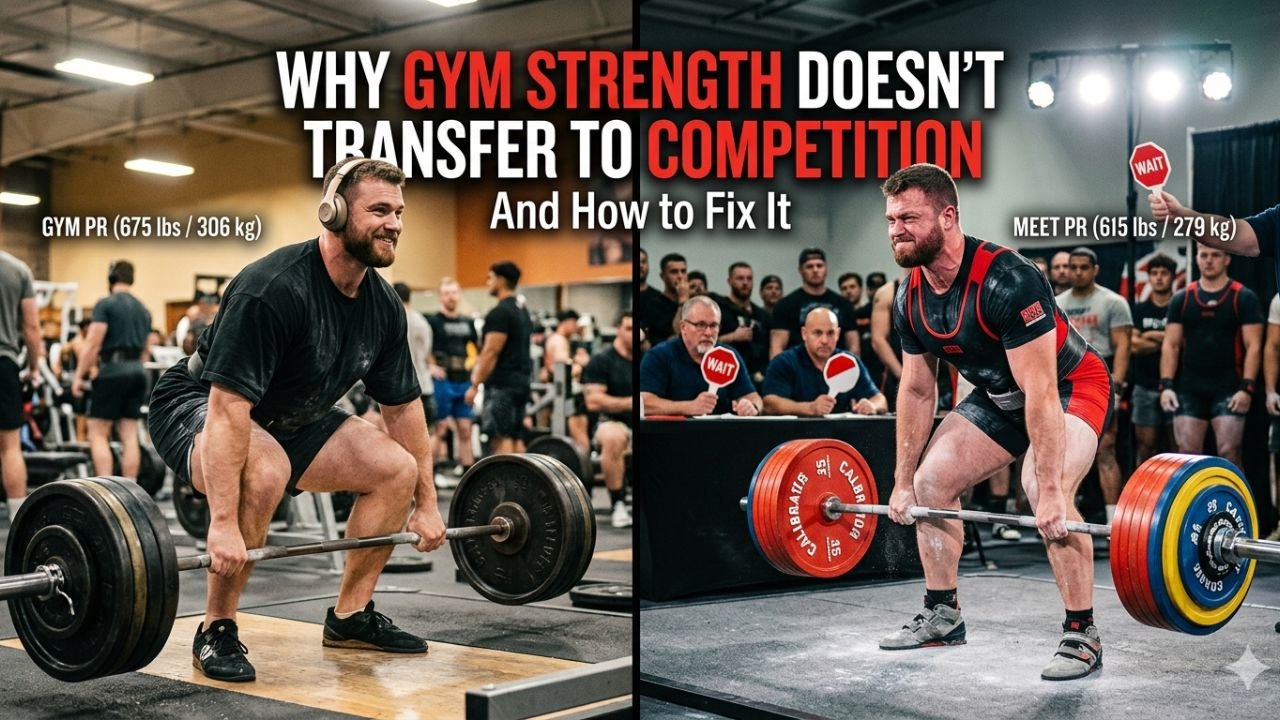
You’ve been training hard for months. Your squat has gone up. Your bench feels solid. Your deadlift numbers keep climbing every few weeks. You walk into the gym with confidence, hit your lifts, and feel like a beast.
Then meet day comes.
You bomb out on squat. Your bench gets red-lighted three times. Your deadlift, the one you’ve hit a dozen times in the gym, suddenly feels like it’s glued to the floor.
What just happened?
You’re not alone. This is one of the most frustrating and common experiences for lifters stepping onto a competition platform for the first time. The truth is, gym strength and meet strength are two very different things. And if you don’t train specifically for the meet environment, your numbers will let you down no matter how strong you actually are.
In this post, we’re going to break down exactly why your gym strength doesn’t transfer to a powerlifting meet and, more importantly, how to fix it so you never leave a platform wondering what went wrong.
The Big Difference Between Gym Lifting and Competitive Powerlifting
Let’s start with the basics. When you lift in the gym, you make all the rules. You start when you want. You go down as far as feels comfortable. You use whatever equipment you like. Nobody is watching your depth. Nobody is judging your lockout.
At a powerlifting meet, someone else makes the rules. Three judges are watching every single inch of your lift. There are commands you have to follow: “squat,” “rack,” “press,” “start,” and “down.” If you don’t follow them exactly, the lift doesn’t count. Doesn’t matter how heavy it was. Doesn’t matter how easy it looked.
That alone changes everything.
Reason #1: You’ve Never Trained with Commands
This one catches almost every first-time competitor off guard.
In competition, you don’t just walk out and squat. You wait for the “squat” command before you begin your descent. On the bench, you pause the bar on your chest and wait for the “press” command. You can’t just touch and go as you do in the gym.
The problem? Most lifters have zero experience with this. They’ve built their entire motor pattern around lifting at their own pace. When a judge shouts a command mid-lift, the body panics. The rhythm is off. The timing feels weird.
Real example: A lifter hits a smooth 180kg squat in the gym every week. At his first meet, he gets called for “squatting early”, descending before the command. His attempt doesn’t count. On his second attempt, he’s so anxious about waiting for the command that he stands in the rack for six seconds, loses his mental focus, and the lift feels twice as heavy.
How to fix it:
- Practice lifting with commands in the gym. Have a training partner shout “squat,” “rack,” and “press” during your sets.
- Use a timer or even a YouTube video of meet commands to train your timing.
- Record yourself and check if you’re following the command sequence correctly.
- Do this for at least 8–12 weeks before your first meet.
Reason #2: Your Technique Doesn’t Meet the Standards
Here’s something nobody tells you when you start powerlifting: gym depth and competition depth are not the same thing.
In competition, squat depth is judged by whether your hip crease breaks parallel. Not your personal feeling of going “low enough.” Not what looks deep in the mirror. A judge decides, and they’ve seen thousands of squats.
Same with bench press. In the gym, most people touch the bar low on their chest and press. In competition, the bar must visibly pause on the chest with no downward movement. A little bounce, a slight sink, red light.
Deadlift requires a complete lockout with hips through, knees locked, and shoulders back. A slight hitch or a soft lockout will get red-lighted even if the bar is at full height.
How to fix it:
- Video every single training session from the side angle. Watch your depth honestly.
- Get a coach or experienced lifter to watch your lifts and give real feedback.
- Enter a “practice meet” or mock competition at your gym before your actual competition.
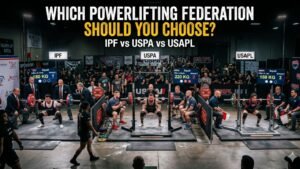
- Know the rulebook of the federation you’re competing in. Every federation (IPF, USAPL, RPS, etc.) has slightly different standards.
Reason #3: You’ve Never Dealt with Meet-Day Nerves
This one is massive and almost nobody talks about it.
Adrenaline is real. At your first meet, your heart is racing. There are crowds, loud music, judges staring at you, a platform, bright lights, and a clock ticking. Your warm-ups feel weirdly light. You feel great. You think, “I’m going to crush this.”
Then you walk out for your first attempt, and your legs forget what squats are.
Adrenaline can actually hurt your performance if you’re not used to managing it. It can make your breathing go haywire, mess with your timing, and cause you to rush your setup, which throws off everything.
How to fix it:
- Compete in smaller local meets before big competitions.
- Do mock meet days at your gym. Treat them seriously, full warm-up, commands, everything.
- Practice breathing and bracing techniques under pressure, not just when you’re calm.
- Develop a pre-lift routine and stick to it no matter what. This gives your nervous system a familiar anchor.
Reason #4: Your Attempts Are Too Ambitious
A lot of lifters go into their first meet thinking, “I’ll open with my PR and work up from there.” This is one of the most common and costly mistakes in powerlifting.
Opening with your gym max is rarely a good idea. Competition conditions are different. You’ve been warming up all day. You may have waited hours between your first lift and your last. The adrenaline has come and gone. Your body isn’t fresh the way it is during a focused gym session.
Smart attempt selection can mean the difference between a good total and bombing out entirely.
The general rule for attempt selection:
- Opener: A weight you could hit on your worst day, even after bad sleep and a stressful week. This should be 85–90% of your gym max.
- Second attempt: Something you’re confident about around 95–97% of your max.
- Third attempt: Your competition PR. This is where you push.
How to fix it:
- Work with a coach or experienced lifter to plan your attempts well before meet day.
- Don’t let your ego pick your opener. Let your best performance pick it.
- Accept that your first meet total might be lower than your gym numbers, and that’s completely normal.
Reason #5: Your Equipment Feels Different on the Platform
This one surprises a lot of people. Competition platforms feel different from gym floors. The bar may be a different brand or thickness. Some federations require specific approved bars. The knurling might be more aggressive. The sleeves might spin differently.
If you’ve been training with a stiff, cheap barbell and you walk onto a platform with an Eleiko or Ohio Bar, the whip alone can throw off your deadlift timing. If you’ve been training in squat shoes but the platform surface is more slippery than your gym floor, your foot placement can shift mid-lift.
How to fix it:
- Train with competition-approved equipment as much as possible.
- If your gym has a competition-grade barbell, use it. If not, find a gym that does.
- Wear the same shoes, belt, and singlet in training that you’ll wear on meet day. Especially the singlet, it feels awkward the first few times.
- Practice your setup on different surfaces so you’re adaptable.
Reason #6: You Don’t Know How to Manage Your Day
Powerlifting meets are long. Like, really long. You might squat at 10 am, bench at 1 pm, and deadlift at 4 pm. That’s a six-hour competition day. In the gym, you do all three lifts in 90 minutes.
Most first-time competitors eat wrong, warm up at the wrong time, or exhaust themselves standing around and watching other flights. By the time they get to deadlifts, they’re mentally tired and physically stiff.
How to fix it:
- Eat and hydrate consistently throughout the day. Don’t let your blood sugar crash between events.
- Warm up smart, get warm when your flight is 15–20 minutes out, not two hours before.
- Stay off your feet between flights. Sit, relax, and save your energy.
- Have a handler or coach who can help you track the bar and tell you when to warm up.
Practical Tips to Bridge the Gap Between Gym Strength and Meet Strength
Let’s bring it all together. Here’s what you can do starting today to make sure your meet performance matches your gym performance:
- Run mock meets in training. At least once every training cycle, run a full mock meet. Pick openers, second attempts, and thirds. Follow all the commands. Treat it like it’s real.
- Get coached by someone who competes. Even one or two sessions with an experienced powerlifter will show you things you’d never notice on your own.
- Record everything. Video is your most honest training partner.
- Join a powerlifting community. Whether it’s online or a local club, training around other competitors speeds up your learning dramatically.
- Compete more. Your first meeting is an information-gathering session. Your second meet is where you start performing. Give yourself grace and keep competing.
Frequently Asked Questions
How much can I expect my lifts to drop at my first powerlifting meet?
It varies by person, but many first-time competitors hit 90–95% of their gym numbers. Some do better, some do worse, depending on nerves and preparation. The good news is that your second meeting almost always goes better than your first simply because you know what to expect.
Do I need a coach to compete in powerlifting?
You don’t need one, but having even one experienced person in your corner on meet day makes a huge difference. They can handle your attempts, track the bar, and keep you calm when nerves kick in. If you can’t get a coach, find a training partner who has competed before.
How long should I train before entering my first powerlifting meet?
Most coaches recommend at least 6–12 months of consistent strength training before competing. This gives you enough time to develop solid technique and build a meaningful base of strength. That said, some beginners compete earlier just for the experience, and there’s nothing wrong with that.
What federation should I compete in for my first meet?
For beginners, look for a local federation with a supportive atmosphere. In the US, federations like USPA, RPS, or SPF are beginner-friendly. If you’re outside the US, look for your country’s affiliated IPF federation. Choose a federation that has meets near you so travel doesn’t add extra stress to your first experience.
Why did I get red-lighted even though I completed the lift?
Red lights in powerlifting come from technical rule violations, not just whether you completed the movement. Common reasons include: not waiting for the command, cutting depth short, hitching on the deadlift, not pausing long enough on the bench, or losing control of the bar during the rack. Study the rules of your federation carefully before the meet day.
Conclusion
You put in the work. The strength you’ve built in the gym is real. But powerlifting competition is a skill on top of that strength, one that has to be practiced just like the lifts themselves.
The gap between gym strength and meet strength isn’t about being weak. It’s about being unprepared for a completely different environment. And the great news is, every single reason in this post is fixable with intentional practice and a little experience.
Your first meeting might not go perfectly. That’s okay. Every elite powerlifter has a story about a bomb-out, a red light that came out of nowhere, or a meet that completely humbled them. The ones who make it back to the platform are the ones who treated it as a lesson, not a failure.
So go compete. Learn. Adjust. Come back stronger.
The platform will always be there. The only question is whether you’ll be ready when you step on it.