Picture this. You’re at your first powerlifting meet. You’ve been training for months, hitting PRs left and right. You walk up to the registration desk, and the official asks, “What’s your opening squat in kilograms?”
You freeze.
You’ve been tracking everything in pounds. Your squat is 315 lbs. But kilograms? No idea.
This happens more than you’d think, especially if you trained in a gym that uses pound plates but you’re competing under an international federation that runs entirely on the metric system. It’s a small knowledge gap that can cause real confusion on a big day.
Whether you’re a beginner just getting into powerlifting or a seasoned lifter preparing for your first international meet, knowing how to convert lbs to kg for your lifts isn’t just a math trick. It’s a practical skill that can affect your competition strategy, your programming, and even how you communicate with coaches around the world.
Let’s break it all down in plain English, no calculus degree required.
Why Powerlifting Uses Kilograms (And Your Gym Uses Pounds)
If you’re based in the United States, you grew up in a world of pounds. Your bathroom scale shows pounds. Your gym’s dumbbells are labeled in pounds. Even your protein powder serving size is in ounces.
But powerlifting as a sport with international roots runs on the metric system. Organizations like the International Powerlifting Federation (IPF) and most affiliated national federations record all lifts in kilograms. Your total, your bodyweight class, and your attempts are all in kg.
So when you say “I deadlift 500,” a coach from Europe or Australia might have no reference point. Are you talking pounds or kilograms? That’s a 220 lb difference. Huge.
Getting comfortable with both systems isn’t about being fancy. It’s about being a serious, informed lifter who can operate in any room.
The Simple Formula: How to Convert lbs to kg
Let’s get the math out of the way first, because it’s honestly not that complicated once you get it in your head.
The formula is:
Kilograms = Pounds ÷ 2.2046
Or for a quick rough estimate:
Kilograms ≈ Pounds ÷ 2.2
That’s it. Divide by 2.2, and you’re close enough for most practical purposes.
Quick Examples
Here are some common lifting numbers converted from lbs to kg:
- 135 lbs = 61.2 kg
- 185 lbs = 83.9 kg
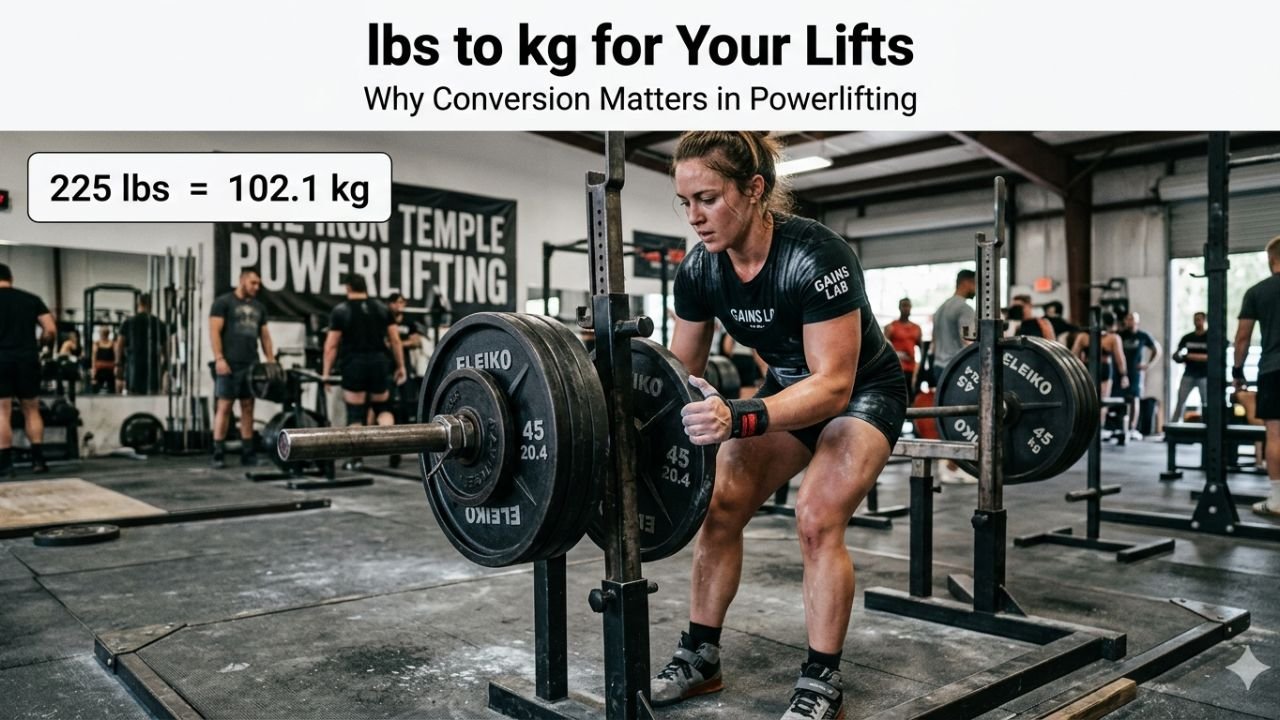
- 225 lbs = 102.1 kg
- 275 lbs = 124.7 kg
- 315 lbs = 142.9 kg
- 365 lbs = 165.6 kg
- 405 lbs = 183.7 kg
- 495 lbs = 224.5 kg
- 500 lbs = 226.8 kg
- 600 lbs = 272.2 kg
Print this list out and tape it to your gym bag. Seriously. You’ll thank yourself later.
The Reverse: Converting kg to lbs
Sometimes you’ll see a world record listed in kilograms and want to know what that feels like in pounds. The formula flips:
Pounds = Kilograms × 2.2046
Or roughly: Pounds ≈ Kilograms × 2.2
Examples:
- 100 kg = 220.5 lbs
- 150 kg = 330.7 lbs
- 200 kg = 440.9 lbs
- 250 kg = 551.2 lbs
- 300 kg = 661.4 lbs
So when you see a world record deadlift of 355 kg, you can quickly calculate that’s about 783 lbs. Now that puts it in perspective.
Why This Matters Specifically for Powerlifting
You might be thinking, “Okay, I get the math, but does this really matter in my day-to-day training?” Actually, yes. Here’s why.
1. Competition Attempt Selection
In a powerlifting meet, you choose your opening attempts ahead of time, usually in kilograms. Picking the wrong number because you miscalculated can mean:
- Opening too heavy and missing your first lift (devastating for your total)
- Opening too light and leaving points on the board
- Misunderstanding what weight the bar actually is
Your attempts set the tone for your entire meet day. A miscalculation in lbs to kg can literally change your competition result.
2. Weight Class Planning
Powerlifting weight classes are measured in kilograms. The IPF classes for men, for example, include 59 kg, 66 kg, 74 kg, 83 kg, 93 kg, and so on.
If you weigh 185 lbs and you’re trying to figure out which weight class to compete in, you need to convert. 185 lbs is 83.9 kg, meaning you’d likely compete in the 83 kg class if you can cut that 0.9 kg, or the 93 kg class if you compete at your natural weight.
That decision has big implications for your competition strategy, your diet leading up to the meet, and your placing.
3. Following International Programming
A lot of elite powerlifting programs, especially those written by European or Australian coaches, are written entirely in kilograms. If your coach sends you a block that says “Work up to 180 kg for 3 sets of 3,” you need to know that’s about 397 lbs. That’s a very different warmup plan than if you assumed it meant 180 lbs.
4. Tracking World Records and Standards
Strength standards and world records are published in kilograms. Knowing the conversions lets you benchmark yourself accurately against the best in the world or even against the minimum qualifying totals for national competitions.
Practical Tips for Lifters Who Struggle With Metric
Okay, so you’re a pounds person trying to get more comfortable in the kilogram world. Here are some real, actionable tips that actually work.
Tip 1: Memorize the Big Milestones
You don’t need to memorize every conversion. Just learn the landmark numbers:
- 100 kg = 220 lbs (the first big metric milestone)
- 140 kg = 308 lbs (solid squat for intermediate lifters)
- 200 kg = 440 lbs (elite territory for most movements)
- 300 kg = 660 lbs (world-class deadlift territory)
Once you know these anchors, you can estimate everything else.
Tip 2: Use 2.2 as Your Quick Divider
Don’t reach for your phone every time. Just remember: divide by 2.2 to get kg, multiply by 2.2 to get lbs. It’s accurate enough for everyday use. The actual factor is 2.2046, but that extra 0.0046 won’t matter for your warmup math.
Tip 3: Train With Metric Plates If Possible
A lot of powerlifting gyms and competition venues use metric plates 20 kg, 15 kg, 10 kg, etc. If your gym has them, start using them occasionally. Loading a bar with metric plates forces your brain to think in kilograms naturally, and eventually it clicks.
Tip 4: Keep a Conversion Cheat Sheet
Create a simple notes file on your phone with your key lifts in both units. Something like:
- Squat: 315 lbs / 142.9 kg
- Bench: 225 lbs / 102.1 kg
- Deadlift: 405 lbs / 183.7 kg
Update it as your PRs go up. This way, whether someone asks in pounds or kilograms, you’ve got the answer ready.
Tip 5: Program in Both Units
When you log your workouts, write both. “Deadlift 3×3 @ 365 lbs (165.6 kg)” takes two seconds longer to write and saves you so much confusion down the road.
A Real-Life Story: The Meet Day Miscalculation
A powerlifter once shared a story about his first equipped meet. He’d been training for a 600 lb squat, his white whale. He knew the number by heart. He walked into the meet, and when asked for his third attempt in kilograms, he panicked and guessed. He ended up selecting 265 kg, which is 584 lbs, not 600.
He made the lift. But afterward, when he realized what had happened, he was frustrated. He could have gone for 272 kg (close to 600 lbs) and had a legitimate shot. Instead, he left weight on the platform because he didn’t know his conversion.
That story sticks. Not because it’s a tragedy, but because it’s so preventable. Five minutes of learning the lbs to kg conversion before meet day could have changed his result.
Common Mistakes Lifters Make With Unit Conversions
Let’s talk about what not to do.
- Rounding too aggressively. Using 2 instead of 2.2 gives you significant errors at heavy weights. 500 lbs ÷ 2 = 250 kg, but the real answer is 226.8 kg. That’s a 50+ lb difference.
- Confusing kg totals with lb totals. A 500 kg powerlifting total and a 500 lb total are wildly different things. Always confirm which unit a total is expressed in before comparing.
- Forgetting the bar weight. In metric gyms, the standard barbell is 20 kg (44 lbs). If you’re used to a 45 lb bar, that’s a small but real difference. Always account for it.
- Assuming all federations use the same standards. Some smaller or regional federations still use pounds. Always check your federation’s rules before meet day.
Frequently Asked Questions
What is the easiest way to convert lbs to kg without a calculator?
Divide the pound number by 2.2. It’s not perfectly precise (the exact factor is 2.2046), but for gym purposes, it’s close enough. So 275 lbs ÷ 2.2 = 125 kg approximately.
Why do powerlifting federations use kilograms instead of pounds?
Most international sports use the metric system, and powerlifting is no different. Organizations like the IPF are global, and kilograms provide a universal standard that works across all countries, whether you’re competing in the USA, Germany, Japan, or Brazil.
Does the bar weight count in my total, and what is it in kg?
Yes, the barbell is always included. In most international meets, the bar weighs 20 kg (about 44 lbs) for men and 15 kg (about 33 lbs) for women. Always include this in your total calculation.
I compete in a pound-based federation. Do I still need to know kg?
It helps, even if it’s not required. Many coaches, online communities, and strength standards use kilograms. Knowing both systems makes you a more informed athlete and helps you communicate across the global powerlifting community.
Is 100 kg a good milestone for powerlifters?
100 kg (220 lbs) is a meaningful milestone, especially for single-lift benchmarks. A 100 kg squat, bench, or deadlift is a solid goal for beginners. A 100 kg bench press is considered a respectable intermediate standard for most natural lifters.
Conclusion
Here’s the thing: converting lbs to kg isn’t rocket science. It’s a simple division. But in the world of powerlifting, that simple division matters more than most people realize.
It affects your attempt selection. It shapes your weight class decision. It determines whether you can read and follow international programming accurately. And on meet day, when your nerves are firing, and the whole gym is watching, you don’t want to be doing mental math under pressure.
Take the time now, in training, to get comfortable with both systems. Memorize the key numbers. Write both units in your training log. And if you’re prepping for a meet, know your three lifts in kilograms before you walk through the door.
The strongest lifters aren’t just strong in the gym. They’re prepared, informed, and sharp when it counts. Understanding the lbs to kg conversion is one of those small, unglamorous skills that separates a nervous first-timer from a confident competitor.