You’ve been training for weeks. Maybe months. The day has finally come, you’re going for a one-rep max. Your hands are chalked up, your belt is on, and your mind is ready.
But here’s the thing most lifters get wrong: they blow it before they even touch the working weight.
A bad warm-up can leave you feeling flat, tight, or straight-up gassed before your serious attempt. A smart warm-up, on the other hand, primes your nervous system, loosens your joints, and builds the mental confidence that walks you into that lift feeling unstoppable.
Whether you’re chasing a new squat PR, a deadlift milestone, or a bench press record, this guide breaks down exactly how to warm up for a 1RM attempt, the right percentages, how many sets to do, and how to time everything perfectly.
Let’s get into it.
What Is a 1RM and Why Does the Warm-Up Matter So Much?
A 1RM (one-rep max) is the maximum amount of weight you can lift for a single repetition with good form. It’s the gold standard for measuring raw strength in the gym.
Now, you might think the warm-up is just “getting the blood flowing.” But it’s actually doing a lot more than that.
A proper warm-up for a 1RM attempt does five key things:
- Raises your core and muscle temperature so your muscles contract faster
- Lubricates your joints with synovial fluid, reducing injury risk
- Activates your central nervous system (CNS) so it’s ready to fire maximally
- Helps you dial in your technique before the real weight goes on
- Builds mental confidence by making the bar feel familiar in your hands
Skip or rush the warm-up, and you’re essentially going into a sprint without stretching. You might make it, but you’re leaving performance on the table and inviting injury.
The Two Phases of a Good 1RM Warm-Up
Think of your warm-up in two phases: general and specific.
Phase 1 General Warm-Up (5–10 Minutes)
This is your body-wide activation phase. You’re not touching a barbell yet. The goal is simply to raise your heart rate, increase blood flow, and wake up your joints.
Good options include:
- 5–8 minutes on a rowing machine, assault bike, or light jog
- Dynamic stretching (leg swings, hip circles, arm rotations)
- Mobility work for the joints involved in your lift (hips and ankles for squats, shoulders and thoracic spine for bench, hamstrings and hips for deadlift)
Don’t overdo it here. You’re warming up, not pre-fatiguing yourself. Break a light sweat, get your breathing going, and move through your full range of motion. That’s it.
Phase 2 Specific Warm-Up (Bar to Working Weight)
This is where the magic happens. Your specific warm-up uses progressively heavier sets with the actual barbell movement you’re about to max out on. This is where percentages, rep schemes, and timing become critical.
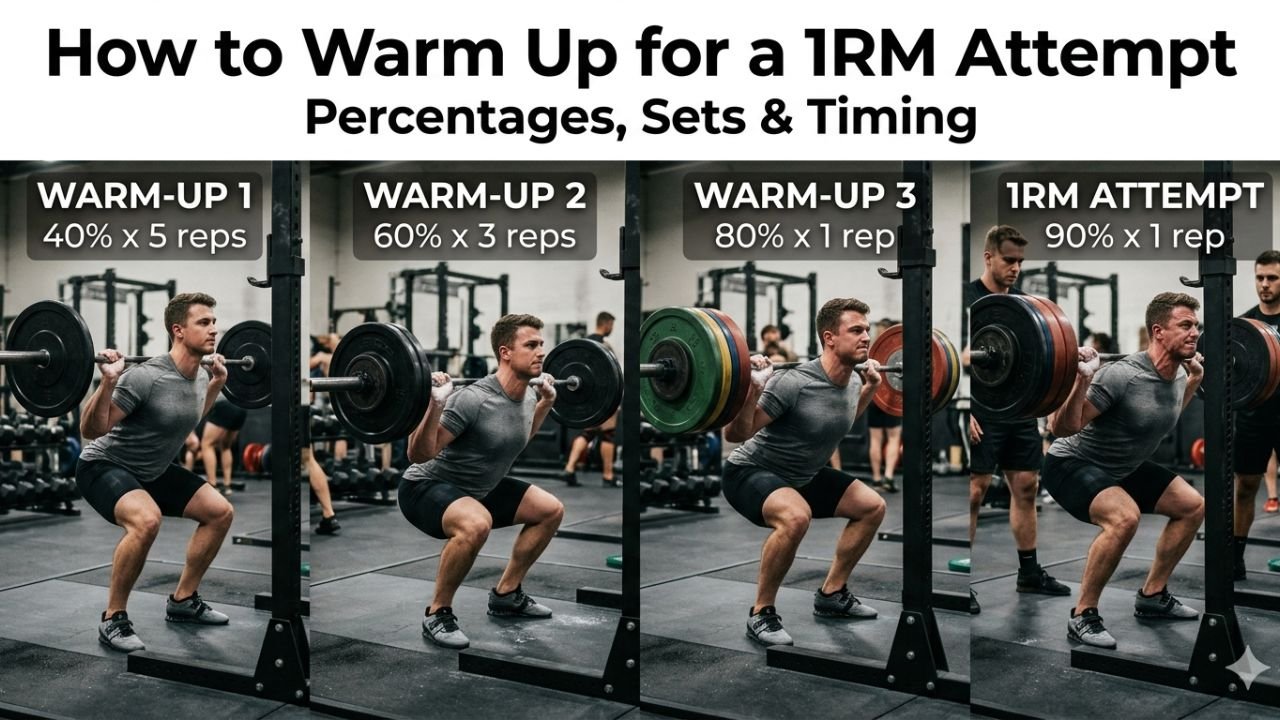
The 1RM Warm-Up Protocol: Percentages and Sets
Here’s the framework that works for most intermediate and advanced lifters. It’s clean, it’s effective, and it’s battle-tested in powerlifting meets and strength gyms all over the world.
Let’s say your target 1RM is 200 kg (or whatever your goal weight is). You’ll work off percentages of that number.
Set 1: Empty Bar (Just the barbell)
- Reps: 10–15
- Purpose: Groove the movement pattern, feel the bar in your hands or on your back, reinforce technique
This set should feel like nothing. Move slowly and deliberately. Think about your setup, your bracing, your bar path. Treat it like a technical rehearsal.
Set 2: 40–50% of Target 1RM
- Reps: 5–8
- Example: If the target is 200 kg, use 80–100 kg
Still moving fast and sharp. Keep your technique tight. Focus on speed out of the hole (for squats) or off the chest (for bench). Fast reps here help prime your nervous system for the real thing.
Set 3: 55–65% of Target 1RM
- Reps: 3–5
- Example: 110–130 kg
You’re starting to feel some weight now. Drop the reps a bit. Focus on your setup ritual, the same breathing, bracing, foot placement, and unrack you’ll use on your max attempt. Build that muscle memory.
Set 4: 70–75% of Target 1RM
- Reps: 2–3
- Example: 140–150 kg
Bar starts to feel heavier. Two reps are plenty. No more speed work lift with intention and full effort on each rep. Treat every rep like it matters.
Set 5: 80–85% of Target 1RM
- Reps: 1–2
- Example: 160–170 kg
One or two solid reps. Your body should be fully awake now. CNS is firing. If your technique breaks down here, take a moment to reset before continuing up. Something is off,f and it’s worth addressing before going heavier.
Set 6: 90–93% of Target 1RM
- Reps: 1
- Example: 180–186 kg
One confident rep. This should feel heavy but very doable. Don’t grind here. If this rep is slow or ugly, reconsider your target. You might want to attempt a slightly lower number or give yourself more rest before the actual max.
Set 7: Your 1RM Attempt
- Reps: 1
- Weight: Your target max
Now you go.
Rest Periods Between Warm-Up Sets: Timing Is Everything
This is where a lot of lifters make mistakes in both directions, either rushing between sets and arriving at the heavy stuff already tired, or resting so long between sets that they go cold again.
Here’s a simple guide:
- Empty bar to 60%: 1–2 minutes rest between sets
- 60% to 80%: 2–3 minutes
- 80% to 90%+: 3–5 minutes
As the weight climbs, your rest time should climb with it. Heavy singles require full nervous system recovery between attempts.
One practical tip: don’t just sit there during your rest. Walk around. Stay warm. Do some light mobility work or activation drills. But keep it light, you don’t want to spike your heart rate again.
How to Adjust Based on Your Target Weight
The protocol above works beautifully for lifters with bigger maxes. But what if you’re working with lighter numbers? Here’s how to scale:
If your 1RM target is under 100 kg, you can collapse some of the middle sets and shorten the overall ramp. Something like:
- Empty bar x 8
- 40% x 5
- 60% x 3
- 75% x 2
- 85% x 1
- 92–93% x 1
- Attempt
The key principle stays the same: gradual, systematic loading. You want to feel confident and prepared — not exhausted.
Mistakes That Can Ruin Your 1RM Warm-Up
Even experienced lifters make these errors. Watch out for them.
Doing Too Many Reps on Heavy Sets
This is the big one. Some people do sets of 5 at 80%, 85%, even 90% before their max. By the time they hit their actual attempt, their legs (or chest, or back) are already half-dead. Keep reps low once you’re above 75%. One rep is almost always enough.
Not Resting Enough Between Heavy Sets
At 90%+, you need full recovery. Three to five minutes is not “being lazy.” It’s science. Your phosphocreatine energy system needs time to replenish. Rushing it means your 1RM attempt is starting from a deficit.
Skipping the General Warm-Up
Jumping straight to the barbell with cold muscles is how people pull things. Spend 5–10 minutes getting the body temperature up first. Always.
Psyching Yourself Out
This one’s mental. If the 90% single feels heavy and you start second-guessing your target, remember 90% is supposed to feel heavy. That’s the point. Trust your training, trust the process.
Using Your Competition Maxes for Calculations
If you hit 200 kg six months ago but have been training lighter since, don’t base your warm-up on that old number. Use a realistic, current estimate. Basing everything on an outdated max will have you jumping too big, too fast.
Quick Warm-Up Tips From Real Lifters
Talking to experienced powerlifters and strength coaches, a few pieces of advice come up over and over again:
“Mirror your competition warm-up in training.” If you compete in powerlifting, practice your warm-up protocol in training the same way you’ll do it on the platform. Consistency builds confidence.
“The last warm-up set should feel heavy but fast.” If it moves slowly, the attempt weight might be too ambitious for today. Stay smart.
“Eat and hydrate before your session.” Your 1RM warm-up and attempt should happen when you’re fueled up. Attempted maxes on an empty stomach or in a dehydrated state are not true maxes.
“Keep your headphones in during rest between heavy sets.” Stay in your zone. Don’t get pulled into conversations. Focus is part of the warm-up, too.
Sample 1RM Warm-Up: Real-World Example
Let’s put this together with a real example. Imagine you’re going for a 140 kg squat 1RM.
- General warm-up: 8 minutes on assault bike + hip circles + ankle mobility
- Empty bar x 12 reps — slow, technical
- 60 kg (43%) x 6 reps — bar speed focus
- 80 kg (57%) x 4 reps — technique tightening
- 100 kg (71%) x 2 reps — full effort
- 115 kg (82%) x 1 rep — 3 min rest
- 125 kg (89%) x 1 rep — 4 min rest
- 140 kg attempt — 5 min rest
Total time from first barbell set to attempt: approximately 30–40 minutes. That’s a well-paced, thoroughly prepared approach to a max.
Frequently Asked Quest
How long should a 1RM warm-up take in total?
Including your general warm-up and all specific warm-up sets with appropriate rest periods, expect 35–50 minutes total. Rushing this process is one of the top reasons people miss their attempts or get injured.
Should I do any stretching before a 1RM attempt?
Dynamic stretching (moving through a range of motion) is great during your general warm-up. Avoid static stretching (holding a stretch for 30+ seconds) right before lifting, research consistently shows it can temporarily reduce force production and power output.
What if I feel flat or weak during my warm-up sets?
Don’t panic. Sometimes the lighter sets feel heavier than they should. It doesn’t always mean your max attempt will go badly. However, if your 90% single feels like an absolute grind, be honest with yourself and consider targeting a slightly lower weight.
Can I do accessory exercises before a 1RM attempt?
Keep it minimal. A few activation drills (glute bridges, band pull-aparts, etc.) are fine. Full accessory sets before a max attempt will only pre-fatigue the muscles you need most. Save everything else for after.
How many attempts should I plan for?
In training, most people do one true max attempt per session. In competition, powerlifters typically get three attempts per lift. For training, one well-planned attempt after a smart warm-up is enough. If it goes well, great. If it doesn’t, don’t keep retrying, note it, and come back fresh another day.
Conclusion
Here’s the truth: by the time you walk up to that bar for your 1RM, most of the work is already done. The training that built your strength happened over months. The preparation for today happened in your warm-up over the last 40 minutes.
A smart warm-up doesn’t tire you out. It builds you up. It tells your body: “Hey, we’ve done this before. We know what’s coming. We’re ready.”
Use the percentages, respect the rest periods, and never skip the general warm-up. Treat every warm-up set as practice, not just filler. Your CNS, your joints, and your confidence will all thank you.
Now go hit that PR. You’ve earned it.