So you’ve been hitting the gym for a while now. You’re eating “clean,” lifting consistently, and yet you’re still not sure if you should be eating more or less. Sound familiar?
Welcome to the eternal fitness debate: cutting vs bulking.
And then there’s the other question that trips up even experienced lifters: how do you properly warm up before going for a one-rep max? Because walking up to a barbell cold and trying to pull your heaviest weight ever is a fast track to injury.
In this guide, we’re breaking both of these down in plain, simple English. No bro-science. No fluff. Just practical, real advice you can apply this week.
Let’s get into it.
What Is Cutting and Bulking, Really?
Before we talk calories, let’s make sure we’re on the same page.
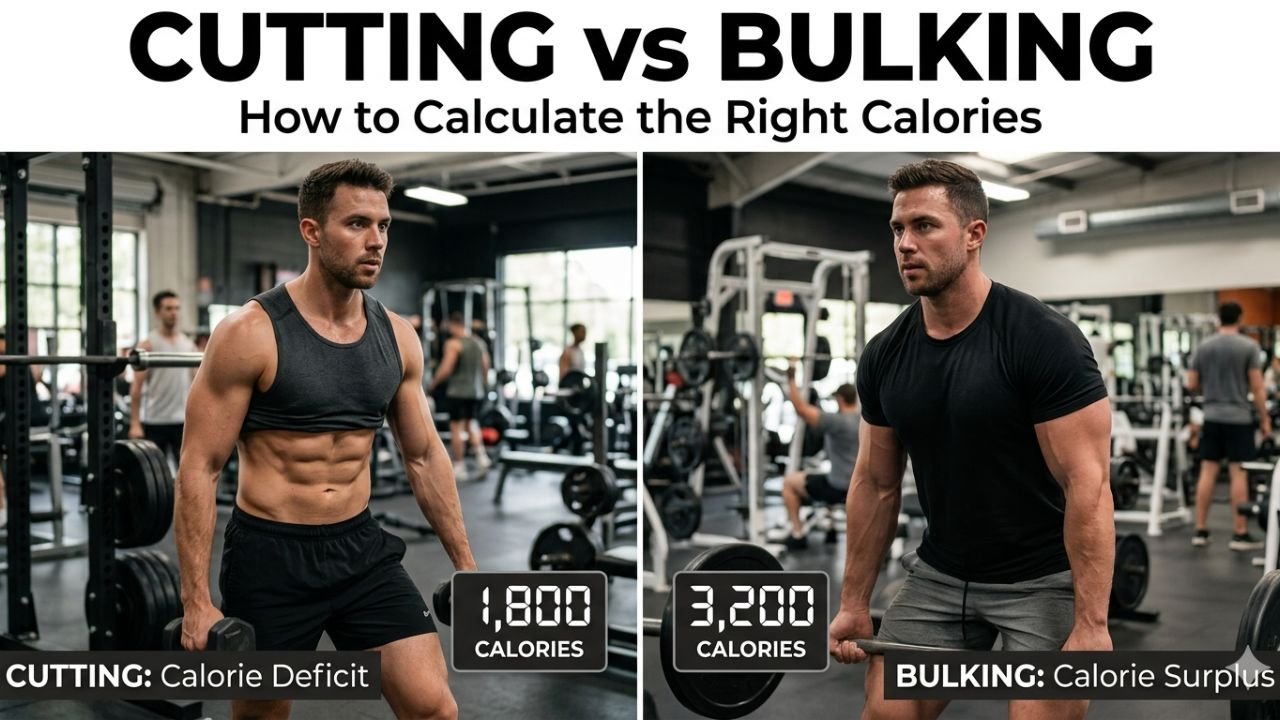
Bulking is when you eat more calories than your body burns. The goal is to gain muscle (and yes, a little fat comes along for the ride; that’s normal).
Cutting is when you eat fewer calories than your body burns. The goal is to lose body fat while holding onto as much muscle as possible.
Most serious lifters go through cycles of both. You bulk in the off-season to build muscle, then cut to reveal that muscle before summer, a competition, or just whenever you want to look leaner.
Simple in theory. A little trickier in practice.
Why Calories Are the Foundation of Everything
Here’s the truth nobody wants to hear: no matter how perfect your training is, if your calories are off, your results will be off.
You can do all the right exercises, use perfect form, sleep eight hours a night, but if you’re eating too much while trying to cut, you won’t lose fat. And if you’re not eating enough while trying to bulk, you won’t gain muscle efficiently.
Calories are the foundation. Everything else builds on top.
How to Calculate Your Calories for Bulking
Step 1: Find Your Maintenance Calories (TDEE)
TDEE stands for Total Daily Energy Expenditure. It’s basically how many calories your body burns in a day just to exist and move around.
The easiest way to estimate it is using the Mifflin-St Jeor formula:
For men: Calories = (10 × weight in kg) + (6.25 × height in cm) − (5 × age) + 5
For women: Calories = (10 × weight in kg) + (6.25 × height in cm) − (5 × age) − 161
Then multiply that number by your activity level:
- Sedentary (desk job, no exercise): × 1.2
- Lightly active (1–3 days/week): × 1.375
- Moderately active (3–5 days/week): × 1.55
- Very active (6–7 days/week): × 1.725
That final number is your TDE, E your maintenance calories.
Step 2: Add a Calorie Surplus for Bulking
For a lean bulk (slow, minimal fat gain), add 200–300 calories above your TDEE.
For a standard bulk, add 300–500 calories above.
For an aggressive bulk (not recommended for most people), some go 500–700+ above. But you’ll gain more fat this way.
Real-life example: Let’s say your TDEE is 2,800 calories. For a lean bulk, you’d eat around 3,000–3,100 calories per day.
Step 3: Nail Your Macros During a Bulk
Calories matter most, but macros (protein, carbs, fat) matter too.
- Protein: 1.6–2.2g per kg of bodyweight (prioritize this, it builds and preserves muscle)
- Carbs: Fill in the majority of remaining calories here (fuel for training)
- Fats: At least 0.8–1g per kg of bodyweight (hormones, joints, recovery)
Practical tip: Eat protein first at every meal. It keeps you full and ensures you hit your muscle-building quota even on days when your appetite is low.
How to Calculate Your Calories for Cutting
Step 1: Start from Your TDEE Again
Same calculation as above. Your TDEE is your starting point, whether you’re bulking or cutting.
Step 2: Create a Calorie Deficit
A moderate deficit is 300–500 calories below your TDEE.
A larger deficit (500–750 below) leads to faster fat loss, but also more muscle loss and more fatigue. Use this only for short periods.
Avoid going below 1,200 calories for women or 1,500 calories for men. Your body starts breaking down muscle for fuel at that point, which is the opposite of what you want.
Real-life example: Same person with a 2,800-calorie TDEE. To cut, they’d eat around 2,300–2,500 calories per day. Not dramatic. Not starving. Just a manageable deficit.
Step 3: Protect Your Muscle While Cutting
This is where most people mess up. They cut calories too aggressively, drop protein, and end up “skinny fat”, smaller but without the muscle definition they wanted.
Here’s how to protect your muscles on a cut:
- Keep protein HIGH, actually higher than during a bulk. Aim for 2–2.4g per kg of bodyweight.
- Keep lifting heavy, your body keeps muscle when it needs it. Show them that you still need it.
- Don’t do too much cardio; a 20–30 minute walk daily is enough. Hours of cardio eat into recovery.
Tip: Don’t drop carbs to zero. Carbs fuel your lifts. Cut calories from fat and refined carbs first, not from protein or workout nutrition.
Should You Bulk or Cut First?
This is probably the most common question beginners ask.
Here’s a simple guide:
Cut first if:
- Your body fat is above 20% (men) or 28% (women)
- You feel sluggish, and your energy is low
- You want to feel better in your clothes before you start adding size
Bulk first if:
- You’re lean already (under 15% body fat for men, under 22% for women)
- You’ve been training for less than 2 years (newbies can build muscle and lose fat at the same time — lucky you)
- Your main goal is building strength and size
There’s no universally “right” answer. But for most beginners, a slight bulk to build a muscle base first tends to pay off long-term.
How to Warm Up for a 1RM Attempt: Percentages, Sets, and Timing
Okay, now let’s shift gears. You’ve got your nutrition dialed in. You’re training hard. And you want to test your true strength with a one-rep max (1RM) attempt.
Please do not skip this section.
A proper warm-up for a max attempt is what separates a successful PR from a torn muscle or a missed lift that kills your confidence.
Why Warming Up for a 1RM Is Different.
This isn’t your regular warm-up where you do a few light sets and jump in. For a max effort, your nervous system, joints, and muscles need to be fully primed — but not fatigued.
That’s the balance. Warm enough to perform your best. Fresh enough to actually lift.
The Best 1RM Warm-Up Protocol (Step by Step)
Here’s a tried-and-true warm-up structure used by powerlifters and strength coaches worldwide:
Start with 5–10 minutes of general warm-up:
- Light cardio (rowing, cycling, or a brisk walk)
- Dynamic mobility work for the joints you’ll be using (hip circles, shoulder rotations, ankle mobility, etc.)
Then move to bar work:
- 2 sets of 5 reps with just the barbell, focus on perfect form, feel the movement
Then follow this percentage-based build-up:
|
Set |
% of Target 1RM |
Reps |
Rest |
|
1 |
50% |
5 |
60 sec |
|
2 |
65% |
3 |
90 sec |
|
3 |
75% |
2 |
2 min |
|
4 |
85% |
1 |
3 min |
|
5 |
90–92% |
1 |
3–4 min |
|
6 |
95–97% |
1 |
4–5 min |
|
Max Attempt |
100%+ |
1 |
Full rest |
Real-life example: Say your target squat 1RM is 150kg.
- 50% = 75kg × 5 reps
- 65% = 97.5kg × 3 reps
- 75% = 112.5kg × 2 reps
- 85% = 127.5kg × 1 rep
- 92% = 138kg × 1 rep
- 97% = 145kg × 1 rep
- Then attempt 150kg or beyond
Key Tips for the Day of a 1RM Attempt
Don’t do extra work before your max. No supersets, no accessory work before the attempt. Save everything for the big lift.
Time to rest properly. Most lifters underestimate how much rest they need between heavy singles. As you get closer to your max, rest longer, 4 to 5 full minutes. Your nervous system needs it.
Visualize the lift. This sounds soft, but elite powerlifters swear by it. Before your max attempt, close your eyes and see yourself completing the lift. It genuinely helps with confidence and focus.
Have a spotter or use a power rack. Non-negotiable. Always have safety measures in place on max-effort days.
Don’t miss an opener. Your first heavy single should be something you could do on a bad day. Never open too close to your actual max.
How Nutrition and 1RM Performance Connect
Here’s something that doesn’t get talked about enough: your calorie phase directly affects your 1RM performance.
When you’re bulking, you’ll likely hit personal records more often. More calories = more energy, better recovery, stronger lifts.
When you’re cutting, your maxes may drop slightly. That’s okay and expected. The goal during a cut is to maintain strength, not necessarily hit new records.
Tip for cutting phase 1RM testing: Do your max attempts at the beginning of your cut, not deep into it. You’ll still have decent glycogen levels and won’t be as depleted.
Practical Tips to Get the Most from Your Bulk or Cut
- Track your food for at least 2–3 weeks at the start of any phase. You don’t need to track forever, but you need to understand what you’re actually eating.
- Weigh yourself weekly (same day, same time, same conditions). Use a 7-day average instead of daily numbers to spot real trends.
- Adjust every 2–3 weeks. If the scale isn’t moving on a bulk, add 100 calories. If fat loss stalls on a cut, drop 100–150 calories or add a short walk each day.
- Sleep 7–9 hours. This is free muscle growth and fat loss support. Seriously, sleep more.
- Don’t switch phases every few weeks. Each phase needs at least 8–12 weeks to show real results.
Frequently Asked Questions
Can I build muscle and lose fat at the same time?
Yes but mainly if you’re a beginner, returning after a long break, or carrying a higher body fat percentage. This is called “body recomposition.” It’s slower than dedicated bulking or cutting, but it works in the right conditions.
How long should a bulk or cut phase last?
Most people do bulks for 3–6 months and cuts for 8–16 weeks. Shorter than that and you won’t see much progress. Longer and fatigue (mental and physical) start creeping in.
What if I miss my calorie goal one day?
Don’t stress. One day doesn’t ruin a bulk or a cut. What matters is your weekly average. Get back on track the next day.
Should I warm up differently for a deadlift vs a squat 1RM?
The percentages stay the same, but your mobility work changes. Deadlift warm-ups should include hip hinges, hamstring stretches, and hip flexor work. Squat warm-ups should focus more on hip mobility, ankle flexibility, and thoracic spine rotation.
How often should I test my 1RM?
Every 8–12 weeks is a good rule of thumb. Testing too frequently is hard on your nervous system. Most strength programs like 5/3/1 or Juggernaut build naturally to a peak over weeks before a max test.
Conclusion
Here’s the bottom line: fitness is a long game.
Whether you’re calculating calories for a bulk or a cut, or preparing to walk up to a loaded barbell for a max attempt, preparation and patience are everything.
You don’t need to be perfect. You need to be consistent, informed, and willing to adjust based on how your body responds.
Start with your TDEE. Add or subtract calories based on your goal. Eat enough protein, no matter what phase you’re in. And when max day comes around, warm up properly, rest between sets, and trust the process.
You’ve put in the work. Now let your preparation do the talking.